Bhagavad Gita 8.14
Akshara Brahma Yoga · English Translation
अनन्यचेताः सततं यो मां स्मरति नित्यशः | तस्याहं सुलभः पार्थ नित्ययुक्तस्य योगिनः ||८-१४||
ananyacetāḥ satataṃ yo māṃ smarati nityaśaḥ . tasyāhaṃ sulabhaḥ pārtha nityayuktasya yoginaḥ ||8-14||
What Does This Verse Mean?
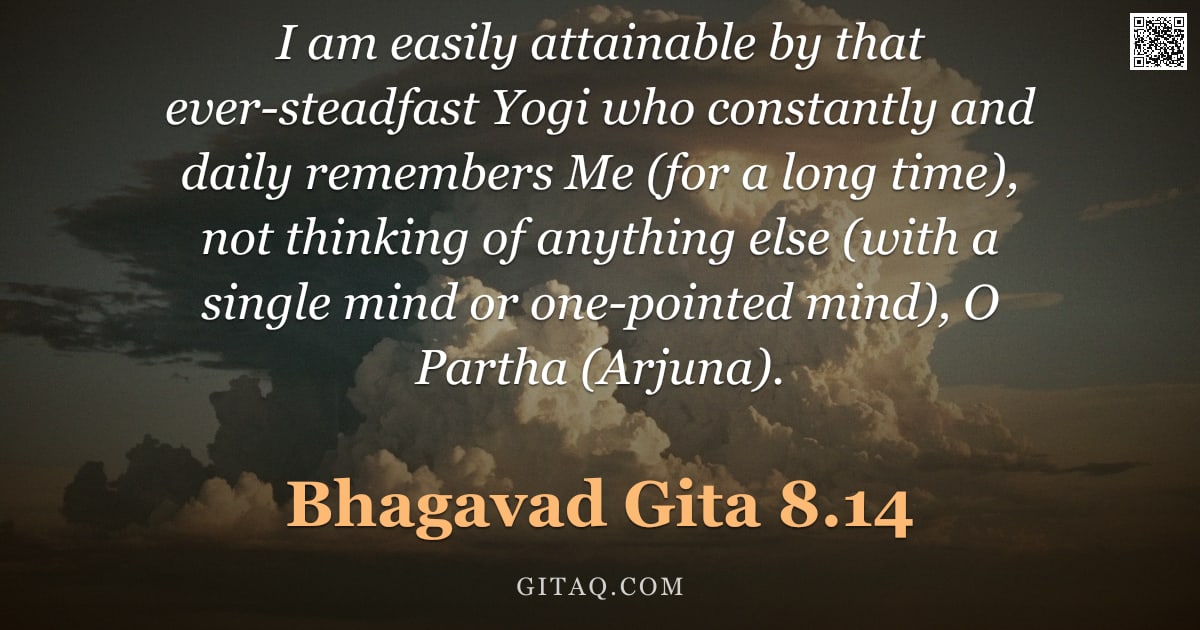
In this verse, Lord Krishna tells Arjuna that He becomes very easy to attain for a person who remembers Him constantly with an undivided mind. The key teaching is that single-pointed devotion and daily remembrance make the divine accessible to anyone willing to focus their entire consciousness on God without distraction. This establishes that consistency in spiritual practice is more powerful than occasional intense effort.
The Teaching Behind It
This verse is a cornerstone of Bhakti Yoga and Dhyana (meditation) within the Gita's framework, specifically developing the concept of 'Ekagrata' or one-pointedness. It illustrates that total surrender through constant remembrance transforms the difficult path to liberation into an accessible journey for the dedicated practitioner.
Word by Word
Classical Commentary
Where This Happens
This verse appears on the battlefield of Kurukshetra during a moment when Arjuna's mind was clouded by confusion and sorrow. Krishna has just been explaining the nature of the imperishable Brahman and how one should prepare for death, emphasizing that our state of consciousness at the end determines our next journey. He is now offering specific guidance to his beloved friend on how to stabilize their minds in this critical moment.
Living It Out Today
Consider a professional facing a high-stakes decision where anxiety pulls them toward multiple conflicting options and past regrets. Instead of trying to analyze every possibility simultaneously, they can adopt the principle of 'ananyacetāḥ' by dedicating one hour each morning to focus solely on their core values or spiritual grounding before checking emails. This single-pointed mental discipline creates a calm foundation from which clear decisions emerge naturally.
Explained for Children
Imagine you have a favorite teacher or grandparent whom you love very much. If you talk about them, think of them, and try your best to please them every single day with all your heart, they will notice you right away and be happy to see you. Krishna is saying that if we keep God in our thoughts like that, without worrying about other things, He will always come close to us because He loves us so much.
Daily Reflection
Arjuna was told by Krishna that when you stop chasing every shadow of desire and fix your gaze on the Divine with unwavering love, what seemed distant becomes startlingly close. This isn't about adding more to your day but subtracting everything else until only the One remains in your awareness. Imagine how much lighter your spirit would feel if you could simply rest it there, knowing that such constant remembrance makes the Lord accessible to you right now.
A Practice for Today
Close your eyes and gently bring to mind the image of Lord Krishna as your sole focus, allowing any other thoughts to dissolve like mist before the sun. Breathe slowly, repeating internally, 'I remember You alone,' cultivating a heart that finds peace only in this singular connection.
Key Teachings
- The Power of Ekagrata (One-Pointedness)
True devotion requires ananya-cetah, meaning a mind free from competing attachments or divided attention. When the heart stops scattering its energy on worldly objects and focuses entirely on the Divine, it becomes a potent instrument for spiritual realization. - The Promise of Accessibility
Krishna declares Himself 'sulabha' (easily attainable) specifically to those who practice constant remembrance. This reveals that God is not hidden behind impossible hurdles, but becomes approachable through the simple, sustained act of remembering Him. - The Discipline of Nitya Smarana
Spiritual progress relies on nityashaḥ, or daily and habitual remembrance rather than sporadic bursts of effort. This verse teaches that the relationship with the Divine is built through a consistent rhythm of love and awareness woven into every moment. - The Role of Steadfastness
A yogi who remains 'satataṃ' (always) in this state achieves stability that cannot be shaken by external circumstances. This steadiness transforms the seeker from a wanderer to one who has found their permanent home.
Themes
Related Verses
Read This Next
- 2.47 — To understand the foundational principle of performing action without attachment to results before diving deeper into devotion.
- 3.30 — To learn how Krishna instructs Arjuna on surrendering all actions and fruits to Him as a form of constant remembrance in daily life.
- 12.15 — To see the fruits of such devotion by reading about the characteristics of those whom Krishna loves most deeply.
Recommended Reading
GitaQ earns from qualifying purchases as an Amazon Associate.