Bhagavad Gita 8.13
Akshara Brahma Yoga · English Translation
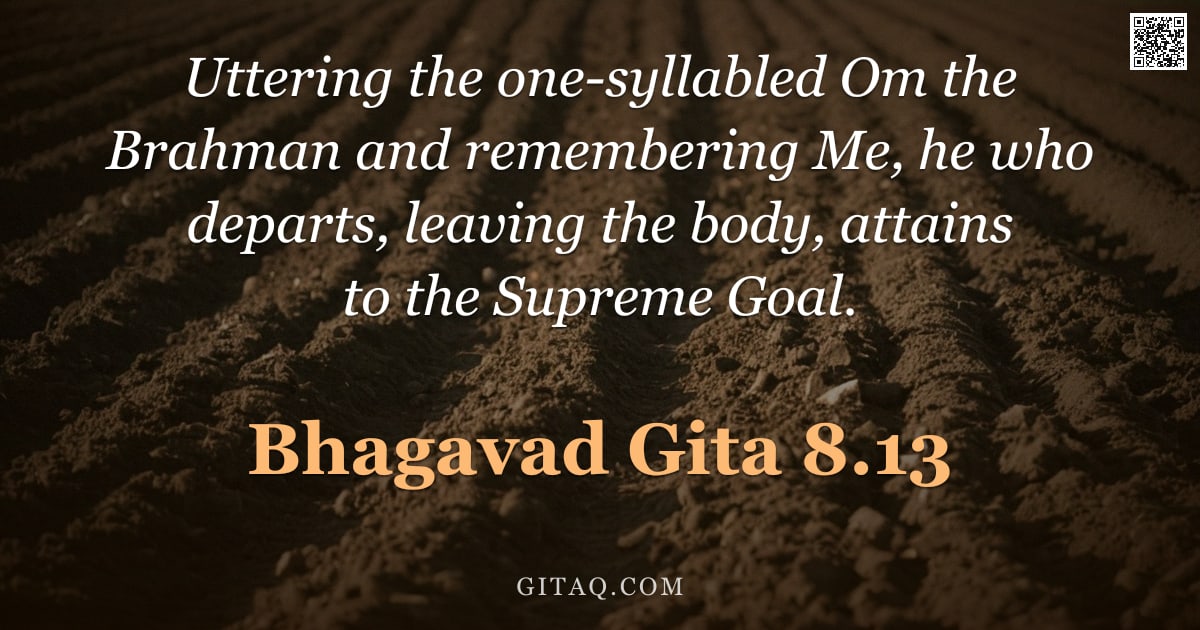
ओमित्येकाक्षरं ब्रह्म व्याहरन्मामनुस्मरन् | यः प्रयाति त्यजन्देहं स याति परमां गतिम् ||८-१३||
omityekākṣaraṃ brahma vyāharanmāmanusmaran . yaḥ prayāti tyajandehaṃ sa yāti paramāṃ gatim ||8-13||
What Does This Verse Mean?
In this verse, Lord Krishna tells Arjuna that the secret to attaining the highest spiritual goal is a specific practice of consciousness at the moment of death. He advises remembering Him while chanting the sacred syllable 'Om', which represents the ultimate reality or Brahman. By keeping one's mind fixed on God and the Divine sound right as they leave their body, a person transcends earthly limitations to reach eternal peace.
The Teaching Behind It
This verse synthesizes Bhakti Yoga (devotion) with Dhyana Yoga (meditation), emphasizing the power of 'smarana' or constant remembrance. It teaches that the consciousness at the time of death determines one's future state, a core concept known as 'antima smriti' or final thought.
Word by Word
Classical Commentary
Where This Happens
This verse appears in Chapter 8 during Lord Krishna's final instructions to Arjuna on the battlefield of Kurukshetra, shortly before the great war begins. After explaining the nature of time and the cycles of creation, Arjuna asks how one can attain Brahman at the moment of death. In this pivotal moment, amidst the tension of impending conflict, Krishna provides a practical method for spiritual success that applies to every soul regardless of their current state.
Living It Out Today
When facing an overwhelming deadline or a family crisis where anxiety threatens to cloud your judgment, use the 'Om' practice as an anchor. Instead of spiraling into fear about the outcome, take a moment to chant mentally and set your intention on a higher purpose before acting. This shifts your focus from panic to clarity, ensuring that even in high-pressure moments, you remain connected to your core values rather than being swept away by temporary stress.
Explained for Children
Imagine you are about to go on a long trip; if your last thought is of home and love, that feeling carries with you wherever you go. Lord Krishna says that when our time comes to leave this world, we should say 'Om' (a special sound of happiness) and think kindly of God in our hearts. If we do this while letting go of our bodies, just like a bird flying away from its nest after singing a sweet song, we will fly straight to the best place possible.
Daily Reflection
Today, imagine that every moment is an opportunity to depart from the limited identity of the body and merge with something infinite. When you feel overwhelmed by the weight of worldly duties or fears of loss, remember that holding onto Krishna's name while letting go of attachment grants true freedom. You do not need to wait for your final departure; this supreme goal becomes accessible right now through a single moment of devoted remembrance.
A Practice for Today
Begin by softly chanting 'Om' to align your consciousness with the imperishable Brahman, allowing the vibration to settle any mental noise. As you exhale fully, hold a gentle, unwavering remembrance of Krishna's presence in your heart, visualizing it as a steady lamp guiding your inner world.
Key Teachings
- The Unity of Sound and Being
The verse reveals that 'Om' is the sonic form of Brahman, serving as the bridge between the finite self and the infinite reality. Chanting this single syllable while remembering Krishna unifies sound with devotion, creating a direct link to the Absolute. - Consciousness at the Moment of Departure
The state of mind one holds when leaving the body determines their next destination in existence. By practicing constant remembrance (smaran) during life, one naturally sustains this focus even as consciousness transitions out of physical form. - Attaining the Supreme Goal
The 'Supreme Goal' is not merely a distant heaven but a return to the eternal source from which all creation springs. This attainment is guaranteed when the practitioner combines the vibration of the sacred syllable with personal devotion to the Divine.
Themes
Related Verses
Read This Next
- 2.47 — This verse establishes the foundational duty of performing action without attachment to results, preparing the mind for the detachment required at life's end.
- 3.30 — It expands on dedicating all actions and thoughts to Krishna, reinforcing the practice of 'remembering Me' mentioned in verse 8.13.
- 12.15 — This chapter concludes with describing the qualities of a true devotee who is dear to God, illustrating the character formed by such constant remembrance.
Recommended Reading
GitaQ earns from qualifying purchases as an Amazon Associate.