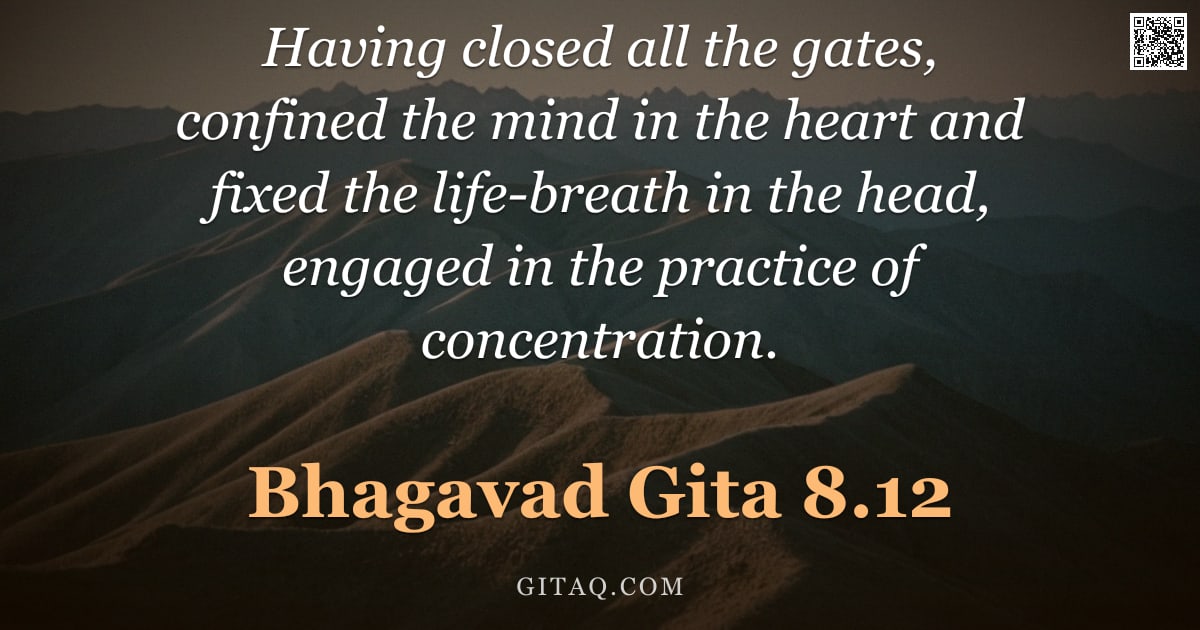
Bhagavad Gita 8.12
Akshara Brahma Yoga · English Translation
सर्वद्वाराणि संयम्य मनो हृदि निरुध्य च | मूध्न्यार्धायात्मनः प्राणमास्थितो योगधारणाम् ||८-१२||
sarvadvārāṇi saṃyamya mano hṛdi nirudhya ca . mūdhnyā^^rdhāyātmanaḥ prāṇamāsthito yogadhāraṇām ||8-12||
What Does This Verse Mean?
In this verse, Lord Krishna instructs Arjuna on the specific physical and mental posture required for deep meditation (Dhyana Yoga). He describes a process of withdrawing the senses from external distractions by closing all 'gates' to sensory input. The practitioner then focuses their mind in the heart center while guiding their breath upward to crown chakra, establishing a state of total inner concentration.
The Teaching Behind It
This verse is a foundational pillar of Dhyana Yoga (the yoga of meditation) and Sankhya philosophy's practice of Pratyahara (withdrawal of senses). It develops the concept that mastery over the life force (Prana) through breath control allows for total mental stillness, which is essential for realizing the Imperishable Brahman.
Word by Word
Classical Commentary
Where This Happens
This instruction occurs during Chapter 8 of the Bhagavad Gita, set on the battlefield of Kurukshetra just before Arjuna prepares for his final decision. Krishna has already explained that death is a transition to another form of existence based on one's state of mind at the moment of dying. Seeing Arjuna still overwhelmed by confusion and emotional turbulence, Krishna provides the technical method (pranayama) necessary to stabilize the mind before he explains how this practice leads to attaining him.
Living It Out Today
When facing a high-stakes work presentation or making a difficult family decision that causes racing thoughts, apply this verse's technique by consciously pausing all external distractions. Turn off your phone and step away from noise (closing the gates), then sit quietly while visualizing your focus moving to your heart center. Simultaneously, regulate your breathing deeply until you feel grounded in your head space, allowing you to make a clear, calm choice rather than reacting out of anxiety.
Explained for Children
Imagine your body is like a computer with many open windows causing it to slow down and get confused. This verse teaches you how to close all those distracting 'windows' (your eyes, ears, etc.) so the screen can focus on just one thing: your own calm heart. It's like turning off the TV and games to solve a puzzle in your mind, breathing slowly until you feel super focused and peaceful inside.
Daily Reflection
In our busy days, we often feel scattered across too many external demands, but this verse reminds you that true peace is found by retreating into your own sanctuary. By consciously withdrawing your senses and centering your awareness within, you discover an unshakeable stillness that no outside chaos can disturb. Today, try to pause whenever the noise becomes overwhelming; simply close those inner gates and rest in the quiet of your heart.
A Practice for Today
Begin by gently closing your eyes, imagining you are sealing every sensory gate to turn the gaze inward toward the heart's center. With each breath, visualize guiding your life force upward from the navel to the crown of the head, resting there in a silent, steady focus.
Key Teachings
- The Architecture of Withdrawal
Krishna outlines a specific physiological process where one must first regulate the senses ('gates') before attempting deep concentration. This withdrawal is not an escape from life, but a strategic re-orientation of energy away from distraction toward the divine. - The Seat and The Flow
The instruction to confine the mind in the heart while fixing breath at the head describes the precise alignment required for yogic practice. It signifies a transformation where the life force (prana) is united with consciousness, creating a vessel capable of holding the vision of the Eternal. - The Goal: Steadfast Focus
All these physical and mental disciplines serve one ultimate purpose: 'yogadhāraṇām' or unwavering concentration on the Supreme. This state is not merely a technique for relaxation, but the necessary preparation to realize the Imperishable Brahman.
Themes
Related Verses
Read This Next
Recommended Reading
GitaQ earns from qualifying purchases as an Amazon Associate.