Bhagavad Gita 8.11
Akshara Brahma Yoga · English Translation
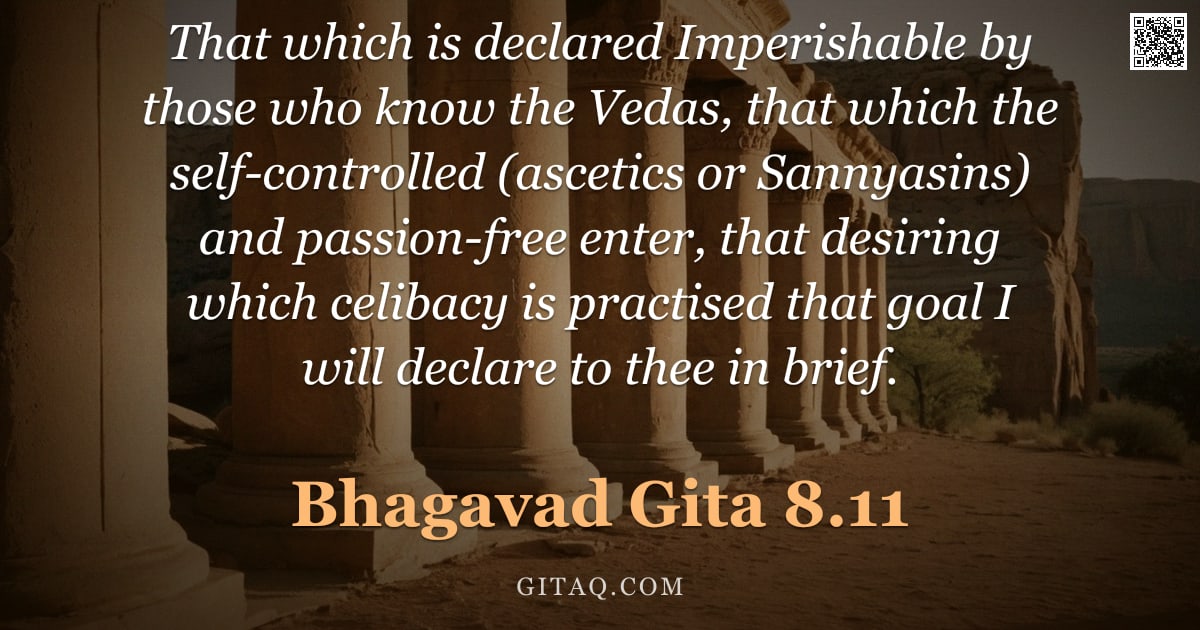
यदक्षरं वेदविदो वदन्ति विशन्ति यद्यतयो वीतरागाः | यदिच्छन्तो ब्रह्मचर्यं चरन्ति तत्ते पदं संग्रहेण प्रवक्ष्ये ||८-११||
yadakṣaraṃ vedavido vadanti viśanti yadyatayo vītarāgāḥ . yadicchanto brahmacaryaṃ caranti tatte padaṃ saṃgraheṇa pravakṣye ||8-11||
What Does This Verse Mean?
In this verse, Lord Krishna is speaking to Arjuna about the ultimate spiritual goal known as 'Akshara Brahma,' or the Imperishable Reality. He explains that sages who have studied the Vedas and yogis free from attachment enter this state by practicing strict self-control and celibacy. Krishna promises to briefly describe this supreme destination, which is sought after by those who wish for liberation from the cycle of birth and death.
The Teaching Behind It
This verse belongs primarily to the Jnana Yoga (path of knowledge) and Sankhya philosophy strands, focusing on the realization of Brahman as the ultimate truth. It develops the concept that liberation is achieved not merely by ritual but through the purification of the mind via renunciation ('vitaraga') and disciplined practice ('brahmacarya').
Word by Word
Classical Commentary
Where This Happens
This verse occurs on the battlefield of Kurukshetra during a moment where Arjuna is overwhelmed by grief after Lord Krishna has just explained that death does not destroy the eternal soul. Speaking as his charioteer and divine friend, Krishna begins to outline the path to liberation in Chapter 8, which focuses on what happens at the time of death. The listener, Arjuna, is seeking clarity on how to prepare for this final moment so he can achieve peace rather than be reborn.
Living It Out Today
When facing a high-stakes decision like changing careers or ending an unhealthy relationship, apply the principle of 'detachment from results' mentioned in the verse. Instead of being driven by fear or immediate desires (the 'ragas'), focus on your core values and practice discipline to let go of attachments that cloud judgment. Just as the ascetic practices celibacy for a higher goal, you can temporarily sacrifice short-term comfort or emotional gratification to achieve long-term spiritual clarity.
Explained for Children
Imagine you are trying to reach a hidden treasure that only very focused people can find. In the story, Lord Krishna tells Arjuna about a special place called 'The Endless Light' where there is no sadness or fear. Just like how athletes train hard every day and give up their favorite snacks (like eating candy) to become champions, great teachers practice self-control so they can reach this wonderful final destination.
Daily Reflection
Today, notice how often you chase external goals driven by fleeting passions rather than a deeper, unchanging peace. When you feel pulled toward new distractions, gently remind yourself that true fulfillment lies not in acquiring more, but in letting go of the attachments that bind your spirit. The path to this sacred goal begins simply with choosing self-control over impulse.
A Practice for Today
Close your eyes and visualize the silence that exists before all names are spoken, the state described as 'Akshara' or imperishable by the sages. Rest your awareness in this quiet foundation where desires dissolve like mist in morning sun.
Key Teachings
- The Nature of the Imperishable
Verse 8:11 defines the ultimate reality as 'Akshara,' a state beyond time and change that is known only through direct experience by those who have studied the Vedas. This is not an abstract concept but the very ground of being where all suffering ceases. - The Discipline of Renunciation
Entry into this divine state requires becoming 'vītarāgāḥ,' or those free from passionate attachment to sensory objects. This freedom is not forced suppression but a natural lightness that arises when the heart stops clinging. - The Purpose of Celibacy
Celibacy (brahmacarya) is presented here as a dedicated means rather than an end, practiced solely to purify the mind for this higher goal. It represents the channeling of vital energy away from transient desires toward eternal union.
Themes
Related Verses
Read This Next
- 2.47 — To understand how to act without attachment, a necessary step for becoming free from passion (vītarāgāḥ) before entering the imperishable.
- 3.30 — This verse elaborates on offering actions and renouncing selfish desires, which deepens the understanding of brahmacarya as a spiritual discipline.
- 12.15 — To see the qualities of the devotee who has transcended desire and is dear to Krishna, aligning with the state described in 8:11.
Recommended Reading
GitaQ earns from qualifying purchases as an Amazon Associate.