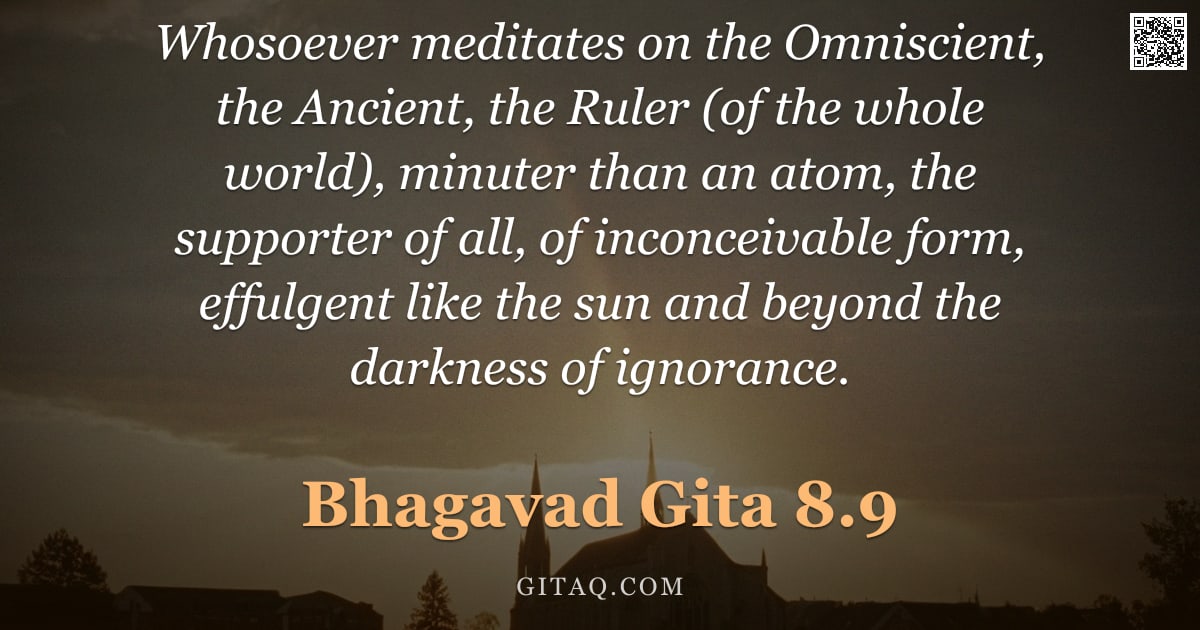
Bhagavad Gita 8.9
Akshara Brahma Yoga · English Translation
कविं पुराणमनुशासितार- मणोरणीयंसमनुस्मरेद्यः | सर्वस्य धातारमचिन्त्यरूप- मादित्यवर्णं तमसः परस्तात् ||८-९||
kaviṃ purāṇamanuśāsitāraṃ aṇoraṇīyaṃsamanusmaredyaḥ . sarvasya dhātāramacintyarūpaṃ ādityavarṇaṃ tamasaḥ parastāt ||8-9||
What Does This Verse Mean?
In this verse, Lord Krishna instructs Arjuna on the proper object of meditation to achieve spiritual perfection before death. He describes the Supreme Reality as being beyond time and space—ancient yet newer than a single atom, invisible to physical eyes but glowing like the sun behind all darkness. The core teaching is that by focusing one's mind on this infinite, formless light who supports everything, a person can transcend ignorance and fear.
The Teaching Behind It
This verse is a cornerstone of Bhakti Yoga (devotion) and Dhyana Yoga (meditation), specifically focusing on the practice of Saguna Brahman meditation before moving toward Nirguna. It develops the concept that the Divine is not distant or abstract, but intimately present as both the microscopic foundation of reality and the macroscopic source of light.
Word by Word
Classical Commentary
Where This Happens
This teaching occurs on the battlefield of Kurukshetra during the Mahabharata, where Prince Arjuna is paralyzed by grief and confusion about fighting his own relatives. After Krishna has explained the difference between the temporary body and the eternal soul in Chapter 2, he now guides Arjuna toward specific meditation techniques to overcome mental fog. At this point in their conversation, Arjuna is seeking a clear path to steady his mind so he can fulfill his duty as a warrior without being overwhelmed by doubt.
Living It Out Today
When you are facing an overwhelming decision at work that feels like it has no right answer, stop and visualize a bright light within you that knows the solution before you do. Instead of getting lost in the 'darkness' of anxiety or overthinking every possible failure, anchor your mind on this sense of inner clarity and support. This shift from panic to trust allows you to act with confidence, knowing you are backed by something far greater than your immediate circumstances.
Explained for Children
Imagine you are looking for your favorite superhero, but they are so small they fit inside a tiny grain of sand, yet at the same time, they hold up the entire world! This verse teaches us that God is like this amazing hero: He knows everything from the very beginning and guides everyone. Even when it feels dark or scary in our lives (like being lost in a fog), remembering this inner light helps us feel safe and strong again.
Daily Reflection
Today, you are invited to let go of the heavy burden of trying to comprehend how the infinite fits into your finite life; instead, rest in the simple awareness that this vastness already supports you. When confusion or fear arises like a thick fog, remember that the light behind those clouds is not only greater than the darkness but also untouched by it. You do not need to force understanding through struggle; simply turn your heart toward that ancient, knowing presence that has always been there.
A Practice for Today
Sit quietly and visualize the infinite light that exists beyond all darkness, recognizing it as your own true nature rather than an external object to chase. Softly repeat the mental image of a sun-like radiance that is simultaneously smaller than the smallest atom yet holds every star in existence within its being.
Key Teachings
- The Paradox of Infinity
Krishna describes the Divine as 'minuter than an atom' yet the ruler of all, teaching us that truth exists in both the microscopic and cosmic scales simultaneously. This collapses our intellectual limitations, showing that the Absolute is not distant but intimately present within every particle. - The Light Beyond Darkness
By describing God as 'effulgent like the sun' yet beyond darkness (ignorance), the verse establishes that true knowledge cannot be obscured by illusion. This teaches us that our inner nature is eternally luminous, regardless of how long we feel trapped in confusion or suffering. - Inconceivable Form
The Divine possesses a form ('rūpa') yet one that defies mental calculation and logic. This invites the devotee to move beyond rigid intellectual debates into a direct, meditative experience of wonder where faith meets transcendence.
Themes
Related Verses
Read This Next
- 2.47 — After meditating on the form of God, this verse grounds your practice by reminding you to focus on action without attachment to results.
- 3.30 — This verse expands on Chapter 8's theme by instructing how to offer all works and their fruits as a sacrifice of devotion.
- 12.15 — To deepen the understanding of the 'inconceivable form,' this chapter describes the qualities of a true devotee who embodies that divine nature in daily life.
Recommended Reading
GitaQ earns from qualifying purchases as an Amazon Associate.