Bhagavad Gita 13.8

Kshetra Kshetrajna Vibhaga Yoga · English Translation
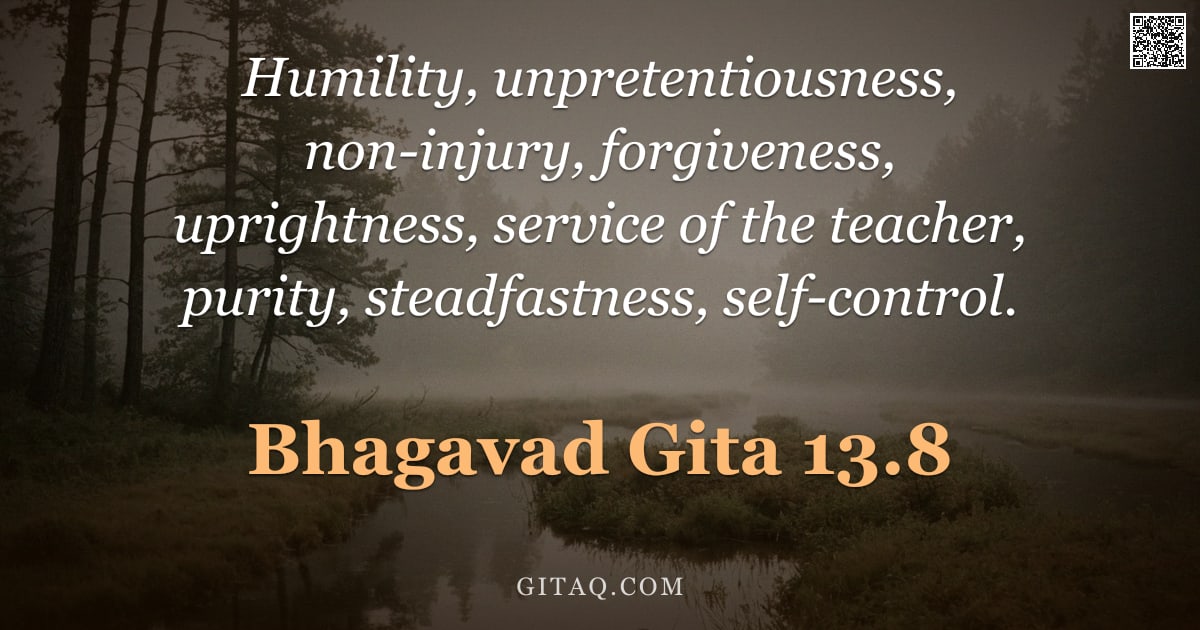
Bhagavad Gita 13.8 — "Humility, unpretentiousness, non-injury, forgiveness, uprightness, service of the teacher, purity, s"
Bhagavad Gita 13.8 — Kshetra Kshetrajna Vibhaga Yoga
Sanskrit

अमानित्वमदम्भित्वमहिंसा क्षान्तिरार्जवम् | आचार्योपासनं शौचं स्थैर्यमात्मविनिग्रहः ||१३-८||

Transliteration

amānitvamadambhitvamahiṃsā kṣāntirārjavam . ācāryopāsanaṃ śaucaṃ sthairyamātmavinigrahaḥ ||13-8||

What Does This Verse Mean?

In this verse, Lord Krishna lists nine essential qualities that characterize a person who is ready to understand the true nature of reality and their own self. Speaking to Arjuna on the battlefield of Kurukshetra, he explains that cultivating humility, non-violence, truthfulness, and devotion are not just moral duties but practical tools for spiritual growth. The key teaching is that these nine traits form a clear roadmap for purifying the mind and intellect, preparing it to receive higher knowledge.

The Teaching Behind It

This verse belongs to the framework of Jnana Yoga (the path of knowledge) within the Sankhya philosophy presented in Chapter 13, specifically detailing 'Guna' qualities that purify the mind. It develops the concept that true wisdom requires a clean vessel; without these nine virtues, the intellect remains clouded by ignorance and cannot perceive the distinction between the field (body/mind) and the Knower of the Field (soul).

Word by Word
अमानित्वम् humility, अदम्भित्वम् unpretentiousness, अहिंसा noninjury, क्षान्तिः forgiveness, आर्जवम् uprightness, आचार्योपासनम् service of the teacher, शौचम् purity, स्थैर्यम् steadiness, आत्मविनिग्रहः selfcontrol
Classical Commentary
These are the alities that constitute wisdom or lead to wisdom. These are the attributes of the man whose mind is turned towards the inner wisdom. If these characteristics are seen in a man in their entirety, you can infer that the knowledge of the Self has dawned in him. Humility It is the negation of vanity. It is absence of selfesteem or selfpraise. The basis of pride is the consciousness of possessing something (wealth, knowledge, strength, beauty and virtuous alities) in a larger measure than others. A proud man possesses at least something but a man of vanity possesses nothing and yet he thinks he is superior to others. Vanity is exaggerated pride. A humble man dislikes respect, honour and praise. He shuns fame and distinction. He never shows his knowledge, ability, prowess, etc. He never praises himself. Absence of hypocrisy Hypocrisy is the desire to appear what one is not. A Sannyasi has some virtues and a little theoretical knowledge derived from books. He pretends to be a liberated sage. This is religious hypocrisy. A man in whom this is absent is simple and modest. He never advertises his own virtuous alities in order to get respect, name and worship from others. He will never disclose any meritorious or charitable act done by him. He is free from pedantry. He will never sell his knowledge in order to achieve fame. Ahimsa Noninjuring of any living being in thought, word and deed. He who practises Ahimsa places his feet very carefully on the ground and avoids stepping on any living creature. If he perceives any living creature in front of him he stops and turns to the other side. His heart is full of compassion. Kshanti Forbearance, patience, forgiveness. This is a true symptom of knowledge. The man of wisdom puts up with everything. He is not affected a bit when others injure him. He never retaliates. He bears insult and injury calmly. Arjavam Straightforwardness. The man of wisdom is upright or straightforward. He is free from cunningness or diplomacy, doubledealing or crookedness. He is ite frank, candid or openhearted. He does not hide anything. His thoughts and words agree. He speaks his mind openly to the people. He is as simple as a child in his speech. He has a heart as pure as a crystal. He never cheats others. Service of the teacher Devotion to the preceptor, worship of the Guru doing acts of service to him who teaches BrahmaVidya or the means of attaining liberation. Acharya is the Master in whom the divine wisdom is embodied. Service of the Guru enables the aspirant to attain Selfrealisation. The aspirant adores his Guru as Brahman? God Himself. He worships him as Lord Vishnu. He superimposes on him all the attributes of Brahman or Lord Vishnu. He realises Brahman in and through his Guru. This is the fruit of devotion to the Guru. For a student of Vedanta devotion to the Guru is absolutely necessary. Even for a correct understanding of the scriptures the guidance of a Guru is necessary. Purity is of two kinds, external and internal purity. External purity is cleansing of the physical body with earth and water. Internal purity is cleansing of the mind of the dirt of attachment, hatred and other passions, by the method of Pratipaksha Bhavana, i.e., by cultivating the opposite positive virtues, and by the recognition of the evil in all objects of the senses. Steadfastness The aspirant never leaves his efforts on the path of salvation even though he comes across many stumbling blocks on the path. This is steadfastness or firmness. No meditation on Brahman is possible with a fickle mind. Selfcontrol is control of the aggregate of the body and the senses. The senses and the body which naturally run externally towards the sensual objects are checked and directed on to the path of salvation. No meditation is possible in a body wherein the senses are out of control and distract attention.

Where This Happens

This verse appears in Chapter 13 of the Bhagavad Gita, part of the Mahabharata epic, set on the desolate plain of Kurukshetra just before the great war begins. Lord Krishna has already begun explaining that the body is merely a 'field' and must be distinguished from the eternal soul; he now details the specific attitudes required to see this truth clearly. Arjuna, overwhelmed by grief and confusion about fighting his own relatives, listens as Krishna shifts from philosophical theory to practical psychology, offering him concrete steps to clear away mental clutter.

Living It Out Today

Consider a high-stakes workplace conflict where you are tempted to blame a colleague for a project failure; applying the quality of 'unpretentiousness' and 'forgiveness' allows you to focus on solving the problem rather than protecting your ego. By practicing 'steadfastness' during this crisis, you avoid impulsive reactions that could damage relationships or your career trajectory. This approach transforms a moment of potential disaster into an opportunity for professional integrity and inner stability.

Explained for Children

Imagine your heart is like a garden; if you want beautiful flowers (wisdom) to grow there, you have to keep out weeds first. This verse tells us what those 'weeds' are—like being mean or thinking we are better than everyone else—and gives us the tools to pull them up instead. Krishna teaches that when we treat others kindly, tell the truth, listen carefully to our teachers, and stay calm even when things get tough, our minds become like a clear window where good thoughts can shine through.

Daily Reflection

Today, I invite you to examine whether your actions are driven by a subtle desire for praise or by the pure joy of service itself. True uprightness means standing firm in truth without needing to announce it to others, while steadfastness is found when you remain kind even after being wronged. When we serve our teachers with humility and control our impulses through self-discipline, we transform from mere observers into worthy vessels for wisdom.

A Practice for Today

Sit quietly and silently recite 'I am not the ego' to dissolve the need for recognition, allowing humility to settle like dust clearing from a room. Follow this by offering forgiveness to anyone you hold in resentment, visualizing your heart as an open field where no injury can take root.

Key Teachings

  1. The Foundation of Humility
    Amānitvam (absence of vanity) is the prerequisite for all spiritual growth; without dropping the false self-image, no higher truth can be received. This teaching urges us to replace the craving for status with a genuine recognition that we are merely students on a path.
  2. The Ethics of Non-Harm
    Kṣānti (forgiveness) and Ahiṃsā (non-injury) form the ethical bedrock of interaction, ensuring that our conduct does not cause pain to others or ourselves. These qualities are not passive weaknesses but active disciplines that require immense inner strength to maintain in a volatile world.
  3. The Discipline of Purity and Control
    Stability (Sthairya) and self-control (Ātmavinigraha) are the practical tools that allow us to serve our teachers and uphold truth without wavering. This section emphasizes that external purity must be matched by internal mastery over the senses to become a true knower of the field.

Themes

Self-ControlHumilityNon-ViolenceMental PurityDevotion to TeacherSpiritual Preparation

Related Verses

2.473.306.518.669.1

Read This Next

  1. 2.47 — This verse complements the theme of action without attachment to results mentioned implicitly through self-control.
  2. 3.30 — It deepens the understanding of surrender and dedication, which are essential for 'service of the teacher' (ācāryopāsanaṃ).
  3. 12.15 — This verse describes the qualities of a devotee who embodies forgiveness, non-injury, and steadiness.

Recommended Reading

GitaQ earns from qualifying purchases as an Amazon Associate.

Share This Verse

Frequently Asked Questions

Why is 'service of the teacher' considered a spiritual quality?
In Vedanta, the teacher (Guru) acts as a bridge between the student and higher truth; serving them with respect removes ego and creates humility. This devotion allows wisdom to flow more easily into a mind that has cleared away arrogance through submission.
How does 'unpretentiousness' help in modern relationships?
Unpretentiousness means acting without the need for show or external validation, which fosters genuine connection and trust. When people interact without trying to impress others with false personas, conflicts decrease and authenticity increases.
Can someone practice these qualities if they don't believe in a specific religion?
Yes, because these nine traits are universal human virtues that apply regardless of religious belief. They represent psychological maturity and emotional intelligence that lead to peace and better decision-making for anyone.
In Other Languages: Bhagavad Gita 13.8 →