Bhagavad Gita 13.7
Kshetra Kshetrajna Vibhaga Yoga · English Translation
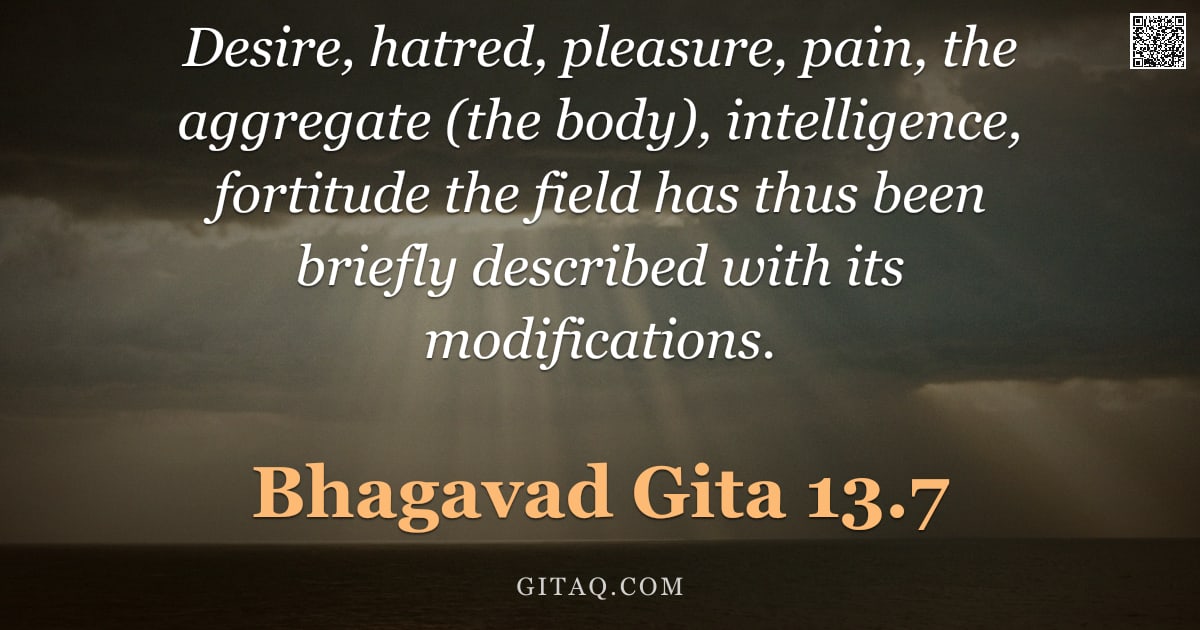
इच्छा द्वेषः सुखं दुःखं संघातश्चेतना धृतिः | एतत्क्षेत्रं समासेन सविकारमुदाहृतम् ||१३-७||
icchā dveṣaḥ sukhaṃ duḥkhaṃ saṃghātaścetanā dhṛtiḥ . etatkṣetraṃ samāsena savikāramudāhṛtam ||13-7||
What Does This Verse Mean?
In this verse, Lord Krishna continues his detailed explanation to Arjuna about the human body and mind, which he calls the 'field' of activity. He lists specific qualities like desire, hatred, pleasure, pain, intelligence, and fortitude as essential characteristics that define how we experience life in this physical form. The key teaching is that these mental states are not who you truly are; they are merely temporary modifications happening within the field of your existence. By understanding them clearly, one begins to distinguish between the changing body-mind complex and the unchanging soul.
The Teaching Behind It
This verse is foundational to Jnana Yoga (the path of knowledge) and Sankhya philosophy, which focuses on discriminative intelligence between the knower and the known. It develops the concept that consciousness must analyze the 'field' of experience—including all emotional modifications—to realize the distinct nature of the Atman (soul). By cataloging these attributes, it sets the stage for detachment from the body-mind complex.
Word by Word
Classical Commentary
Where This Happens
This verse appears in Chapter 13, where Krishna is systematically explaining 'Kshetra' (the field) and 'Kshetrajna' (the knower of the field) to Arjuna on the battlefield of Kurukshetra. Just before this, Krishna has described the physical elements that make up the body; now he shifts focus to the psychological and emotional modifications that arise within it. Arjuna is in a state of deep confusion and sorrow, paralyzed by attachment to his relatives, so Krishna provides this analytical framework to help him gain clarity about what is merely temporary emotion versus eternal truth.
Living It Out Today
Consider a professional facing a high-stakes project decision where they feel intense anxiety (pain) coupled with an overwhelming urge for success (desire). Instead of identifying as the anxious person or being swept away by the fear, this teaching suggests observing these feelings as 'modifications' occurring within their mind-field. By recognizing that intelligence and fortitude are also present to guide them through, they can separate their true self from the temporary stress response. This shift allows for a calmer, more rational approach rather than reacting impulsively out of habit or fear.
Explained for Children
Imagine your mind and body are like a busy garden where many different plants grow at once. Sometimes you feel happy (pleasure) or sad (pain), sometimes you really want something new (desire), and other times you might get angry with someone (hatred). This verse is telling us that all these feelings, along with your ability to think smartly (intelligence) and stay strong when things are hard (fortitude), are just part of how the garden works. It's like checking a weather report for your heart: knowing what storms or sunny days might come helps you understand yourself better without getting confused by them.
Daily Reflection
Today, I invite you to pause and notice when your mind tightens around a desire or recoils from an annoyance; realize this is just nature playing out within the 'field' of experience. These reactions are not who you truly are, but merely modifications like clouds moving across the sky of your consciousness. By gently acknowledging their presence without getting swept away by them, you begin to discover the stillness that remains untouched beneath it all.
A Practice for Today
Close your eyes and simply observe the rising of desire, aversion, pleasure, or pain as passing weather patterns within you, rather than claiming them as 'my' permanent state. Notice how these fluctuations arise in the body-mind complex—the field—and rest briefly in that quiet awareness which watches without judging.
Key Teachings
- The Body as a Dynamic Field
Krishna identifies the physical body not just as flesh and bone, but as an active field where sensory experiences like pleasure and pain constantly arise. This 'aggregate' is the stage upon which all psychological drama unfolds. - The Duality of Human Experience
Desire (icchā) and hatred (dveṣa), paired with pleasure (sukha) and pain (duḥkha), are the fundamental dualities that drive our actions. Understanding these as natural modifications helps us stop identifying with them as permanent truths. - The Foundation of Conscious Action
Intelligence (buddhi) and fortitude (dhṛti) are the tools within this field that allow a seeker to navigate these dualities. True wisdom lies in using intelligence to discern what is real from temporary sensations.
Themes
Related Verses
Read This Next
- 2.14 — To see how Krishna explicitly defines pleasure and pain as transient appearances that come and go like seasons.
Recommended Reading
GitaQ earns from qualifying purchases as an Amazon Associate.