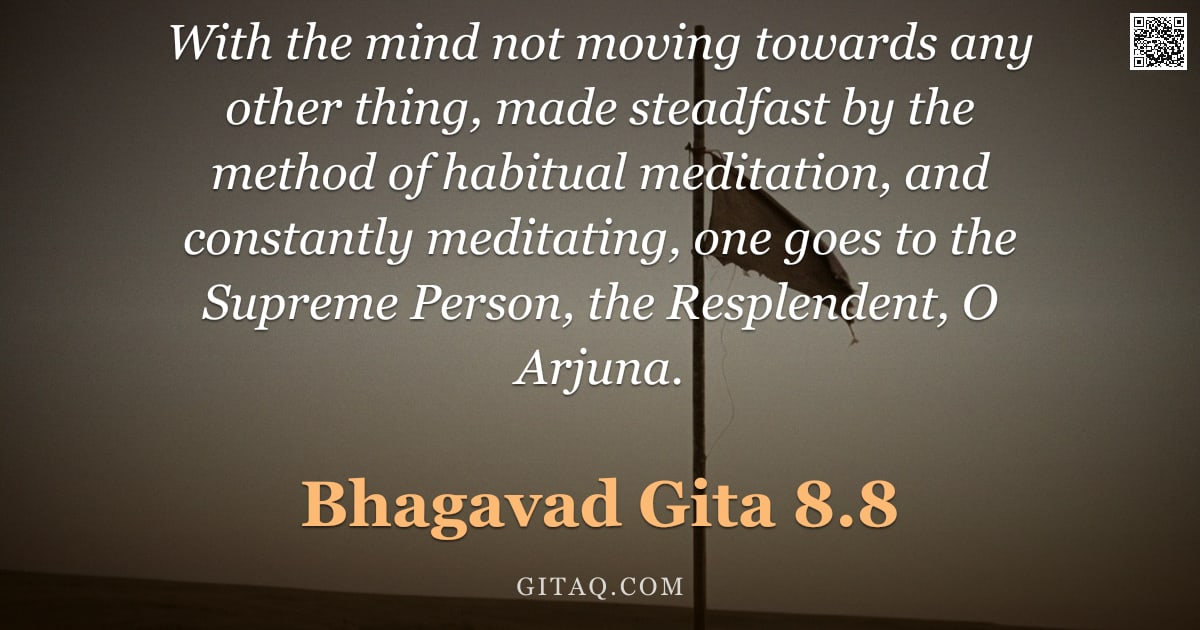
Bhagavad Gita 8.8
Akshara Brahma Yoga · English Translation
अभ्यासयोगयुक्तेन चेतसा नान्यगामिना | परमं पुरुषं दिव्यं याति पार्थानुचिन्तयन् ||८-८||
orsaṃśayama abhyāsayogayuktena cetasā nānyagāminā . paramaṃ puruṣaṃ divyaṃ yāti pārthānucintayan ||8-8||
What Does This Verse Mean?
Lord Krishna is instructing Arjuna on how to reach the Supreme Divine Consciousness through focused meditation. He explains that by training the mind to stay fixed on God without distraction, a person can attain spiritual perfection in this very life. The core teaching emphasizes consistency and single-pointed focus as the key tools for overcoming mental restlessness.
The Teaching Behind It
This verse is foundational to Dhyana Yoga (the yoga of meditation) while synthesizing elements of Bhakti Yoga (devotion). It teaches that by stabilizing the mind on the Supreme Person (Purusha), one transcends the duality of the material world and realizes their inherent spiritual nature.
Word by Word
Classical Commentary
Where This Happens
This verse occurs during the Bhagavad Gita's dialogue between Lord Krishna and Prince Arjuna on the battlefield of Kurukshetra. At this moment, Arjuna is overwhelmed by grief and confusion about fighting his own relatives, having just heard Krishna's teachings on duty and the immortality of the soul. He seeks a practical method to steady his mind in such a chaotic environment, prompting Krishna to reveal the path of meditation.
Living It Out Today
Consider a software developer facing a critical deadline who is plagued by anxiety about personal health issues or social media notifications. Instead of multitasking and letting attention fragment across ten different screens, they apply this teaching by dedicating one hour of deep work where all other distractions are silenced. By training the mind to return immediately to the task when it wanders, like a muscle being strengthened through repetition, clarity returns and high-quality results emerge.
Explained for Children
Imagine you are trying to take a photo of a butterfly; if your hand shakes or you look at other things, the picture will be blurry. This verse is like learning how to hold your camera perfectly still so that only one thing is in focus: God. Krishna tells Arjuna that if we practice focusing our minds on something good and beautiful over and over again, just like practicing a game until it feels natural, we can finally see the most wonderful light.
Daily Reflection
You often feel pulled in a hundred directions by the noise of the world, but today I invite you to try holding your gaze on just one thing: the divine within and around you. This steadiness isn't about forcing your mind to stop; it is about lovingly returning again and again until that single point becomes your entire universe for these moments.
A Practice for Today
Sit quietly and gently bring your awareness to just one point of focus, such as the breath or a silent mantra. Allow any wandering thoughts to dissolve like mist without following them, keeping your mind steady in that singular intention.
Key Teachings
- Unwavering Focus
The verse demands a mind that refuses to drift toward other objects, cultivating an exclusive devotion known as ekāgratā. This singular concentration acts as the bridge connecting the finite self directly to the infinite. - Habitual Discipline
Steadfastness is not achieved through a single burst of will but through yuktvena, or disciplined practice over time. By making meditation a daily habit, the mind naturally settles into its true nature without resistance. - The Goal of Union
When the heart is purified by constant remembrance (nāśayati) and focused intent, one transcends temporary forms to reach the Supreme Person. This state ensures that even at the moment of leaving the body, consciousness remains anchored in the eternal.
Themes
Related Verses
Read This Next
- 2.47 — This verse establishes the foundational principle of doing one's duty without attachment to results, which prepares the mind for the steady devotion described in 8.8.
- 3.30 — It expands on surrendering all actions to the Divine, reinforcing the 'not moving towards any other thing' aspect of this verse by dedicating every act as an offering.
- 12.15 — This chapter details the qualities of a devotee who is dear to Krishna, illustrating how one becomes fixed in meditation and steady-minded through love and service.
Recommended Reading
GitaQ earns from qualifying purchases as an Amazon Associate.