Bhagavad Gita 2.20
Sankhya Yoga · English Translation
न जायते म्रियते वा कदाचिन् नायं भूत्वा भविता वा न भूयः | अजो नित्यः शाश्वतोऽयं पुराणो न हन्यते हन्यमाने शरीरे ||२-२०||
na jāyate mriyate vā kadācin nāyaṃ bhūtvā bhavitā vā na bhūyaḥ . ajo nityaḥ śāśvato.ayaṃ purāṇo na hanyate hanyamāne śarīre ||2-20||
What Does This Verse Mean?
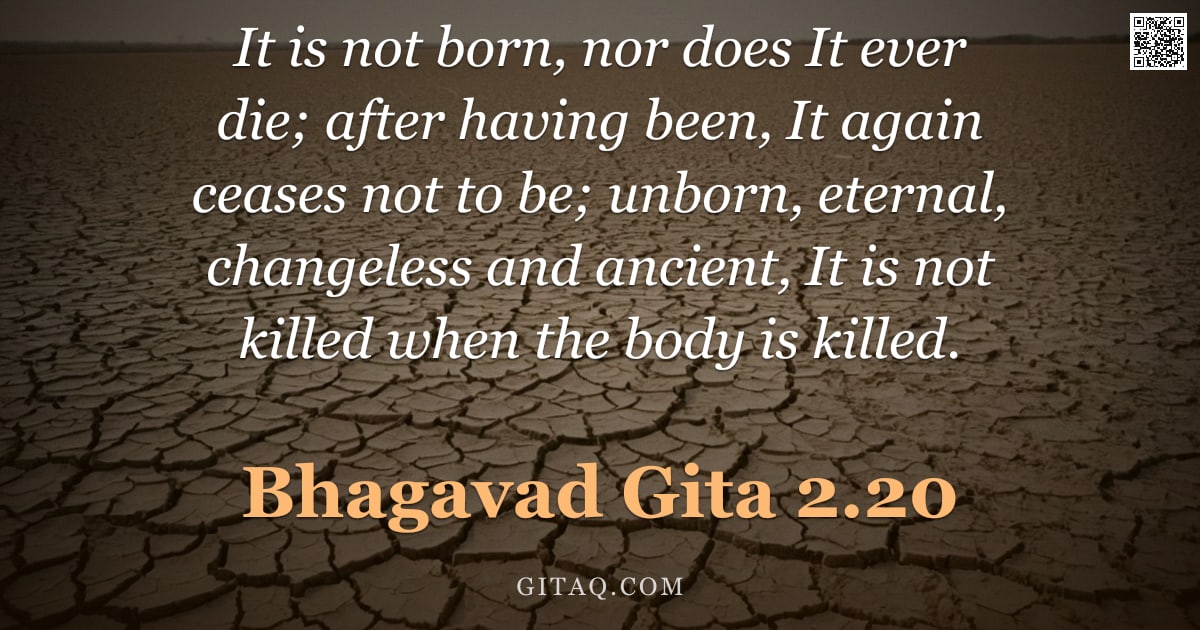
In this verse, Lord Krishna explains to Arjuna that the true Self (the soul) is never born and never dies; it exists beyond time as an eternal, unchanging reality. Just because a physical body ages or ends does not mean the essence within it has ceased to exist. The core teaching here is that death applies only to the temporary container of the body, while our essential nature remains immortal and indestructible.
The Teaching Behind It
This verse is foundational to Jnana Yoga (the path of knowledge) and the Sankhya philosophy presented in the Gita. It develops the concept of Atman as distinct from Sharira (body), establishing that consciousness is eternal (Nitya) and unaffected by material transformations or physical destruction.
Word by Word
Classical Commentary
Where This Happens
This verse occurs in Chapter 2 of the Bhagavad Gita on the battlefield of Kurukshetra, where Prince Arjuna has just collapsed in despair. Overcome by grief for his kinsmen he must fight against, Arjuna refuses to pick up his bow and asks Krishna to spare him from fighting. In response to this paralysis born of attachment, Krishna begins His discourse on Sankhya Yoga (transcendental knowledge) by clarifying the true nature of the soul to lift Arjuna's confusion.
Living It Out Today
Consider a professional facing sudden job loss or retirement; they often feel their identity is shattered when their role ends. This verse reminds us that our core worth and essence are not tied to a specific title, salary, or workplace environment which can change overnight. By internalizing this truth of being 'unborn' and eternal, one can navigate career transitions with resilience rather than fear, focusing on what truly remains constant within.
Explained for Children
Imagine you are wearing your favorite winter coat on a cold day. When summer comes, you take off the heavy coat because it's too hot, but you don't disappear—you just put on something lighter. Your Self is like that 'you' inside, not the body or clothes you wear. Even if the coat gets torn or thrown away (which represents death), the real 'you' remains safe and unchanged.
Daily Reflection
Today, try to notice when fear or sadness tells you that something is ending forever; remind yourself that this feeling belongs only to the temporary body, not to your true self. You are that ancient witness which has never truly begun nor will it ever cease to be, regardless of how the world around you shifts and changes. When you realize you cannot be killed because you were never born, a profound peace settles in as the weight of mortality lifts from your shoulders.
A Practice for Today
Close your eyes and gently shift your awareness from the changing sensations of your body to the silent witness within that observes them without being touched by them. Rest for a moment knowing that while your clothes wear out, you are like the sky—unborn, unchanging, and untouched by any storm passing through.
Key Teachings
- The Timeless Nature of the Soul
This verse establishes that the true self (Atman) exists outside the linear constraints of birth and death, remaining unchanged through all time. It clarifies that what we perceive as life or death is merely a transformation in form, not an alteration of existence itself. - The Distinction Between Body and Self
Krishna draws a sharp line between the perishable physical vessel and the imperishable consciousness that inhabits it. Just as one discards old clothes for new ones, this teaching explains how death is only a transition of the body while the soul remains untouched. - The Immutability of Consciousness
Being described as 'unborn' and 'ancient,' the self has no beginning or end to cause anxiety about loss. This eternal quality means that our essential nature is immune to destruction, offering a foundation for fearless living.
Themes
Related Verses
Read This Next
- 2.13 — Read this to understand Krishna's analogy of discarding old clothes when wearing new ones, which explains how the soul transitions after death.
- 2.47 — This verse follows logically by teaching you to act without attachment to results, a natural response for one who knows they are beyond birth and death.
Recommended Reading
GitaQ earns from qualifying purchases as an Amazon Associate.