Bhagavad Gita 2.13
Sankhya Yoga · English Translation
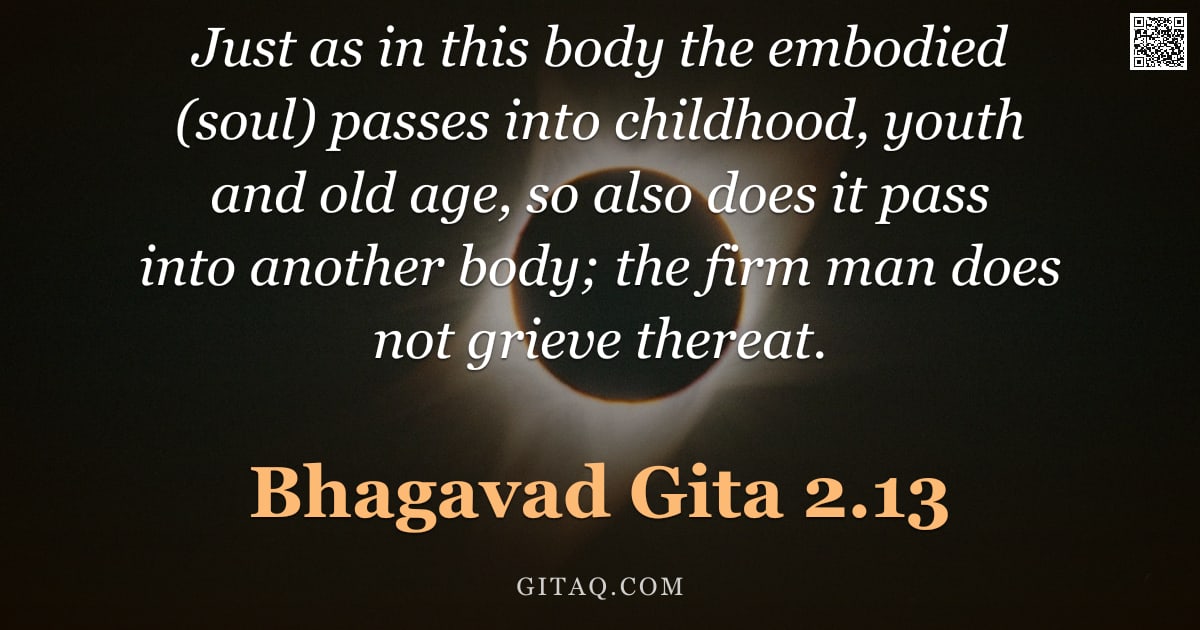
देहिनोऽस्मिन्यथा देहे कौमारं यौवनं जरा | तथा देहान्तरप्राप्तिर्धीरस्तत्र न मुह्यति ||२-१३||
dehino.asminyathā dehe kaumāraṃ yauvanaṃ jarā . tathā dehāntaraprāptirdhīrastatra na muhyati ||2-13||
What Does This Verse Mean?
In this verse, Lord Krishna explains to Arjuna that the soul is eternal and merely changes bodies as it moves through different stages of life like childhood, youth, and old age. Just as a person naturally outgrows their clothes or transitions between ages without stopping their existence, the soul leaves one worn-out body to enter a new one upon death. The key teaching is that wise people (the 'dhiras') understand this natural cycle and therefore do not waste time grieving over the inevitable loss of any physical form.
The Teaching Behind It
This verse is the foundational pillar of Sankhya Yoga and Jnana Yoga (the yoga of knowledge) within the Gita. It develops the concept of 'deha-antara-prapti' (transmigration), distinguishing between the temporary physical body (matter) and the permanent, unchanging soul (spirit), which forms the basis for all subsequent teachings on detachment.
Word by Word
Classical Commentary
Where This Happens
This verse appears in Chapter 2 of the Bhagavad Gita during the critical moment on the battlefield of Kurukshetra where Arjuna has dropped his bow and refused to fight. He is overwhelmed by attachment and grief, believing that killing his relatives will destroy their lineage and cause him eternal sin. Lord Krishna begins His discourse here by establishing Sankhya Yoga (transcendental knowledge) as a counter-argument to Arjuna's delusion, aiming to shift the warrior's mindset from emotional paralysis to spiritual clarity.
Living It Out Today
Consider a professional who loses their job after decades of service and feels their entire identity has been shattered by this loss. Instead of spiraling into despair over the 'death' of that specific role or office, they can apply this wisdom to see themselves as an evolving consciousness adapting from one chapter of life (the career) to another. This perspective allows them to make a hard decision—like retraining for a new industry—with equanimity rather than fear, recognizing that their core self remains intact despite external changes.
Explained for Children
Imagine you have an old pair of shoes that are too small or worn out; naturally, your parents buy you a new size to wear. Your feet don't stop being yours just because they need different shoes! The soul is like those feet inside our bodies—it grows up from childhood into youth and then gets older, but it never stops existing. When the body gets very old and tired, the soul simply moves on to a brand new one, so there is no reason for us to cry or be scared.
Daily Reflection
Imagine how much lighter your heart would feel if you truly saw yourself not as an aging body, but as a traveler changing suits for different stages of life. When you stop identifying so tightly with wrinkles or physical decline, grief loses its grip because it tries to mourn something that isn't actually lost. You are the constant witness behind every transition, never breaking even when the world around you shifts.
A Practice for Today
Visualize your current body as a garment that has served you well, just as childhood clothes eventually give way to youth and then age. Sit with the quiet certainty that while this outer layer changes, the inner observer remains untouched by time or loss.
Key Teachings
- The Metaphor of Change
Krishna uses the universal human experience of growing from childhood to old age as an analogy for death. Just as we do not grieve when a child outgrows their clothes, we should not mourn the soul leaving one body for another. - The Distinction Between Body and Soul
This verse establishes that the 'dehin' or embodied self is distinct from the physical form it inhabits. The true identity of a person remains constant while the temporary vehicle undergoes inevitable transformation. - The Mark of Wisdom
A wise person (dhīraḥ) understands this natural law and therefore does not fall into delusion or excessive sorrow. True intelligence is recognizing that death is merely a transition, not an end. - Equanimity in Grief
The verse invites us to cultivate a steady mind that remains undisturbed by the inevitable changes of existence. Understanding these truths allows for peace even amidst the sorrow of separation or loss.
Themes
Related Verses
Read This Next
- 2.47 — After understanding the nature of the self, this verse teaches how to act without attachment to results.
- 3.30 — This shifts focus from theoretical knowledge to practical surrender through action and duty.
- 12.15 — To see the ultimate expression of a mind that has conquered grief, read about Krishna's description of His beloved devotee who is not disturbed by others' sorrow or joy.
Recommended Reading
GitaQ earns from qualifying purchases as an Amazon Associate.