Bhagavad Gita 2.12
Sankhya Yoga · English Translation
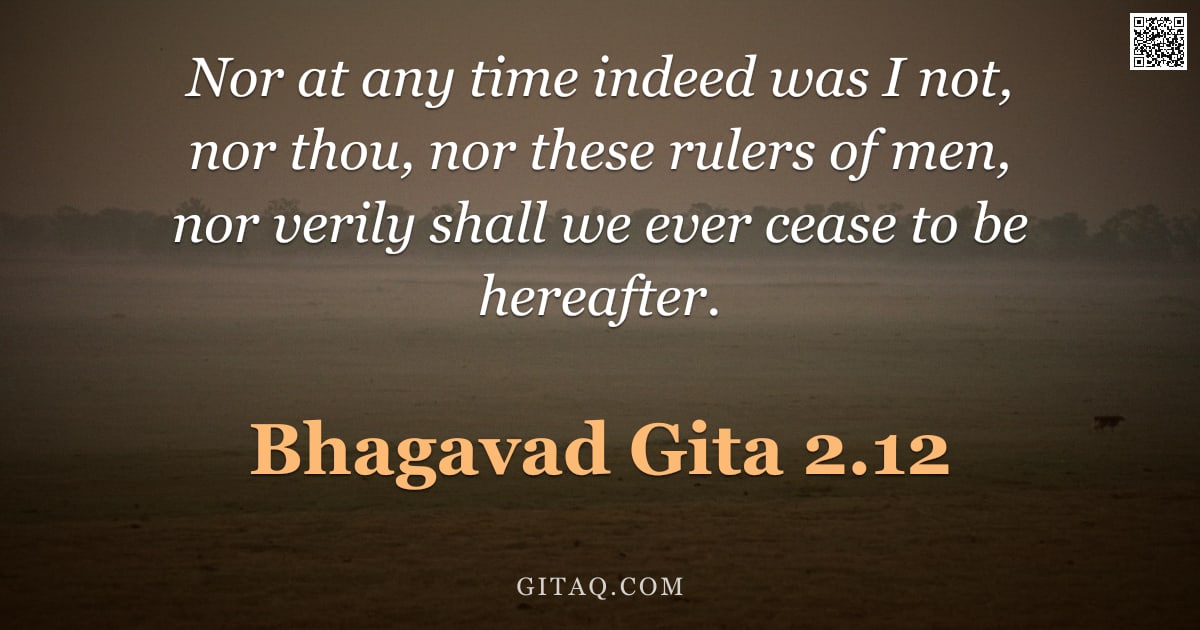
न त्वेवाहं जातु नासं न त्वं नेमे जनाधिपाः | न चैव न भविष्यामः सर्वे वयमतः परम् ||२-१२||
na tvevāhaṃ jātu nāsaṃ na tvaṃ neme janādhipāḥ . na caiva na bhaviṣyāmaḥ sarve vayamataḥ param ||2-12||
What Does This Verse Mean?
In this verse, Lord Krishna addresses Arjuna and the other warriors to reassure them that their true essence—the soul—has no beginning or end. He clarifies that neither he nor they have ever not existed in a spiritual sense, nor will there be any future time when existence ceases completely. This teaching directly counters Arjuna's grief by establishing that while bodies change and die, the eternal self remains untouched and indestructible.
The Teaching Behind It
This verse is foundational to Jnana Yoga (the path of knowledge) and the Sankhya philosophy discussed in Chapter 2, which distinguishes between the eternal Atman (Self) and the temporary body. It establishes the doctrine of immortality, teaching that existence is a continuous cycle where the essential self transcends birth and death.
Word by Word
Classical Commentary
Where This Happens
This verse occurs on the battlefield of Kurukshetra in Chapter 2, shortly after Arjuna has dropped his bow in despair. The warrior prince is overwhelmed by grief at the prospect of killing his elders and kin, believing that death means total non-existence for himself and others. Krishna speaks this to a deeply distressed student who is trapped in the illusion that life ends with physical death.
Living It Out Today
When facing a sudden job loss or career shift that feels like an identity crisis, remember that your professional title is just a temporary role you are playing, not your core self. Just as a child outgrows their shoes but remains the same person, losing a specific status does not mean you have ceased to be valuable or alive. This perspective allows you to make difficult decisions from a place of stability rather than fear of non-existence.
Explained for Children
Imagine you are wearing your favorite winter coat. When it gets too hot in summer, you take off the heavy coat to wear a t-shirt instead. You didn't disappear when you took off the coat; you just changed what you were wearing! Krishna is saying that our bodies are like those coats—they might change or stop being used eventually—but 'you,' your true self, has always existed and will continue to exist forever.
Daily Reflection
Today, try to release the heavy burden of fear regarding loss, for the verse assures us that neither I nor thou were ever non-existent, nor shall we ever stop being. You are not a temporary assembly of cells but an eternal consciousness that has always been and will forever remain unchanged by time's flow. When you feel small or transient in your daily struggles, remember that your true identity is as timeless as the sky itself.
A Practice for Today
Sit quietly and breathe, imagining your true Self not as the body that changes with time, but as an eternal presence untouched by birth or death. In this stillness, acknowledge that while you have existed since the beginning of creation, your essence will never cease to be even in the future.
Key Teachings
- The Timelessness of Existence
Krishna establishes that the Soul (Atman) has no beginning and therefore can have no end, existing beyond linear time. This counters the natural human anxiety about death by defining existence as an eternal continuum rather than a finite line. - The Equality of All Beings
By stating 'nor I nor thou nor these rulers,' Krishna dissolves hierarchies between teacher and student, or divine and mortal. It reveals that every living entity shares the same indestructible spiritual nature regardless of their current status in life. - The Illusion of Cessation
The verse explicitly negates the idea of 'ceasing to be,' clarifying that what we perceive as death is merely a change of state, not an annihilation. This teaching removes the root cause of grief by proving that true identity persists through all transitions.
Themes
Related Verses
Read This Next
- 2.47 — After establishing that we are eternal, read this verse on performing duty without attachment to results as a natural response.
- 3.30 — This verse deepens the understanding of action by instructing one to dedicate all works to the Divine Self, aligning with our eternal nature.
- 12.15 — To conclude this study on eternity and detachment, read how a devotee who is free from fear of loss becomes dear to Krishna.
Recommended Reading
GitaQ earns from qualifying purchases as an Amazon Associate.