Bhagavad Gita 2.18
Sankhya Yoga · English Translation
अन्तवन्त इमे देहा नित्यस्योक्ताः शरीरिणः | अनाशिनोऽप्रमेयस्य तस्माद्युध्यस्व भारत ||२-१८||
antavanta ime dehā nityasyoktāḥ śarīriṇaḥ . anāśino.aprameyasya tasmādyudhyasva bhārata ||2-18||
What Does This Verse Mean?
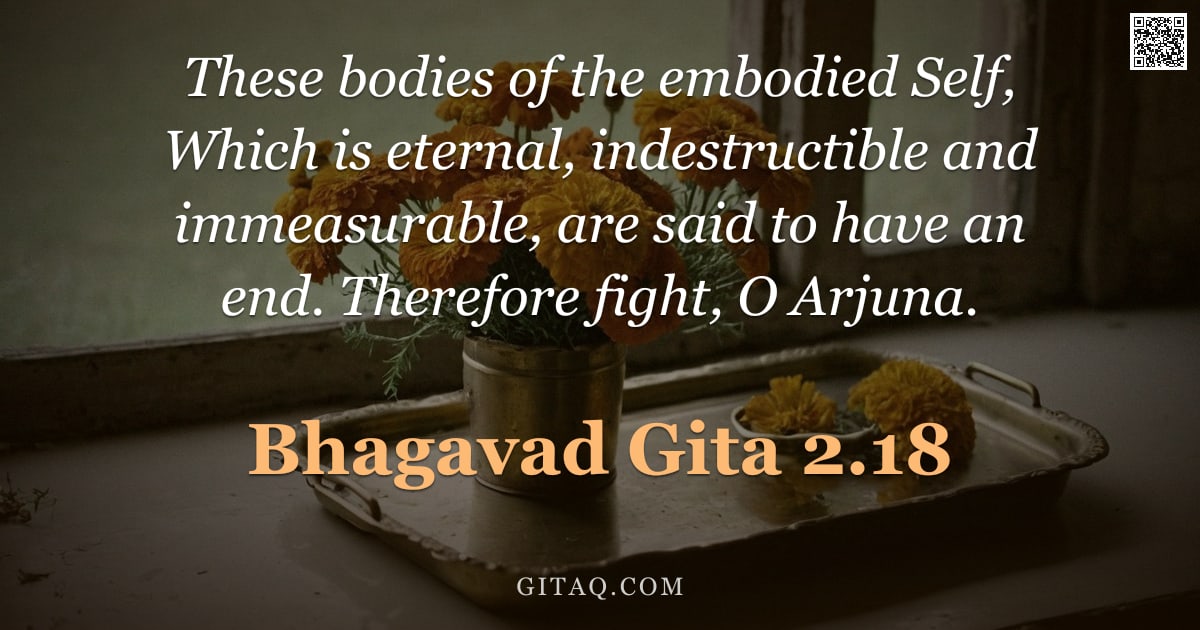
In this verse, Lord Krishna is speaking to Arjuna on the battlefield of Kurukshetra, reassuring him that while physical bodies are temporary and eventually perish, the true self (the soul) inside them is eternal and indestructible. Since death only affects the outer shell and not the essence within one's being, there is no need for grief or fear regarding mortality. Krishna uses this truth as a logical foundation to urge Arjuna to rise up and fulfill his duty by fighting against injustice.
The Teaching Behind It
This verse is a cornerstone of Sankhya Yoga and Jnana (knowledge) yoga within the Gita, focusing specifically on the distinction between the physical body and the eternal Atman. It develops the concept that the true self is 'anashin' (indestructible), establishing the metaphysical basis for performing duty without attachment to results.
Word by Word
Classical Commentary
Where This Happens
This verse occurs in Chapter 2 of the Bhagavad Gita during the war at Kurukshetra, immediately after Lord Krishna has begun his teachings. Just before this, Arjuna was overwhelmed by grief and confusion upon seeing his teachers, cousins, and friends on the opposing side and refused to fight. The speaker is Sri Krishna acting as a charioteer and spiritual guide, addressing the paralyzed warrior who feels that killing his kin would be an eternal sin.
Living It Out Today
Consider a professional facing a difficult decision like restructuring their team during a company crisis; they might fear being seen as 'heartless' or causing pain to loyal employees. This verse teaches that while the specific roles and titles people hold (the bodies) may change due to business needs, the value of every individual remains intact regardless of job status. Instead of paralyzing guilt over potential short-term discomfort, one should focus on making the necessary tough decisions for the greater good of the organization's survival.
Explained for Children
Imagine you are wearing your favorite warm jacket during winter; when spring comes, the jacket might get old, torn, or even thrown away, but that doesn't mean *you* have disappeared. You still exist! The Bhagavad Gita teaches us that our bodies are just like those jackets—they change and eventually end—but our true selves are like the person inside who never changes or disappears. Because we will always be here as ourselves, Krishna tells Arjuna not to cry over a jacket wearing out, but to do what needs to be done right now.
Daily Reflection
Today, notice how often you worry about things that will eventually pass away like these temporary bodies do. You carry a spark of the infinite within you that no circumstance can ever truly diminish or destroy. When fear arises about loss or change, remember that the essence of who you are is indestructible and timeless.
A Practice for Today
Close your eyes and visualize your body not as who you are, but merely as a garment worn by the eternal spirit within. Take three deep breaths, imagining that just as old clothes are discarded for new ones, this physical form has an end while your true self remains untouched.
Key Teachings
- The Distinction Between Body and Soul
This verse establishes a fundamental separation between the perishable physical form (the body) and the imperishable embodied spirit. Recognizing this distinction is the first step toward transcending fear, as we realize our true identity exists beyond biological limits. - The Nature of Eternity
While bodies have a beginning and an end like any other object in nature, the soul is described as eternal (nitya) without origin or cessation. This unchanging reality means our core identity is immune to the destruction that affects all material things. - The Call to Righteous Action
Because death only applies to the body and not the self, one should act with courage rather than hesitation or grief. Krishna urges Arjuna to fight because his duty is for the eternal soul manifesting through a temporary vessel.
Themes
Related Verses
Read This Next
Recommended Reading
GitaQ earns from qualifying purchases as an Amazon Associate.