Bhagavad Gita 14.6
Gunatraya Vibhaga Yoga · English Translation
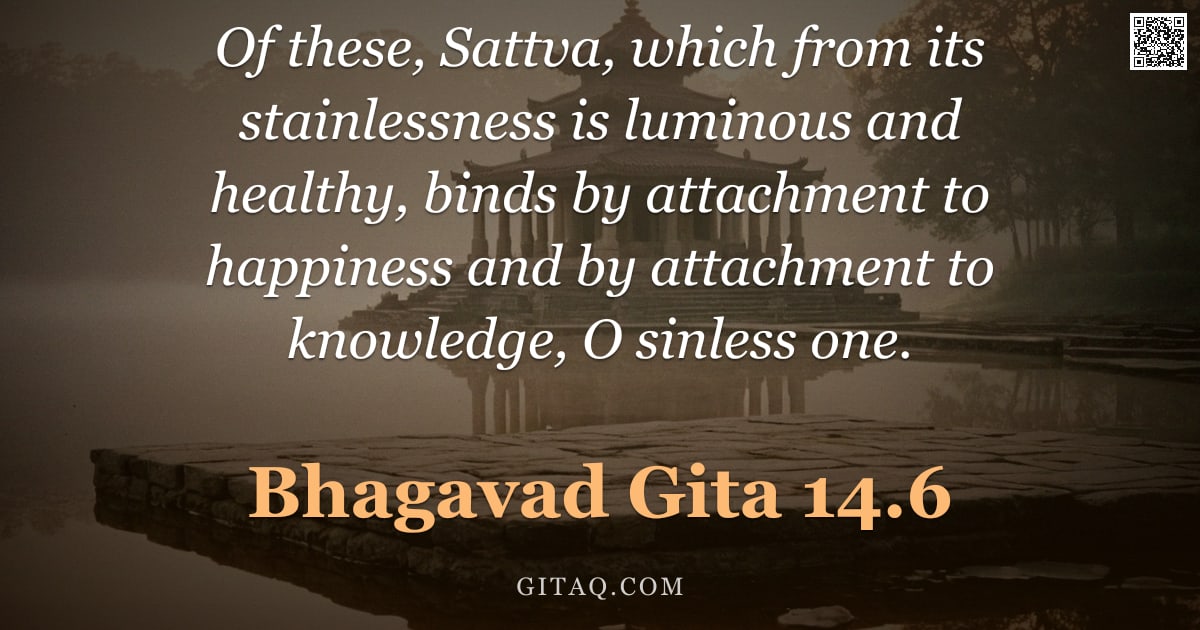
तत्र सत्त्वं निर्मलत्वात्प्रकाशकमनामयम् | सुखसङ्गेन बध्नाति ज्ञानसङ्गेन चानघ ||१४-६||
tatra sattvaṃ nirmalatvātprakāśakamanāmayam . sukhasaṅgena badhnāti jñānasaṅgena cānagha ||14-6||
What Does This Verse Mean?
In this verse, Lord Krishna explains the nature of Sattva (purity) to Arjuna after describing how it binds us more subtly than other qualities. Although Sattva is luminous and brings true happiness, it still creates a chain by attaching people to pleasant experiences and their own sense of knowledge. The key teaching is that even good states like clarity and joy can become traps if we cling to them instead of transcending all three modes of nature.
The Teaching Behind It
This teaching belongs primarily to Sankhya philosophy as interpreted through Vedanta, specifically focusing on the nature of Prakriti (material nature) and its three Gunas. It develops the concept that while Sattva is superior to Rajas and Tamas because it leads toward liberation, attachment to any mode—even a pure one—keeps the soul bound in the cycle of rebirth.
Word by Word
Classical Commentary
Where This Happens
This verse occurs during Lord Krishna's discourse to Prince Arjuna on the battlefield of Kurukshetra, where they are preparing for a great war. Just before this, Krishna has begun explaining the three Gunas (modes of material nature) that influence all living beings. Arjuna is in a state of deep confusion and emotional distress after refusing to fight his relatives, prompting Krishna to systematically analyze the forces binding him to this world.
Living It Out Today
Consider a professional who excels at their job, receiving praise and feeling deeply satisfied with their expertise; they may become so attached to being seen as 'the expert' that they refuse new challenges or adapt to changes. This verse teaches us to enjoy our success and use our knowledge without letting the ego of being 'smart' prevent growth or cause arrogance. True freedom comes when you can let go of both failure's pain and success's pride, remaining steady regardless of external validation.
Explained for Children
Imagine you are playing with your favorite toys or solving a really hard puzzle; it feels so wonderful that you never want to stop, right? That feeling is like Sattva—it's bright and happy. But even when something makes us feel great, if we get too attached and think only our way of thinking is the best, we can't move on to do other important things. Krishna tells Arjuna not to fall in love with being smart or happy so much that you forget there is a bigger world waiting for you.
Daily Reflection
You often find comfort in Sattvic states like happiness and knowledge, believing them to be your true refuge. Yet even these beautiful qualities can become subtle chains if you attach to the feeling rather than the source behind it. True freedom lies not just in enjoying clarity, but in remaining unattached to the very joy that enlightens you.
A Practice for Today
Sit quietly and notice how your mind clings to moments of clarity, peace, or intellectual insight as if they were the only things that matter today. Ask yourself: is this joy binding you to a specific state of being, preventing you from resting in pure awareness?
Key Teachings
- The Luminous Trap
Sattva is described as luminous and pure, yet it binds us more subtly than passion or ignorance by making us cling to happiness. This teaches that even spiritual elevation can become a shackle if we mistake the experience for liberation. - The Dual Bind
Attachment operates through two primary channels: emotional satisfaction (happiness) and intellectual validation (knowledge). Recognizing these dual hooks helps us see that perfection of mind is not yet freedom from all conditioning. - Transcending the Good
The verse implies a hierarchy where one must eventually move beyond even the 'good' qualities to reach the Gunateeta state. A wise seeker appreciates Sattva but does not rest content, knowing it is still part of nature's play.
Themes
Related Verses
Read This Next
- 2.47 — Directs the mind away from attachment to results, which complements the warning against clinging to Sattvic outcomes.
- 3.30 — Reinforces the practice of surrendering all actions and their fruits as a method to transcend the modes of nature.
- 12.15 — Describes the qualities of those who have transcended attachment, offering a vision of what lies beyond the bind of Sattva.
Recommended Reading
GitaQ earns from qualifying purchases as an Amazon Associate.