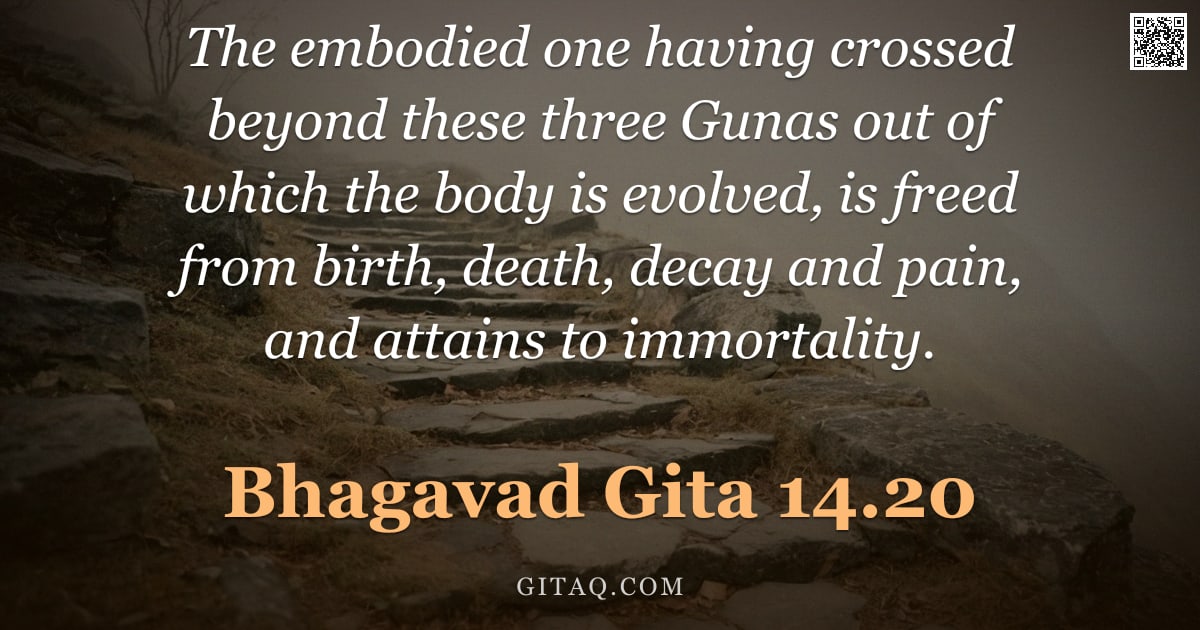
Bhagavad Gita 14.20
Gunatraya Vibhaga Yoga · English Translation
गुणानेतानतीत्य त्रीन्देही देहसमुद्भवान् | जन्ममृत्युजरादुःखैर्विमुक्तोऽमृतमश्नुते ||१४-२०||
guṇānetānatītya trīndehī dehasamudbhavān . janmamṛtyujarāduḥkhairvimukto.amṛtamaśnute ||14-20||
What Does This Verse Mean?
In this verse, Lord Krishna tells Arjuna that once a person transcends the three modes of material nature (goodness, passion, and ignorance) that shape their physical body, they are liberated from the cycle of birth, death, old age, and suffering. This state is achieved not by destroying the world but by rising above identification with these temporary qualities. The ultimate result for such a soul is attaining immortality and freedom from all pain.
The Teaching Behind It
This verse belongs to the synthesis of Sankhya philosophy and Jnana Yoga (the path of knowledge), focusing on 'Viveka' or discrimination between the eternal self and temporary nature. It develops the concept that liberation is possible while living, achieved by realizing one's distinctness from the three Gunas that govern physical existence.
Word by Word
Classical Commentary
Where This Happens
This teaching occurs on the battlefield of Kurukshetra during the Mahabbarata war, where Lord Krishna is serving as Arjuna's charioteer and spiritual guide. It follows Chapter 14, which details how the three Gunas (modes) bind the soul to the body; here, Krishna concludes that section by revealing the final goal of transcendence. At this moment, Arjuna is seeking a way out of his confusion and grief over fighting his own relatives, needing reassurance about the nature of existence.
Living It Out Today
Consider a professional facing burnout who feels trapped between perfectionism (goodness), fear of losing their status (passion), and cynicism or laziness after setbacks (ignorance). By recognizing these emotions as temporary states rather than their identity, they can detach from the outcome. This shift allows them to make decisions based on clarity rather than anxiety, ultimately finding peace regardless of external success or failure.
Explained for Children
Imagine you are wearing three different jackets: one heavy and sad (ignorance), one very flashy but stressful (passion), and one clean and calm (goodness). Even if the jacket feels good, it still makes you hot or cold. This verse teaches that when you learn to take off all those jackets and realize you are not them, you feel truly free! You stop worrying about getting sick or growing old because your true self is like a special light inside that never goes out.
Daily Reflection
You often mistake the constant changes in your mood or circumstances for who you truly are, but today let us remember that your body is merely an evolved vessel for these natural forces. When you step back and realize you are not the turbulence itself, birth, death, and decay lose their grip on your peace of mind. By recognizing yourself as the silent witness beyond these three modes, you begin to taste a freedom that no external condition can ever take away.
A Practice for Today
Close your eyes and imagine yourself as an observer floating just above the waves of passion, inertia, and goodness that constantly toss you about like a boat on the sea. Silently acknowledge each fluctuation without identifying with it, feeling a subtle shift where the weight of these three modes begins to lift from your shoulders.
Key Teachings
- The Transcendent Observer
This verse establishes that your true Self (Atman) is distinct from the body and its three governing modes of nature. You are not the waves, but the ocean floor upon which they break. - Freedom from Samsara's Cycle
Crossing beyond these gunas liberates you from the inevitable cycle of birth, death, aging, and sorrow that binds all embodied beings. This is not a future promise but a present reality for those who know their true identity. - Attaining Immortality
The state achieved after transcending the modes is described as amrita, or immortality, which signifies an eternal existence beyond physical decay. This freedom allows one to experience the infinite nature of consciousness without limitation.
Themes
Related Verses
Read This Next
- 2.47 — To understand how to perform duty without attachment while still engaged with the gunas.
- 3.30 — To learn the practical method of surrendering actions, which aids in transcending the modes' influence.
- 12.15 — To see how a person who has crossed beyond duality becomes dear to Krishna and attains supreme peace.
Recommended Reading
GitaQ earns from qualifying purchases as an Amazon Associate.