Bhagavad Gita 2.45
Sankhya Yoga · English Translation
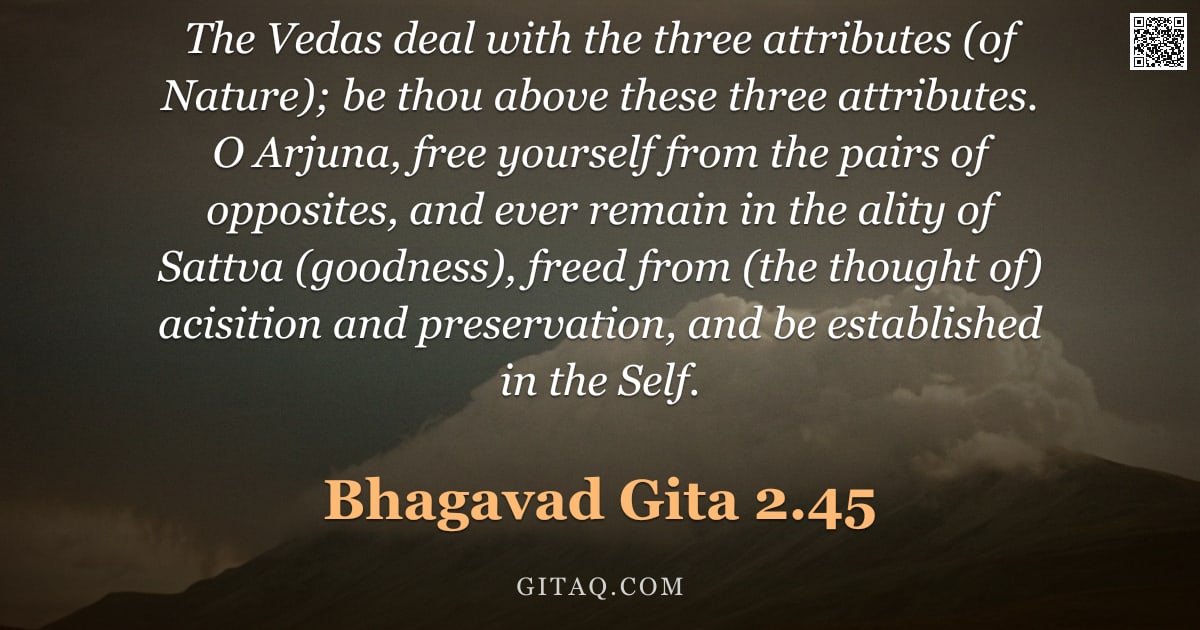
त्रैगुण्यविषया वेदा निस्त्रैगुण्यो भवार्जुन | निर्द्वन्द्वो नित्यसत्त्वस्थो निर्योगक्षेम आत्मवान् ||२-४५||
traiguṇyaviṣayā vedā nistraiguṇyo bhavārjuna . nirdvandvo nityasattvastho niryogakṣema ātmavān ||2-45||
What Does This Verse Mean?
In this verse, Lord Krishna advises Arjuna that the ancient scriptures primarily address the three modes of material nature (goodness, passion, and ignorance). He urges Arjuna to rise above these temporary fluctuations by remaining steady in his true spiritual consciousness. The teaching emphasizes freeing oneself from anxiety about gaining or losing anything while staying balanced against life's dualities like pleasure and pain.
The Teaching Behind It
This verse sits at the intersection of Sankhya philosophy (the analysis of material nature) and Karma Yoga (action without attachment). It develops the concept of 'Trigunatita'—transcending the three gunas—to establish a state of pure consciousness where one acts from duty rather than desire.
Word by Word
Classical Commentary
Where This Happens
This verse appears in Chapter 2 during the critical moment on the battlefield of Kurukshetra where Arjuna has collapsed with grief, refusing to fight his relatives and teachers. After a brief pause following Krishna's initial teachings on the immortality of the soul, He now addresses how one should relate to scripture and material nature. The listener, Arjuna, is currently overwhelmed by emotional attachment and confusion about duty versus family loyalty.
Living It Out Today
Consider a professional facing an uncertain market where stock prices fluctuate wildly based on rumors; instead of panicking over potential losses or obsessing over quick gains, they maintain their focus on the quality of their work. By detaching from the 'what if' scenarios and trusting in one's inherent skills rather than external validation, the individual remains calm during a high-stakes negotiation.
Explained for Children
Imagine the Vedas are like a map of different weather patterns—sometimes sunny, sometimes rainy, sometimes stormy. Krishna tells Arjuna not to get stuck watching just one type of weather but to become like the sky itself: vast, clear, and unchanged no matter what happens outside. When you stop worrying about winning every game or losing any toy, you feel strong inside your own heart.
Daily Reflection
Today, you are invited to pause whenever you feel pushed by the urge to acquire something or fear losing what you have. Remember that true peace is not found in balancing these opposites but in standing firm as an observer of them all. When you release the heavy burden of needing to control outcomes, your natural state of clarity and inner freedom will naturally shine through.
A Practice for Today
Sit quietly and notice how your mind currently chases pleasure or avoids pain based on the three modes of nature. Breathe deeply and intentionally step back from these fluctuations, resting your awareness in a stillness that exists beyond success and failure.
Key Teachings
- Transcending the Three Gunas
The Vedas operate within the three modes of material nature (goodness, passion, ignorance), but your true goal is to rise above this conditioning. By not identifying with these shifting qualities, you discover a stable consciousness that remains untouched by external changes. - Freedom from Duality
Suffering often arises when we cling only to pleasant experiences and reject unpleasant ones; the wise person remains equipoised in all pairs of opposites. This detachment allows you to act without being emotionally swayed by success or failure, heat or cold. - The State of Niryogakshema
Anchored in the Self, one ceases to be driven by anxiety over acquiring new things (yoga) or preserving what is already possessed (kshema). This complete trust in divine order liberates you from the endless cycle of striving and fear.
Themes
Related Verses
Read This Next
- 2.47 — This famous verse immediately follows by clarifying that while you must act, your right is only to the action itself, not its fruits.
- 3.30 — It expands on this detachment by teaching the practice of surrendering all actions and their results to the Divine Will.
- 12.15 — This verse describes the personal qualities of a devotee who has successfully cultivated such transcendence, making them dear to Krishna.
Recommended Reading
GitaQ earns from qualifying purchases as an Amazon Associate.