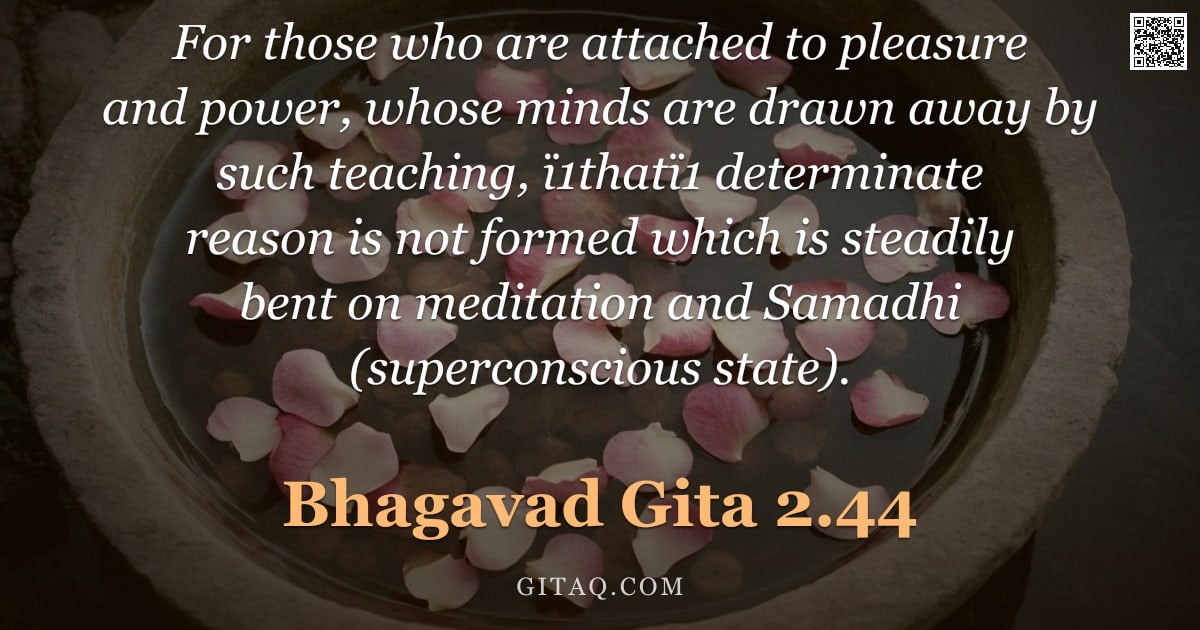
Bhagavad Gita 2.44
Sankhya Yoga · English Translation
भोगैश्वर्यप्रसक्तानां तयापहृतचेतसाम् | व्यवसायात्मिका बुद्धिः समाधौ न विधीयते ||२-४४||
bhogaiśvaryaprasaktānāṃ tayāpahṛtacetasām . vyavasāyātmikā buddhiḥ samādhau na vidhīyate ||2-44||
What Does This Verse Mean?
Lord Krishna is explaining to Arjuna that people who are deeply obsessed with material enjoyment and power cannot develop the steady, focused mind required for spiritual meditation. When a person's attention is constantly pulled toward wealth, status, or sensory pleasures, their intellect becomes scattered rather than fixed on higher truths. This verse teaches that true inner stability requires detaching from these temporary distractions to find lasting peace.
The Teaching Behind It
This verse belongs to the Sankhya Yoga strand of the Gita's teaching, which establishes the foundation of discriminative knowledge (viveka) and the nature of the intellect. It develops the concept that without detachment from sensory objects, one cannot attain 'samadhi' or a state of superconscious stability necessary for self-realization.
Word by Word
Classical Commentary
Where This Happens
This verse occurs on the battlefield of Kurukshetra during the Mahabharata war, where Arjuna is paralyzed by grief and confusion about fighting his relatives. Krishna has just begun teaching him that duty transcends personal desire, but Arjuna remains fixated on temporary worldly pleasures like kingdom and family bonds rather than spiritual truth. The speaker, Lord Krishna as charioteer and divine teacher, is addressing the listener's scattered state of mind caused by attachment to results.
Living It Out Today
Consider a professional who wants to launch a startup but spends all their mental energy comparing salaries with peers or chasing quick profits instead of focusing on product innovation. Their anxiety stems from this 'bhoga-airyaprasakta' (attachment to pleasure and power) mindset, preventing them from entering the flow state needed for success. By shifting focus from external validation to internal purpose, they can develop the 'vyavasaya-buddhi' or determined resolve required to overcome obstacles.
Explained for Children
Imagine trying to listen to your favorite song while someone keeps playing a loud video game right next to you; it's impossible to focus on the music, right? The Bhagavad Gita says our minds are like that too. If we spend all day chasing toys, candy, or being the 'winner' in every game, our brains get so busy and distracted that they can't calm down enough to feel true inner happiness. To find real peace, we need to step back from those loud distractions for a while.
Daily Reflection
Today, you might find yourself pulled by the siren song of immediate gratification or the desire for power over others. It feels natural to chase these things because they promise happiness, yet they often scatter your focus and leave you feeling hollow. True stability comes not from acquiring more, but from realizing that a mind fixed on higher truths remains unshaken even when external circumstances shift.
A Practice for Today
Sit quietly and observe any thoughts that arise about future pleasures or the need for control; simply label them as 'attachments' without engaging with their stories. Allow your mind to rest in this awareness, gently returning it to a state of stillness where no specific outcome is being chased.
Key Teachings
- The Trap of Sensory Attraction
Those deeply engrossed in the pursuit of sensory pleasures and material power have minds that are easily diverted from spiritual truth. This attachment creates a distraction so strong it prevents the formation of any firm resolve. - The Necessity of Steady Resolve
Determinate reason (Vyavasaya-buddhi) is the focused intelligence required to sustain deep meditation and Samadhi. Without this unwavering internal conviction, the mind remains fluid and unable to anchor itself in transcendence. - The Exclusion of Dualistic Goals
One cannot simultaneously hold onto worldly rewards as ultimate goals while seeking liberation through meditation. The verse clarifies that these two paths are mutually exclusive for the mind's highest development.
Themes
Related Verses
Read This Next
- 2.47 — This famous verse immediately follows by teaching how to act without attachment to results, offering a practical alternative to being bound by desire.
- 3.30 — It deepens the understanding of surrender and action as an instrument of devotion, helping to dissolve the very attachments mentioned in verse 44.
- 12.15 — This describes the qualities of a devotee who is free from envy and desire for worldly gain, embodying the stable mind Krishna advocates.
Recommended Reading
GitaQ earns from qualifying purchases as an Amazon Associate.