Bhagavad Gita 18.41
Moksha Sanyasa Yoga · English Translation
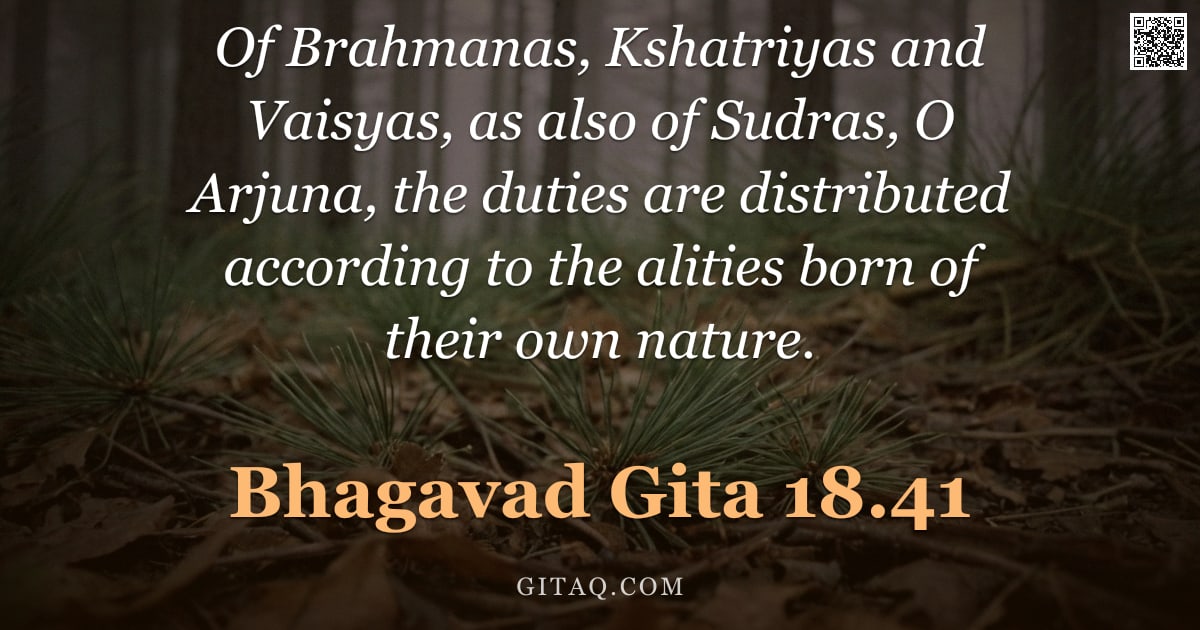
ब्राह्मणक्षत्रियविशां शूद्राणां च परन्तप | कर्माणि प्रविभक्तानि स्वभावप्रभवैर्गुणैः ||१८-४१||
brāhmaṇakṣatriyaviśāṃ śūdrāṇāṃ ca parantapa . karmāṇi pravibhaktāni svabhāvaprabhavairguṇaiḥ ||18-41||
What Does This Verse Mean?
In this verse, Lord Krishna explains to Arjuna that the duties of society are naturally divided among Brahmins (teachers/scholars), Kshatriyas (warriors/rulers), Vaishyas (merchants/farmers), and Shudras (workers) based on their innate qualities. He emphasizes that these roles are not assigned by birth alone but flow from a person's inherent nature, or 'Swabhava,' which is composed of three gunas: goodness, passion, and ignorance. The key teaching is that every individual has unique talents and inclinations, and fulfilling one's own natural duty leads to personal harmony and societal order.
The Teaching Behind It
This teaching belongs primarily to the framework of Sankhya philosophy and Karma Yoga within Vedanta. It develops the concept that 'Swabhava' (one's own nature), formed by the interplay of the three Gunas, dictates one's appropriate action (Svadharma) as a path to spiritual liberation.
Word by Word
Classical Commentary
Where This Happens
This verse appears in Chapter 18 of the Bhagavad Gita during the climax on the battlefield of Kurukshetra, where Lord Krishna is concluding his teachings to Prince Arjuna. At this point, Arjuna has just asked for clarity on whether one should renounce all actions or perform them with detachment; he feels confused about his specific duty as a warrior versus the spiritual path of renunciation. Krishna responds by explaining that true renunciation does not mean abandoning duties, but rather performing them according to one's natural constitution without attachment to the results.
Living It Out Today
Consider a talented software engineer who is naturally drawn to coding and problem-solving but feels pressured by family expectations or societal trends to become a corporate manager. This verse guides that person to recognize their innate nature (Swabhava) and pursue deep technical work rather than forcing themselves into a leadership role where they feel drained, as fulfilling one's true nature leads to greater success and inner peace.
Explained for Children
Imagine a big sports team where everyone plays the position they are naturally best at; some kids are great goalkeepers, others make excellent strikers, and coaches help them find their spot. This verse teaches that just like in a game or a garden with different flowers having different jobs to grow together, people have special talents suited for specific tasks. Krishna is telling Arjuna that you don't need to try being someone else; if you do the job your heart naturally loves and fits best, everyone around you will be happy and safe.
Daily Reflection
You often feel that you must force yourself to fit molds created by others, yet this verse reminds you that your true path begins with who you already are. Your specific talents and temperament are the very tools Krishna has entrusted to you for your own growth and service. When you stop fighting against your nature and start working *with* it, even mundane tasks transform into acts of devotion.
A Practice for Today
Close your eyes and observe how your natural inclinations—whether to lead, serve, create, or support—are not random accidents but the unique design of your soul. Invite these innate qualities into your daily tasks as a sacred offering rather than burdensome obligations.
Key Teachings
- The Divine Architecture of Duty
Dharma is not an arbitrary set of rules imposed from the outside but arises organically from the specific qualities (gunas) inherent in one's nature. Each individual possesses a unique constitution that dictates their natural role within the cosmic order. - Purity Through Authentic Service
Perfection and spiritual liberation are found not by abandoning one's prescribed duties but by performing them with total fidelity to one's own nature. The path of renunciation is actually a higher form of engagement where the ego dissolves in authentic action. - Universal Harmony Through Diversity
Society functions as a harmonious whole only when every individual, regardless of their specific role or class, performs duties aligned with their own intrinsic nature. This diversity of function ensures that the collective needs are met without friction or forced imitation.
Themes
Related Verses
Read This Next
- 2.47 — Read this next for the foundational instruction on performing duty without attachment to results.
- 3.30 — This verse elaborates on surrendering all actions to the Divine, which is essential when acting according to one's nature.
- 12.15 — After understanding your duty, read this to learn how a person who acts without selfish desire becomes dear to Krishna and thus liberated.
Recommended Reading
GitaQ earns from qualifying purchases as an Amazon Associate.