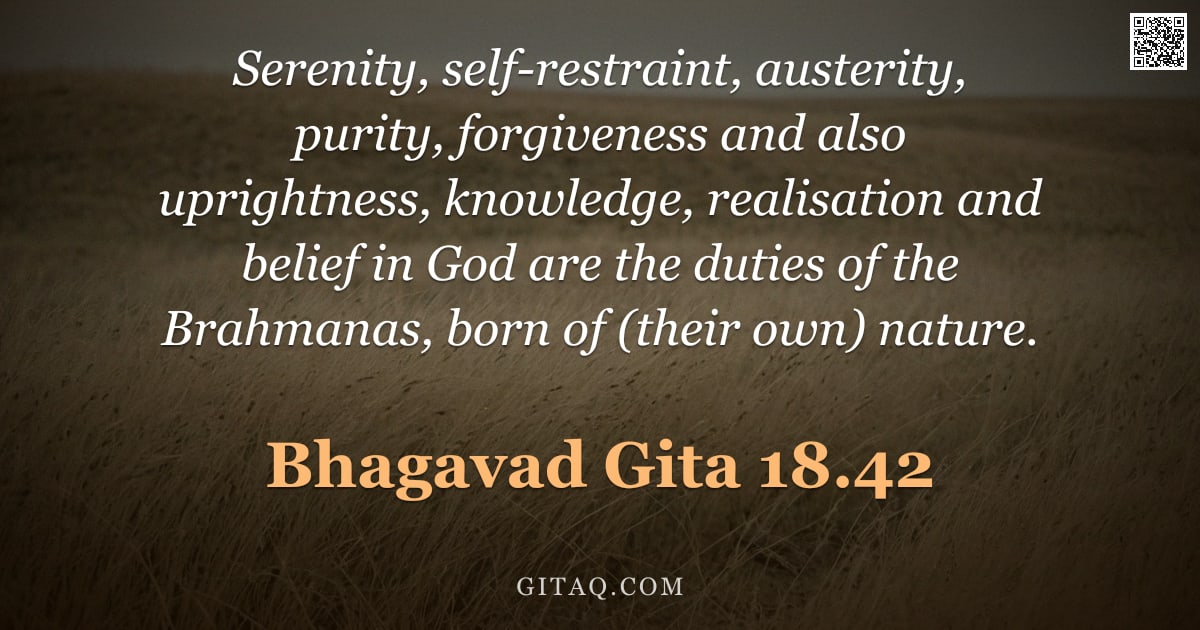
Bhagavad Gita 18.42
Moksha Sanyasa Yoga · English Translation
शमो दमस्तपः शौचं क्षान्तिरार्जवमेव च | ज्ञानं विज्ञानमास्तिक्यं ब्रह्मकर्म स्वभावजम् ||१८-४२||
śamo damastapaḥ śaucaṃ kṣāntirārjavameva ca . jñānaṃ vijñānamāstikyaṃ brahmakarma svabhāvajam ||18-42||
What Does This Verse Mean?
In this verse, Lord Krishna outlines the natural duties specific to Brahmanas (those inclined towards wisdom and teaching) as part of his final instructions on duty in Chapter 18. He lists ten essential qualities: inner peace, self-control, austerity, purity, forgiveness, honesty, knowledge, deep understanding, and faith in the divine. The core teaching is that these virtues are not just rules to follow but intrinsic traits (svabhāvajam) naturally arising from one's own nature when aligned with spiritual wisdom.
The Teaching Behind It
This teaching integrates Karma Yoga (performing one's specific duty without attachment) with Jnana Yoga (gaining knowledge through realization). It emphasizes that true spiritual practice is not about suppressing nature but aligning it with higher virtues, where the soul naturally expresses qualities like serenity and faith as its highest function.
Word by Word
Classical Commentary
Where This Happens
This verse appears in Chapter 18 of the Bhagavad Gita, set on the battlefield of Kurukshetra just before Arjuna agrees to fight. Lord Krishna has already explained various paths to liberation and duties for different groups; here he concludes his discourse by summarizing the specific natural obligations of Brahmanas. Arjuna, who was previously paralyzed by confusion about fighting his kinsmen, is now receiving the final piece of wisdom needed to understand his own duty as a warrior within this broader framework of dharma.
Living It Out Today
If you are feeling overwhelmed at work and tempted to cut corners or lie to meet a deadline, this verse reminds you that 'uprightness' (ārjavam) is your natural strength. Instead of compromising your integrity for short-term gain, choose the path of honesty; it builds trust with colleagues just as purity and serenity clear your mind from anxiety.
Explained for Children
Imagine you have a special job as a 'teacher of kindness' for your family and friends, like the Brahmanas in this story. This verse lists ten superpowers you need: being calm inside, controlling yourself when angry, practicing good habits, staying clean, forgiving others quickly, always telling the truth, learning new things, understanding why we do what we do, and having faith that everything is okay because a loving God is watching over us.
Daily Reflection
You often feel overwhelmed by external chaos, yet this verse reminds you that peace is an internal duty born within you. When you practice self-restraint or forgiveness today, remember you are simply aligning with who you already are meant to be. These qualities like uprightness and knowledge are not things you must acquire from outside; they are the seeds of your own spirit waiting to bloom.
A Practice for Today
Sit quietly and bring your attention to three distinct qualities within yourself today: serenity, self-restraint, and purity. For one minute each, silently affirm that these are not burdensome rules but the natural expression of your truest nature as a seeker.
Key Teachings
- Dharma as Innate Nature
The duties listed here, such as austerity and forgiveness, are described as 'svabhāvajam,' meaning they arise naturally from one's inherent constitution rather than being forced by external command. This teaches that spiritual discipline is most effective when it flows authentically from the self. - The Inner Sanctum of Purity
External rituals are hollow without 'śauca' (purity) and 'jñāna' (knowledge), which represent the cleansing of both body and mind. True service to God begins with a heart that is free from deceit, jealousy, and impure thoughts. - The Architecture of Character
Serenity ('śama') and self-restraint ('dama') form the foundation upon which higher realizations like 'vijñāna' (realized wisdom) are built. Without these stabilizing virtues, intellectual knowledge remains abstract; with them, it becomes a living reality.
Themes
Related Verses
Read This Next
- 2.47 — Read this to understand how performing one's duty without attachment complements the intrinsic duties outlined here.
- 3.30 — This verse expands on offering all actions and their fruits, connecting naturally with the theme of self-restraint and purity.
- 12.15 — Discover how a person who is not agitated by others becomes dear to Krishna, reinforcing the teaching on serenity and uprightness.
Recommended Reading
GitaQ earns from qualifying purchases as an Amazon Associate.