Bhagavad Gita 14.7
Gunatraya Vibhaga Yoga · English Translation
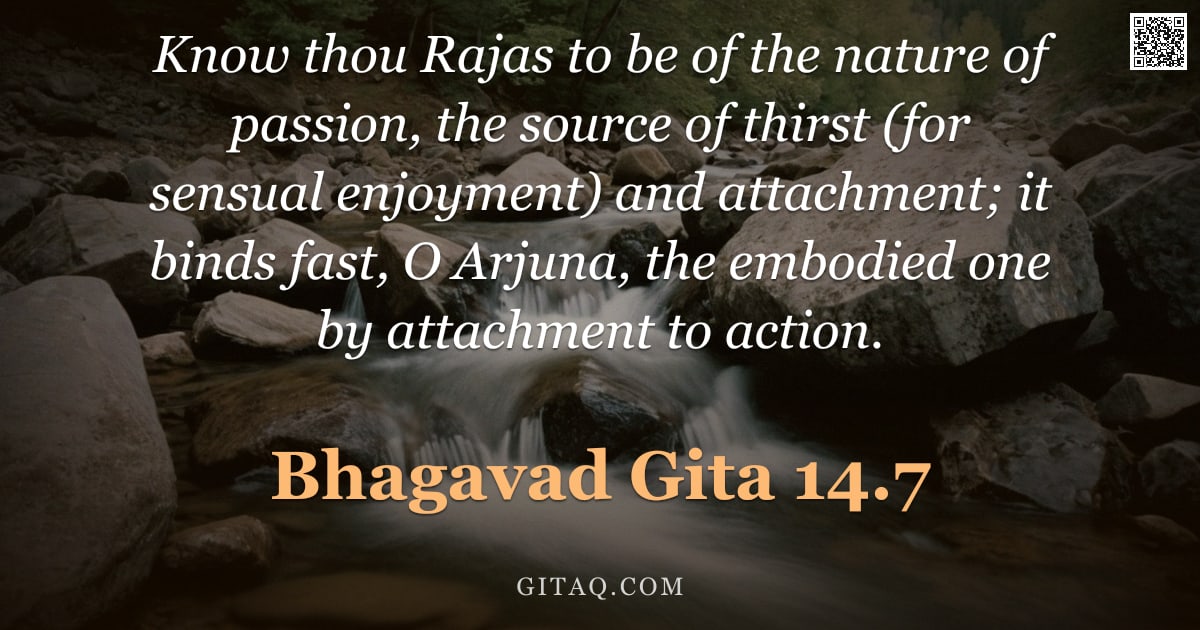
रजो रागात्मकं विद्धि तृष्णासङ्गसमुद्भवम् | तन्निबध्नाति कौन्तेय कर्मसङ्गेन देहिनम् ||१४-७||
rajo rāgātmakaṃ viddhi tṛṣṇāsaṅgasamudbhavam . tannibadhnāti kaunteya karmasaṅgena dehinam ||14-7||
What Does This Verse Mean?
In this verse, Lord Krishna is explaining the nature of Rajas to Arjuna. He describes it as a mode driven by intense desire and attachment that keeps people bound to their actions. Unlike peace or wisdom, passion creates an endless cycle where one acts only for personal gain, leading to restlessness and bondage.
The Teaching Behind It
This verse belongs primarily to Sankhya philosophy as it categorizes the three gunas (modes) that constitute material nature. It also integrates Karma Yoga by identifying 'attachment to action' as the specific mechanism through which Rajas binds the soul, contrasting with selfless service.
Word by Word
Classical Commentary
Where This Happens
This teaching occurs on the battlefield of Kurukshetra during a moment of deep hesitation by Arjuna, who is overwhelmed by grief and confusion about fighting his kin. Krishna has already explained that the soul is eternal but must now address why the mind feels restless even after understanding duty. By addressing Rajas here, Krishna helps Arjuna recognize how his emotional agitation stems from attachment to personal outcomes rather than pure duty.
Living It Out Today
Consider a professional who works late into every night not because they are truly needed there, but due to an insatiable need for promotion or recognition. This 'Rajas' state creates anxiety where their self-worth becomes tied entirely to the next achievement, leading to burnout and poor health. The solution is shifting focus from the result of the work to the integrity of doing one's duty today.
Explained for Children
Imagine you have so much candy in your mouth that you can't stop eating it because you want more; that's like Rajas. It makes us feel like we need to keep playing or winning all the time just to be happy. This constant craving keeps our minds busy and stops us from feeling calm inside.
Daily Reflection
You often find yourself driven by an invisible current that pushes you toward constant activity and immediate gratification; today, pause to see if this is truly necessary or merely a habit of passion. This mode of nature feels like fuel for your ambitions, yet it quietly ties the soul to the cycle of endless striving through attachment to what we do. Notice how easily your sense of peace becomes dependent on external achievements rather than inner stillness.
A Practice for Today
Sit quietly and observe any sudden surge of desire or restlessness within you today, recognizing it not as a command to act, but as the stirring energy of Rajas. Gently acknowledge how this inner fire binds your spirit to specific outcomes, then invite yourself to release the grip on those results while remaining engaged in your duty.
Key Teachings
- The Nature of Rajas
Rajas is defined by intense desire (tṛṣṇā) and attachment, acting as the engine that drives all restless activity in human life. It creates a state where one feels compelled to act not out of duty or wisdom, but from an insatiable thirst for sensory enjoyment. - The Mechanism of Binding
Unlike ignorance which clouds the mind, passion binds by creating a strong attachment (saṅga) to the fruits and processes of action itself. This linkage keeps the embodied soul trapped in a cycle where every effort generates new desires for future rewards. - The Call to Detachment
Recognizing Rajas is the first step toward liberation, as one learns to perform actions without being enslaved by the passion that initiates them. True freedom arises when action continues but the binding attachment to its outcomes dissolves.
Themes
Related Verses
Read This Next
- 2.47 — To understand Krishna's instruction on performing action without attachment to its fruits.
- 3.30 — For the practical application of surrendering all actions to the Divine, countering Rajas-driven egoism.
- 12.15 — To see how a devotee who transcends such modes remains beloved by Krishna and free from agitation.
Recommended Reading
GitaQ earns from qualifying purchases as an Amazon Associate.