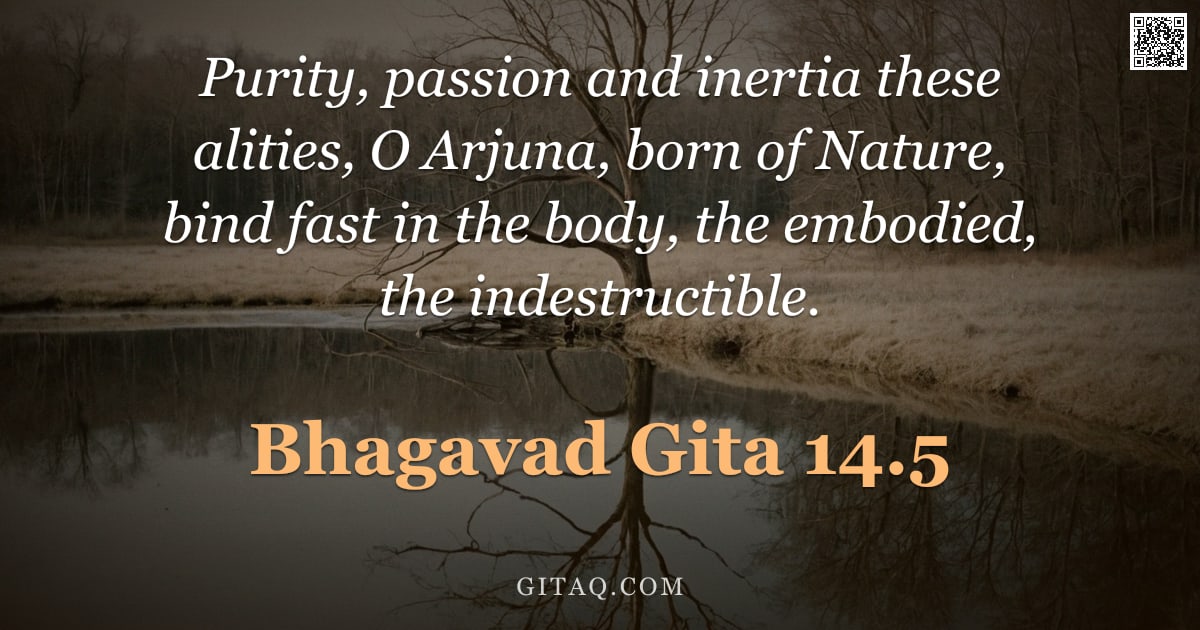
Bhagavad Gita 14.5
Gunatraya Vibhaga Yoga · English Translation
सत्त्वं रजस्तम इति गुणाः प्रकृतिसम्भवाः | निबध्नन्ति महाबाहो देहे देहिनमव्ययम् ||१४-५||
sattvaṃ rajastama iti guṇāḥ prakṛtisambhavāḥ . nibadhnanti mahābāho dehe dehinamavyayam ||14-5||
What Does This Verse Mean?
In this verse, Lord Krishna explains to Arjuna that the three qualities of nature—purity (sattva), passion (rajas), and inertia (tamas)—are responsible for binding the eternal soul to the physical body. These modes are not external forces but arise naturally from Prakriti (material nature) itself. The key teaching is that while we experience these energies in our daily lives, they act as chains keeping us trapped in the cycle of birth and death unless we learn to transcend them.
The Teaching Behind It
This verse is foundational to Sankhya philosophy as integrated into the Gita, specifically detailing how material nature operates through the three gunas. It bridges the concepts of Karma Yoga (action) and Jnana Yoga (knowledge), teaching that true liberation comes from understanding that the soul itself is untouched by these binding qualities. The text develops the critical distinction between the eternal self (atman) and the temporary, ever-changing states of mind created by nature.
Word by Word
Classical Commentary
Where This Happens
This verse appears on the battlefield of Kurukshetra during the Mahabharata war, where Prince Arjuna has just collapsed into a state of moral confusion and grief. Krishna, acting as his charioteer and divine friend, begins to explain the nature of reality after hearing Arjuna's hesitation to fight. The listener is overwhelmed by sorrow and attachment to family members on the opposing side, making him question his duty (dharma). In response, Krishna introduces the Sankhya philosophy of the three gunas to help Arjuna understand that his pain stems from mistaking the temporary body for the eternal soul.
Living It Out Today
Consider a modern scenario where you are working on a high-stakes project and feel paralyzed by indecision. You might be stuck in 'inertia' because the task feels too heavy, or trapped in 'passion' due to an intense fear of failure that clouds your judgment. Krishna's teaching suggests stepping back as an observer: recognize which mode is driving you right now without judging yourself for it. By identifying whether you are acting out of confusion (tamas), ego-driven ambition (rajas), or clarity and calmness (sattva), you can make a choice to detach from the emotional turbulence and act with wisdom rather than reaction.
Explained for Children
Imagine your mind is like a playroom with three different types of toys: bright red ones that make you want to run around (passion), soft blue ones that help you feel calm and happy (purity), and heavy gray stones that make you sleepy and stuck in one spot (inertia). Krishna tells us that even though these toy piles come from the big box of nature, they can sometimes hold our hands so tight we forget to play with them. The lesson is that while it's fun to use all three types of toys, we shouldn't let any single pile trap us; instead, we should learn how to step back and see which one is in charge at any moment.
Daily Reflection
You may feel trapped by your current mood today, as if it defines your entire existence, but remember that this is merely the interplay of purity, passion, or inertia acting upon your body. The indestructible soul within you remains untouched and free from these shifting tides, just as the sky remains clear despite passing clouds. By gently witnessing these states without judgment, you begin to loosen their grip on your spirit.
A Practice for Today
Close your eyes and observe which of the three modes—clarity, activity, or inertia—is currently coloring your thoughts. Acknowledge that these are not who you truly are, but rather temporary guests visiting through nature's play.
Key Teachings
- The Origin of Bondage
All experiences in life stem from the three gunas born of material nature (Prakriti), not from a flaw within you. These modes bind the eternal soul to the temporary body, creating the illusion that we are limited by our physical form. - The Distinction Between Seer and Seen
You must distinguish between the unchanging embodied self (the dehin) and the changing modes of nature acting upon it. Recognizing this separation is the first step toward liberation from worldly entanglements. - The Threefold Nature of Existence
Life operates through sattva (purity), rajas (passion), and tamas (inertia), each binding us in different ways. Understanding these forces allows you to navigate life with greater wisdom rather than being blindly driven by them.
Themes
Related Verses
Read This Next
- 2.47 — This verse establishes right action without attachment to results, a practical antidote to being bound by rajasic passion.
- 3.30 — It teaches the practice of surrendering all actions to the Divine, helping one transcend the binding nature of personal ego and desire.
- 12.15 — This verse describes the qualities of a devotee who is free from agitation and attachment, reflecting the stability of sattva beyond mere mode-based behavior.
Recommended Reading
GitaQ earns from qualifying purchases as an Amazon Associate.