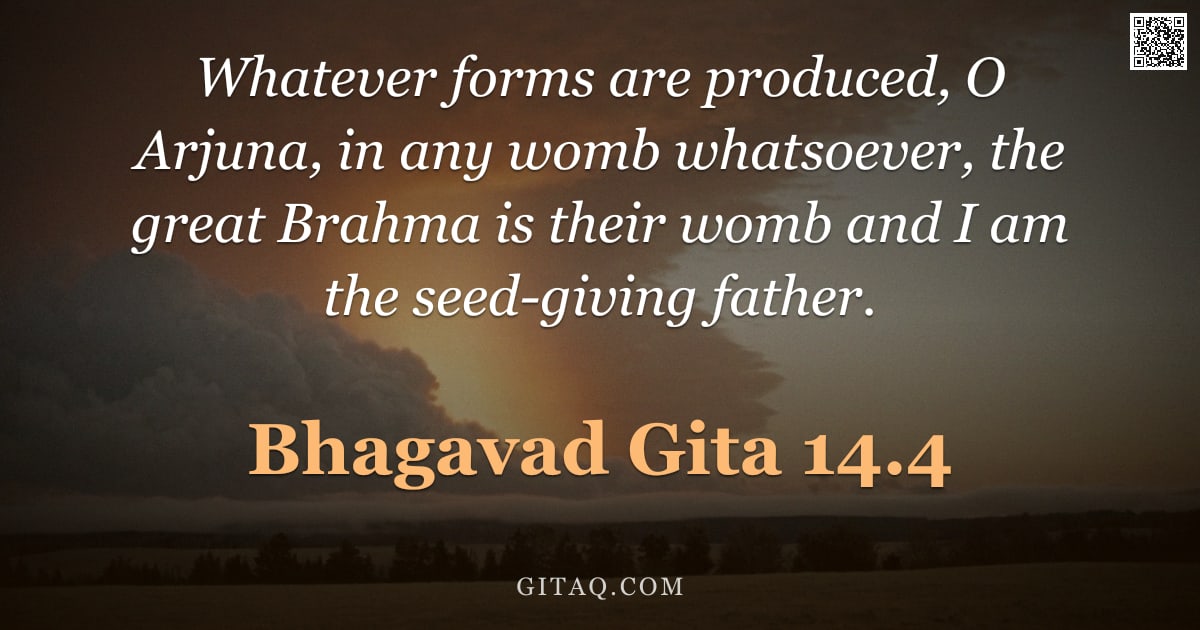
Bhagavad Gita 14.4
Gunatraya Vibhaga Yoga · English Translation
सर्वयोनिषु कौन्तेय मूर्तयः सम्भवन्ति याः | तासां ब्रह्म महद्योनिरहं बीजप्रदः पिता ||१४-४||
sarvayoniṣu kaunteya mūrtayaḥ sambhavanti yāḥ . tāsāṃ brahma mahadyonirahaṃ bījapradaḥ pitā ||14-4||
What Does This Verse Mean?
In this verse, Lord Krishna addresses Arjuna as the son of Kunti to reveal a profound spiritual truth about creation. He explains that while Brahma acts as the womb or matrix where life forms develop, it is Krishna himself who provides the essential seed of consciousness for every living being. The core teaching is that all diverse forms in existence originate from this single divine source, establishing God as both the nurturing environment and the initiating cause of life.
The Teaching Behind It
This verse belongs to Jnana Yoga (the path of knowledge) as it elucidates the fundamental metaphysical relationship between the Supreme Self (Purusha), material nature (Prakriti/Brahma), and individual souls. It develops the Sankhya concept that while matter provides the form, spirit is the active cause of existence, ultimately pointing toward the non-dual reality where all creation emerges from one source.
Word by Word
Classical Commentary
Where This Happens
This verse appears in Chapter 14 of the Bhagavad Gita during the intense dialogue on the battlefield of Kurukshetra. Lord Krishna has just finished explaining how material nature (Prakriti) operates under three modes and is now revealing his supreme role within that system. Arjuna, who was previously filled with confusion about duty and killing relatives, listens as Krishna shifts from discussing ethics to unveiling the metaphysical reality of creation itself.
Living It Out Today
When you feel overwhelmed by a difficult decision at work or family conflict, remember that your anxiety stems from identifying only with the temporary 'womb' circumstances rather than your eternal nature. Instead of getting lost in external pressures which are like the soil changing around you, ground yourself in the awareness of being the conscious seed within, guided by higher wisdom. This shift helps reduce stress and allows you to act with clarity, knowing that every challenge is a unique form developing from a single source.
Explained for Children
Imagine you are planting a garden full of different flowers like roses, sunflowers, and tulips. Brahma is like the rich soil where the seeds grow big and strong, but who gives the tiny seed that starts every single plant? That is God! Just as one gardener holds all the seeds for every flower in the world to help them bloom into unique shapes, Krishna says He is the father giving life's starting point to everything living.
Daily Reflection
Today, try seeing everyone and everything around you not as separate entities but as expressions of the same divine seed planted in the womb of nature. When you encounter someone difficult or a situation that frustrates you, pause to remember that their essential spirit is also cherished by this Father who gives life itself. This shift from judgment to reverence can turn your daily interactions into moments of sacred recognition.
A Practice for Today
Sit quietly and visualize your own existence as emerging from the same divine womb that births all life forms across every species. Feel a deep sense of connection to the Supreme Source, recognizing that just as you are cherished by God, so too is every living being born with equal potential for divinity.
Key Teachings
- The Unity of Origin
All diverse forms, whether human or animal, originate from a single universal matrix known as Mahat-Brahma. This teaches that biological diversity is merely a surface variation masking a profound spiritual unity in origin. - God as the Father of All
The Lord explicitly claims the role of 'seed-giving father,' establishing a personal, paternal relationship with every living entity. This redefines creation not as an impersonal mechanical process but as an intimate act of divine will and love. - Sacredness of Life
Since the Divine seed is present in all wombs, every form of life carries a fragment of that ultimate reality. Recognizing this transforms how we treat other beings, fostering universal compassion rather than hierarchy based on species.
Themes
Related Verses
Read This Next
- 2.47 — To understand how recognizing our shared divine origin leads to performing duty without attachment to results.
- 3.30 — To learn the practical method of surrendering all actions and their fruits back to the Divine Father who sustains us.
- 12.15 — To see how a devotee who recognizes the Lord in all beings becomes dear to God through universal compassion.
Recommended Reading
GitaQ earns from qualifying purchases as an Amazon Associate.