Bhagavad Gita 6.47
Dhyana Yoga · English Translation
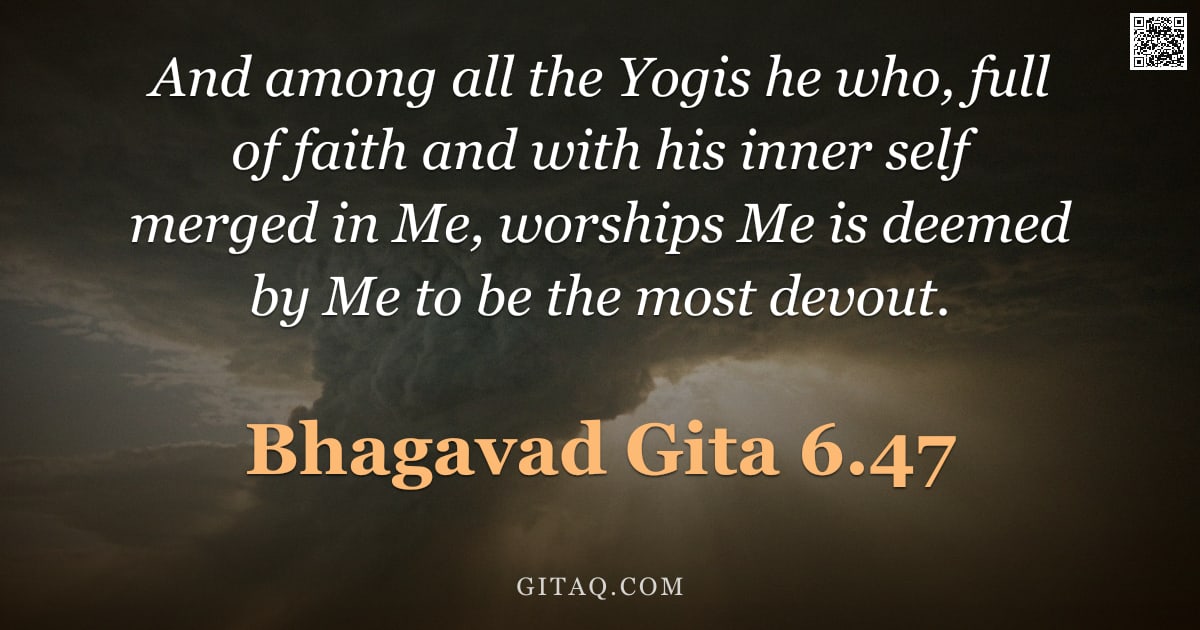
योगिनामपि सर्वेषां मद्गतेनान्तरात्मना | श्रद्धावान्भजते यो मां स मे युक्ततमो मतः ||६-४७||
yogināmapi sarveṣāṃ madgatenāntarātmanā . śraddhāvānbhajate yo māṃ sa me yuktatamo mataḥ ||6-47||
What Does This Verse Mean?
In this verse, Lord Krishna speaks to Arjuna about the hierarchy of spiritual practices found throughout his teachings. He declares that while many paths exist for self-realization and meditation, the person who maintains unwavering faith and keeps their inner consciousness fully merged in God is considered the most perfect yogi. This teaching elevates devotion (Bhakti) as the highest form of yoga because it combines knowledge with deep emotional surrender.
The Teaching Behind It
This verse synthesizes the teachings of Dhyana Yoga (meditation) and Bhakti Yoga (devotion), asserting that true perfection in yoga is achieved when meditation becomes an act of loving surrender. It develops the concept that 'Jnana' (knowledge/merging with the Divine Self) combined with 'Shraddha' (faith) creates the most potent spiritual practice, surpassing mechanical ritual or isolated concentration.
Word by Word
Classical Commentary
Where This Happens
This verse appears in Chapter 6, 'Dhyana Yoga', where Lord Krishna has just finished explaining the difficult steps of meditation (dharana) and concentration (dhyana). Arjuna is listening intently on the battlefield of Kurukshetra after witnessing a divine vision earlier; he now understands that while meditative discipline is powerful, it requires immense effort. In this climactic moment of instruction, Krishna reassures his friend by placing Bhakti Yoga above all other forms of yoga to show him an accessible path to perfection.
Living It Out Today
Consider a professional facing a high-stakes project where the outcome feels uncertain and stress is overwhelming. Instead of trying to force a solution through sheer willpower alone, they dedicate their inner focus and trust in a higher purpose or divine guidance before taking action. By merging their intent with this faith, they find clarity that pure logic cannot provide, allowing them to work with calmness and effectiveness rather than anxiety.
Explained for Children
Imagine you are playing a video game where your goal is to become best friends with the game creator, Krishna. Some players try very hard by just doing puzzles or solving riddles alone (meditation), but they don't always feel close. The player who wins the most points is the one who not only plays well but also trusts their friend completely and talks to them constantly from their heart. Krishna says this trusted friend feels closest to him because of that pure love.
Daily Reflection
You often feel separate from the divine because of the noise in your mind or the chaos around you, but today remember that the most profound worship happens when you simply rest as yourself. When you approach life with unwavering faith and keep your heart anchored inwardly, you discover that you are never truly apart from what you seek to honor. This verse invites you to stop striving for a distant goal and instead recognize that your very presence is an act of devotion.
A Practice for Today
Close your eyes and gently bring awareness to the space within your chest, imagining it as a quiet sanctuary where you are one with the Divine presence. Allow any wandering thoughts to settle like dust in still water until only pure faith remains, affirming that your inner self is already merged in this sacred connection.
Key Teachings
- The Primacy of Faith (Shraddha)
True yoga is not merely physical posture but begins with a deep, unshakeable trust in the Divine and one's own capacity to connect. Without this foundational faith, even complex practices remain superficial, as belief opens the door for grace to enter. - Inner Merging (Antaratman)
The highest form of worship is not found in external rituals but in withdrawing consciousness from the senses to merge with the Divine within. This 'inner self' connection signifies a state where the individual soul recognizes its essential oneness with the Supreme. - The Crowned Yogi (Yuktatamo)
Among all spiritual seekers, Krishna declares that the one who combines faith with inner absorption is supreme in their yoga practice. This teaching elevates the devotee to the highest status not by ascetic feats alone, but through a loving union of will and spirit.
Themes
Related Verses
Read This Next
- 2.47 — To understand the foundation of action without attachment, which clears the mind for this inner merging.
- 6.30 — To see how a yogi who sees God in all beings naturally extends their devotion outward from that internal state.
- 12.20 — Because this verse mirrors 6.47, explicitly confirming that devotees with faith and inner absorption are most dear to Krishna.
Recommended Reading
GitaQ earns from qualifying purchases as an Amazon Associate.