Bhagavad Gita 6.30
Dhyana Yoga · English Translation
यो मां पश्यति सर्वत्र सर्वं च मयि पश्यति | तस्याहं न प्रणश्यामि स च मे न प्रणश्यति ||६-३०||
yo māṃ paśyati sarvatra sarvaṃ ca mayi paśyati . tasyāhaṃ na praṇaśyāmi sa ca me na praṇaśyati ||6-30||
What Does This Verse Mean?
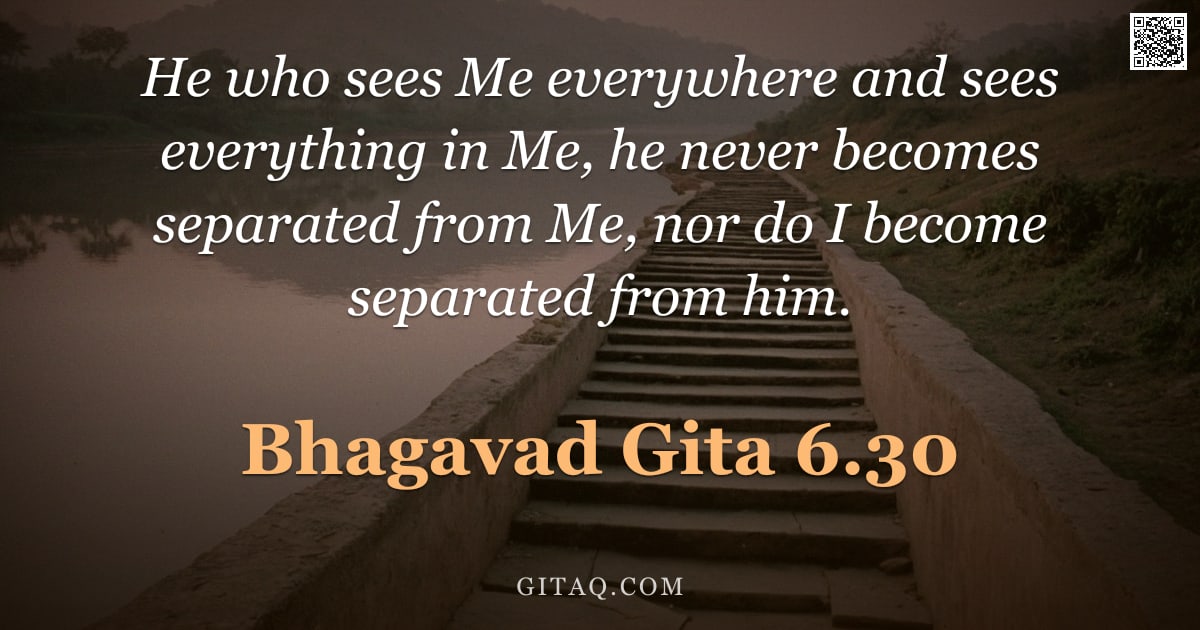
In this verse, Lord Krishna tells Arjuna that a person who perceives the Divine presence in every living being and sees all creation existing within God has achieved true unity with the Creator. This vision of oneness ensures that neither the devotee nor God ever becomes separated from one another. It is the core promise that spiritual realization leads to an eternal, unbreakable bond between the individual soul and the Supreme Soul.
The Teaching Behind It
This verse sits at the intersection of Bhakti Yoga (devotion) and Jnana Yoga (knowledge), culminating the teachings of Dhyana Yoga. It develops the concept of 'Vasudhaiva Kutumbakam' (the world is one family) by asserting that true knowledge involves seeing the One Reality behind all multiplicity, thereby erasing the sense of separation between the devotee and the Divine.
Word by Word
Classical Commentary
Where This Happens
This verse occurs during the intense battle of Kurukshetra on the battlefield where Prince Arjuna has just laid down his weapons, paralyzed by grief and moral confusion. Krishna is speaking to a despondent Arjuna after having explained the nature of the self (Atman) and the temporary reality of the physical world in Chapter 2. Having established that the soul is eternal, Krishna now guides Arjuna toward Dhyana Yoga (meditation), describing the ultimate state where the warrior sees the Divine not as a distant ruler but as the very essence within himself.
Living It Out Today
When facing a high-stakes business decision or a family conflict, instead of viewing others solely as competitors or obstacles to your success, try to see them as partners sharing in the same struggle and potential for growth. This shift from 'me versus you' to 'us together under a shared purpose' dissolves anxiety and fosters collaboration rather than defensiveness. By acting with this awareness that everyone's well-being is interconnected with yours, you make decisions rooted in empathy, ensuring your actions lead to sustainable harmony.
Explained for Children
Imagine you are wearing a pair of magical glasses that let you see how much everyone loves each other and how we all share the same heart inside us all. When you look at your friends, your toys, or even strangers and realize they are part of one big family connected by love, you never feel alone again. Krishna is saying that when you truly understand this connection with God in everything around you, God will always be right there holding your hand.
Daily Reflection
In moments when the world feels vast or isolating, remember that your separation is an illusion born of limited sight rather than reality. When you begin to see the Divine in others as clearly as in yourself, the heavy burden of loneliness dissolves into a shared existence. You are never truly apart from the Source, just as the ocean water never separates itself from the sea it belongs to.
A Practice for Today
Close your eyes and gently shift your gaze from the objects around you to the awareness witnessing them, recognizing that same presence as the Divine within all things. Visualize a single thread of consciousness connecting every face, tree, and star back to the source you seek.
Key Teachings
- The Vision of Unity
True vision transcends physical sight to perceive the singular Divine essence underlying all diverse forms. This shift in perception transforms the universe from a collection of separate objects into a unified manifestation of God. - Mutual Inseparability
The relationship between the devotee and the Divine is reciprocal; where one exists, both must be present. This mutual indwelling ensures that spiritual realization guarantees eternal connection rather than transient experience. - Action through Oneness
Seeing everything in God naturally leads to selfless action performed for the welfare of all beings. The devotee acts not from personal desire but as an instrument of that universal presence seen within every circumstance.
Themes
Related Verses
Read This Next
- 2.47 — Foundational context on performing duty without attachment before attempting this vision of unity.
- 3.30 — Practical instruction on how to offer all actions as a sacrifice, maintaining that connection in daily life.
- 12.15 — Describes the qualities of one who is dear to Krishna, complementing the state of mutual inseparability described here.
Recommended Reading
GitaQ earns from qualifying purchases as an Amazon Associate.