Bhagavad Gita 10.20
Vibhuti Yoga · English Translation
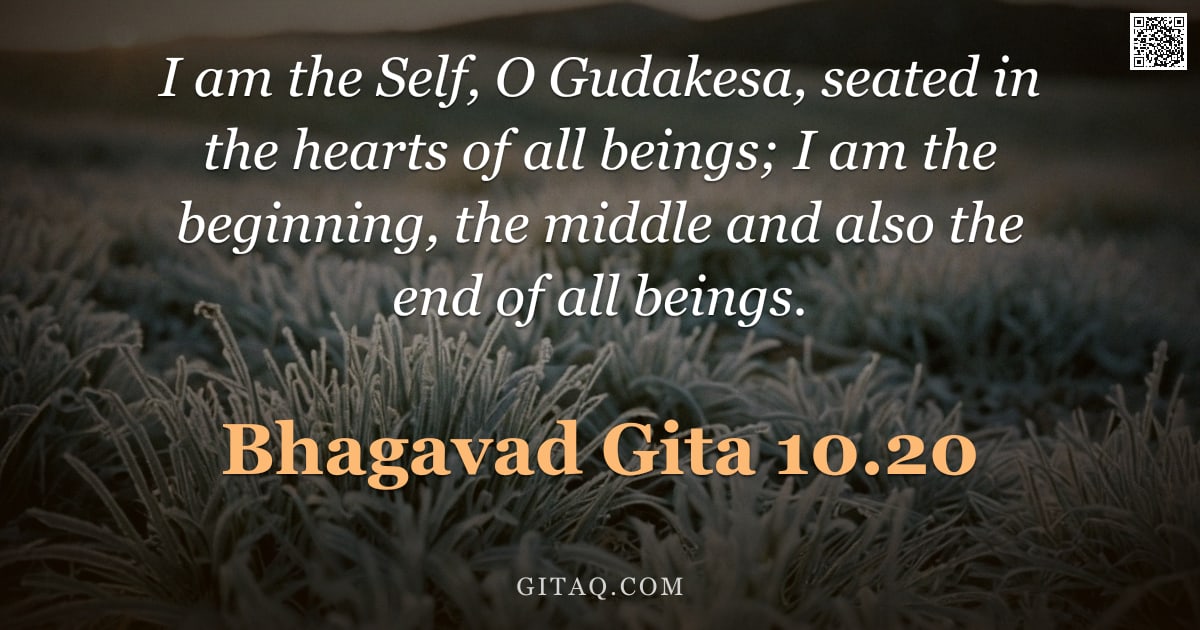
अहमात्मा गुडाकेश सर्वभूताशयस्थितः | अहमादिश्च मध्यं च भूतानामन्त एव च ||१०-२०||
ahamātmā guḍākeśa sarvabhūtāśayasthitaḥ . ahamādiśca madhyaṃ ca bhūtānāmanta eva ca ||10-20||
What Does This Verse Mean?
In this verse, Lord Krishna speaks to Arjuna (called Gudakesa), explaining that He is the innermost essence of every living being and exists within their hearts as the true Self. Beyond just being inside us now, Krishna reveals Himself as the beginning, middle, and end of all creation, indicating His presence in everything from birth to death. The key teaching is that there is no separation between the divine and any individual; God is not distant but intimately present as the source and sustainer of life itself.
The Teaching Behind It
This verse belongs primarily to Jnana Yoga (the path of knowledge) while deeply supporting Bhakti Yoga (devotion), as it establishes the non-dualistic concept that the individual soul and the Supreme Self are fundamentally one. It develops the core Vedantic teaching of 'Sarvabhuta-Atmatva', asserting that God is not a distant ruler but the immanent substratum ('Ashaya') in which all existence rests.
Word by Word
Classical Commentary
Where This Happens
This verse appears in Chapter 10 of the Bhagavad Gita during a critical moment on the battlefield of Kurukshetra where Arjuna has just hesitated to fight. Krishna is shifting from describing specific cosmic forms (Vibhutis) like the sun, moon, and mountains to revealing His universal nature as the underlying reality of all things. Arjuna, overwhelmed by confusion about his duty against relatives, is being gently guided toward a realization that if God resides in everyone's heart, then fighting for righteousness is aligned with divine will.
Living It Out Today
When you are facing an impossible decision at work or family conflict where every option seems flawed, remember that the same consciousness driving your thoughts also drives the person opposing you. Instead of viewing them as a separate enemy to defeat, recognize their inner self (Atman) is one with yours, which can shift your approach from aggression to understanding and collaboration. This perspective reduces anxiety by reminding you that no matter how complex the situation or where it began or ends, there is a unifying purpose behind all events.
Explained for Children
Imagine you are playing with a huge pile of different toys—cars, dolls, blocks—but hidden inside every single one is your favorite special friend. Krishna says He is like that special friend who lives inside all people, animals, trees, and even the stars! Just as he helps start a game, plays through the middle until it gets boring, and then knows exactly when to clean up, God starts our life, stays with us while we grow, and welcomes us home at the very end.
Daily Reflection
You often feel like an isolated traveler on a long journey, yet Krishna reminds you that He is the very thread stitching your past, present, and future together. This truth means you are never truly alone; even in moments of silence or struggle, you are held by the same energy that began creation and will welcome it back at its end. Allow this realization to soften your anxiety about what lies ahead, for if He is the beginning and the middle, He is also the ultimate resolution.
A Practice for Today
Close your eyes and gently turn your awareness inward to the quiet space within your heart, recognizing it as a sanctuary where the Divine resides alongside you. Visualize this same radiant presence not only in yourself but extending outward as the source of life for every being around you.
Key Teachings
- The Indwelling Witness
Krishna reveals that the Self (Atman) is not an external deity to be sought in distant temples but dwells intimately within the heart of every creature. This teaching shifts our focus from worshiping a remote god to recognizing the sacred presence already active inside us. - The Temporal Cycle
By declaring Himself as both the beginning and the end, the Lord illustrates His role as the sole sustainer of time itself. Nothing exists outside His influence, meaning our origins are divine and our destination is secure within Him. - Non-Dual Presence
The verse dissolves the illusion that separation between the creator and creation is absolute or permanent. Recognizing this unity allows a seeker to see the same light in everyone, fostering deep compassion for all life forms.
Themes
Related Verses
Read This Next
- 2.47 — This verse on duty without attachment complements the realization of the indwelling Self by teaching how to act while remaining rooted in that inner truth.
- 3.30 — Following this, you will learn the practical application of surrendering all actions and their fruits back to God as an offering.
- 12.15 — This later verse describes the qualities of a devotee who has realized Krishna's presence in all beings, showing the natural outcome of this understanding.
Recommended Reading
GitaQ earns from qualifying purchases as an Amazon Associate.