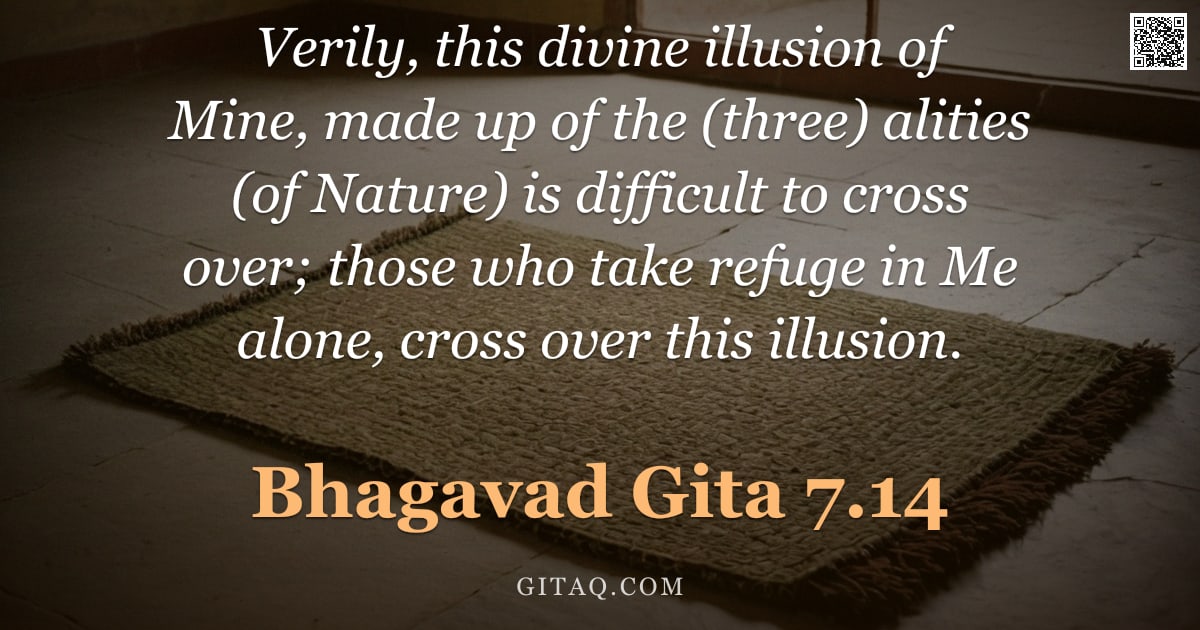
Bhagavad Gita 7.14
Jnana Vijnana Yoga · English Translation
दैवी ह्येषा गुणमयी मम माया दुरत्यया | मामेव ये प्रपद्यन्ते मायामेतां तरन्ति ते ||७-१४||
daivī hyeṣā guṇamayī mama māyā duratyayā . māmeva ye prapadyante māyāmetāṃ taranti te ||7-14||
What Does This Verse Mean?
In this verse, Lord Krishna explains to Arjuna that the material world is governed by a powerful divine illusion called 'Maya,' which binds beings through the three modes of nature (goodness, passion, and ignorance). He states clearly that while this illusion is extremely difficult to overcome on one's own, those who surrender completely to Him are able to transcend it. The core teaching emphasizes that self-effort alone has limits, but divine grace accessed through total devotion can break these bonds.
The Teaching Behind It
This verse is central to Bhakti Yoga within the framework of Jnana Vijnana Yoga, bridging the gap between intellectual knowledge and practical liberation. It develops the concept that true wisdom (Vijnana) requires not just understanding Maya but also surrendering to the Divine Personality who controls it.
Word by Word
Classical Commentary
Where This Happens
This verse appears in Chapter 7 during Krishna's discourse to Arjuna on the battlefield of Kurukshetra, just after describing his divine energies. At this point, Arjuna has listened to Krishna explain how he pervades everything through these three gunas (modes) and is now seeking clarity on how to actually escape their grip. The listener, a warrior prince paralyzed by confusion about duty and the nature of reality, feels overwhelmed by the complexity of existence that Krishna has just revealed.
Living It Out Today
Consider a professional facing burnout or a sudden career crisis where every strategy seems to fail despite hard work; this feeling is akin to being stuck in 'Maya' where logic alone cannot provide an exit. Instead of spiraling into anxiety, the practical application here suggests surrendering one's ego and rigid plans to a higher purpose or trusted guidance (prayer, meditation, or ethical alignment). By shifting focus from controlling every outcome to maintaining faith while acting with integrity, the individual finds the mental clarity needed to navigate the situation effectively.
Explained for Children
Imagine you are wearing a pair of glasses that makes the whole world look scary and confusing; this is like our minds being trapped in an illusion called Maya. Krishna tells Arjuna that trying to take off those special glasses by yourself is very hard because your hands keep slipping, but if you let someone who can see clearly help you, they can guide you out of it. The lesson is simple: when we feel lost or scared, asking for help from a loving source like God makes the scary world become clear and safe again.
Daily Reflection
You may feel overwhelmed by the shifting tides of emotions and circumstances that seem impossible to navigate on your own. Remember that these difficulties are not random obstacles but a divine play designed for your growth when approached with surrender rather than resistance. When you stop trying to fight this illusion alone and instead place your trust in the Divine, you discover an inner strength that allows you to transcend even the toughest situations.
A Practice for Today
Sit quietly and acknowledge that every challenge you face today carries the quality of divine illusion, a force designed to obscure your true nature. Silently invite Krishna into this moment as your sole refuge, offering him your confusion so he can guide you through it.
Key Teachings
- The Nature of Māyā
This verse reveals that the world's complexity is not a trap set by enemies but 'Māyā,' a divine energy composed of the three gunas. It functions as a veil that keeps us entangled in duality, making it appear difficult to cross without spiritual aid. - The Difficulty of Crossing
Krishna explicitly states that this illusion is 'duratyayā,' or hard to overcome through mere intellectual effort or willpower. This acknowledges the profound depth of our conditioning and the necessity for a spiritual breakthrough rather than superficial fixes. - The Path of Surrender
Liberation is found not in escaping the world but in taking refuge exclusively in the Divine through devotion. When we surrender to Krishna, He becomes the bridge that allows us to cross over this illusion and realize our true self.
Themes
Related Verses
Read This Next
- 2.47 — Read this next to understand how Krishna advises performing duty without attachment while navigating the world.
- 3.30 — This verse offers practical instructions on surrendering all actions and their fruits, which is essential for crossing Māyā.
- 12.15 — Read this to see how devotion (Bhakti) transforms the practitioner into a beloved of Krishna who effortlessly transcends worldly difficulties.
Recommended Reading
GitaQ earns from qualifying purchases as an Amazon Associate.