Bhagavad Gita 7.1
Jnana Vijnana Yoga · English Translation
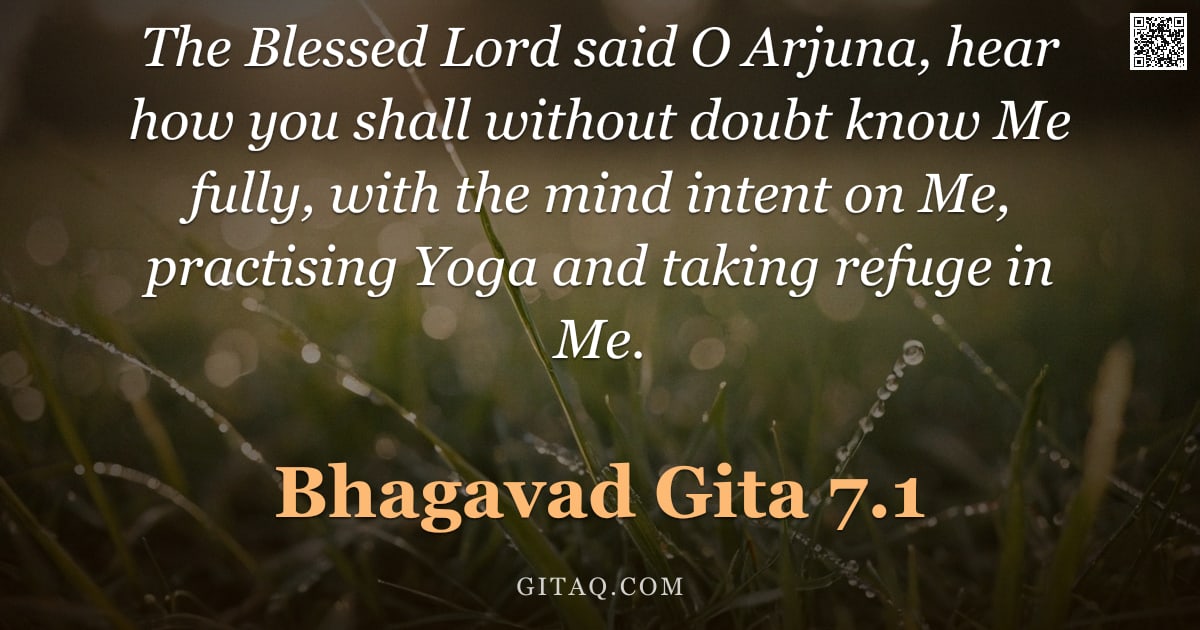
श्रीभगवानुवाच | मय्यासक्तमनाः पार्थ योगं युञ्जन्मदाश्रयः | असंशयं समग्रं मां यथा ज्ञास्यसि तच्छृणु ||७-१||
śrībhagavānuvāca . mayyāsaktamanāḥ pārtha yogaṃ yuñjanmadāśrayaḥ . asaṃśayaṃ samagraṃ māṃ yathā jñāsyasi tacchṛṇu ||7-1||
What Does This Verse Mean?
In this verse, Lord Krishna addresses Arjuna to offer a promise of complete clarity about the Divine nature. He states that if one fixes their mind on Him with total devotion and takes refuge in His guidance while practicing spiritual discipline, they will understand God fully without any doubt or confusion. The key teaching is that unwavering focus combined with surrender leads to perfect knowledge of the Ultimate Reality.
The Teaching Behind It
This verse sits at the intersection of Bhakti Yoga and Jnana Yoga within Vedanta philosophy. It teaches that true knowledge (Jnana) of the Divine is not merely intellectual but is achieved through loving surrender (Bhakti) and single-pointed meditation, suggesting that devotion and wisdom are two sides of the same coin.
Word by Word
Classical Commentary
Where This Happens
This verse opens Chapter 7 of the Bhagavad Gita, taking place on the battlefield of Kurukshetra during a momentary pause after Arjuna's initial despair. Just before this, Krishna had explained the difference between matter and spirit (Chapters 2-6), but Arjuna still felt overwhelmed by the complexity of duty versus family bonds. Now that Arjuna is receptive, Krishna shifts from explaining abstract philosophy to offering a direct path for personal realization.
Living It Out Today
When facing an overwhelming career crisis or making a life-altering decision where every option seems fraught with risk, instead of spiraling into anxiety, one should take a moment to 'take refuge' in their core values and higher purpose. By consciously directing all mental energy toward that guiding principle (mind intent) rather than scattering attention on fears or external opinions, clarity naturally emerges. This approach transforms the paralysis of indecision into confident action based on inner wisdom.
Explained for Children
Imagine you are trying to find a hidden treasure map, but it's very foggy and confusing. Krishna tells Arjuna: 'If you hold my hand tight (take refuge), look only at me while we walk together (mind intent on Me), and keep walking the right path (practising Yoga), then suddenly the fog will clear! You won't just guess where the treasure is; you will see it clearly in your heart without any worries.'
Daily Reflection
Today, notice how often your attention drifts away from what truly matters to chasing fleeting distractions. Krishna invites you not just to know Him intellectually, but to anchor your heart in a relationship where He becomes the very ground of your existence. When you practice this surrender with genuine feeling, even small challenges transform into moments of deep connection rather than obstacles.
A Practice for Today
Sit quietly and gently bring your awareness to the space between thoughts, visualizing it as a vessel where you place every worry and desire before the Divine presence within. As you breathe in, silently affirm that your mind is now resting fully on this source of peace, letting go of all need for control or separate achievement.
Key Teachings
- The Power of Mental Anchoring
True knowledge begins when the mind ceases to wander and becomes firmly fixed on the Divine as its sole object. This unwavering focus is not a forceful suppression, but a natural settling that occurs through sincere devotion. - Yoga as Active Surrender
The verse defines Yoga here as the active discipline of uniting one's will with God's while simultaneously taking refuge in His grace. It is a dynamic practice where action and surrender become two sides of the same spiritual coin. - Certainty Through Intimacy
Full knowledge of the Divine removes all doubt because it comes from direct, personal experience rather than second-hand theory. When one takes refuge in God with an attached heart, the truth reveals itself as self-evident and complete.
Themes
Related Verses
Read This Next
- 2.47 — This verse establishes the foundational principle of performing duty without attachment, which prepares the ground for taking full refuge.
- 3.30 — It expands on the act of surrendering all actions to God, deepening the theme of madāśrayaḥ (taking refuge in Me).
- 12.15 — This verse describes the qualities of a devotee who has successfully attained this state of being fully known and knowing God.
Recommended Reading
GitaQ earns from qualifying purchases as an Amazon Associate.