Bhagavad Gita 9.13
Raja Vidya Raja Guhya Yoga · English Translation
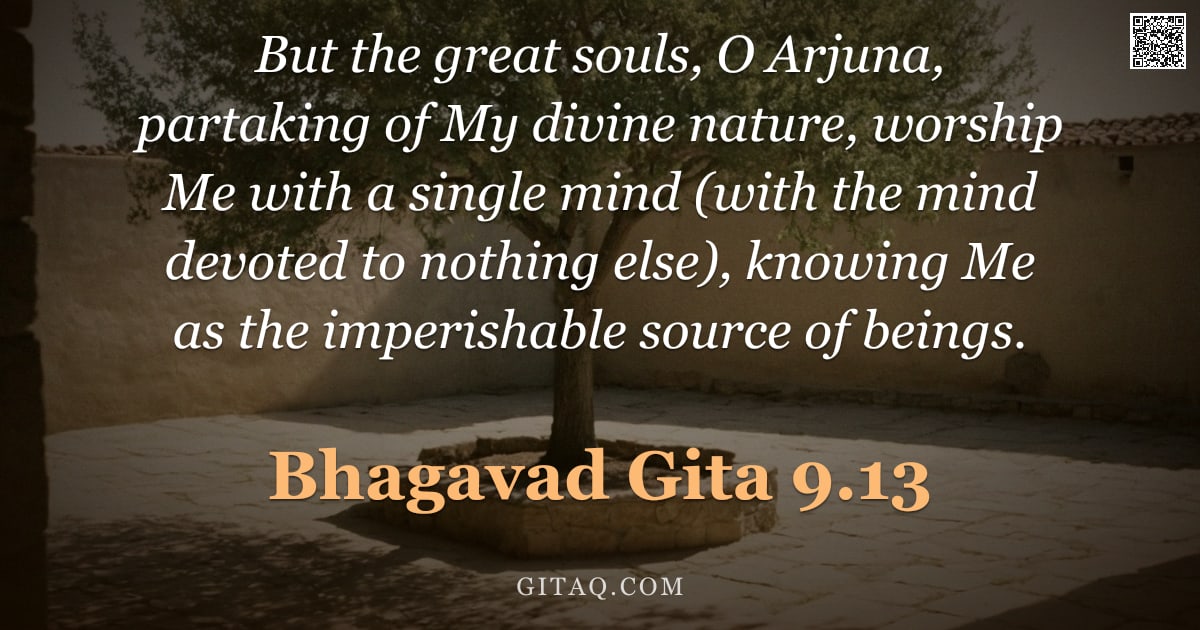
महात्मानस्तु मां पार्थ दैवीं प्रकृतिमाश्रिताः | भजन्त्यनन्यमनसो ज्ञात्वा भूतादिमव्ययम् ||९-१३||
mahātmānastu māṃ pārtha daivīṃ prakṛtimāśritāḥ . bhajantyananyamanaso jñātvā bhūtādimavyayam ||9-13||
What Does This Verse Mean?
In this verse, Lord Krishna tells Arjuna that the truly great souls (mahātmās) are those who take refuge in His divine nature and worship Him with a single-pointed mind. These individuals have realized that Krishna is the imperishable source from which all beings originate and to whom they will return. Unlike others who may be distracted by worldly desires, these devotees focus their entire consciousness on the Divine without seeking anything else.
The Teaching Behind It
This verse sits at the intersection of Bhakti Yoga (devotion) and Jnana Yoga (knowledge), illustrating how true devotion arises from spiritual wisdom. It develops the concept that realizing God as the 'avyayam' (imperishable source) naturally leads to an 'ananyamanasah' (single-pointed mind), where knowledge transforms into unwavering love.
Word by Word
Classical Commentary
Where This Happens
This verse occurs during Lord Krishna's discourse with Prince Arjuna on the battlefield of Kurukshetra, where Arjuna is overwhelmed by doubt and grief at having to fight his own relatives. Having revealed His cosmic form (Vishwaroopam) in Chapter 11, which caused Arjuna fear, Krishna now begins to offer comfort through 'Raja Vidya' or the King of Knowledge. He speaks this verse after describing how those who are not devoted fall into darkness; here he contrasts them with the noble souls who remain steady and joyful despite the chaos of war.
Living It Out Today
Consider a professional facing a high-stakes merger decision that causes immense anxiety about failure. Instead of letting fear paralyze them or causing their mind to jump between 'what-ifs' (loss, reputation, income), they adopt an attitude of surrendering the outcome to a higher purpose while focusing entirely on doing the right action with integrity today. By anchoring their identity in something stable and larger than immediate results—like service to truth—they find clarity that allows them to execute difficult tasks without being consumed by stress.
Explained for Children
Imagine you are looking for a lost toy in your room. You might look under one chair or behind some books, but if someone told you exactly where it is—a special treasure chest that never loses things—you would run straight there and not get distracted by toys on the floor anymore. Krishna says that great people are like those who know He is that safe, perfect place for everyone to return to. They don't worry about other games; they just trust Him completely because they know He created everything.
Daily Reflection
Today, pause to consider how often your mind chases the temporary rather than resting in the imperishable reality of God's presence. You are invited to see yourself not as a seeker separate from the divine, but as partaking in that very divine nature already within you. When anxiety arises, remember that by holding an undivided heart towards this source, you discover the peace that transcends all change.
A Practice for Today
Close your eyes and recall a moment when you felt truly connected to the divine; anchor yourself in that feeling of safety and wholeness. Remind yourself just as this verse teaches, that your true nature is already aligned with this eternal source, allowing all scattered thoughts to settle into one-pointed devotion.
Key Teachings
- The Identity of the Great Soul
A 'mahatma' is defined not merely by moral goodness but by recognizing their own divine essence and taking refuge in God's eternal power. This recognition transforms one's life from a struggle against nature to a joyful participation in it. - The Power of Undivided Mind
True worship requires an 'ananya-manas' or single-pointed focus where the heart is devoted exclusively to the Divine without distraction. This singularity of intent acts as a powerful filter, removing the noise that obscures our spiritual vision. - God as the Imperishable Source
The devotee worships knowing Krishna as 'bhūtādim avyayam,' the unchanging origin from which all beings emerge and into which they return. This knowledge of God's permanence provides an anchor that stabilizes the soul amidst a world in constant flux.
Themes
Related Verses
Read This Next
- 2.47 — Read this next to understand how Krishna defines true yoga and action without attachment to results.
- 3.30 — This verse complements the theme of surrender by instructing one to dedicate all actions completely to God.
- 12.15 — Read this final selection to see how Krishna describes the qualities of a devotee who is dear to Him and established in His nature.
Recommended Reading
GitaQ earns from qualifying purchases as an Amazon Associate.