Bhagavad Gita 4.33
Jnana Karma Sanyasa Yoga · English Translation
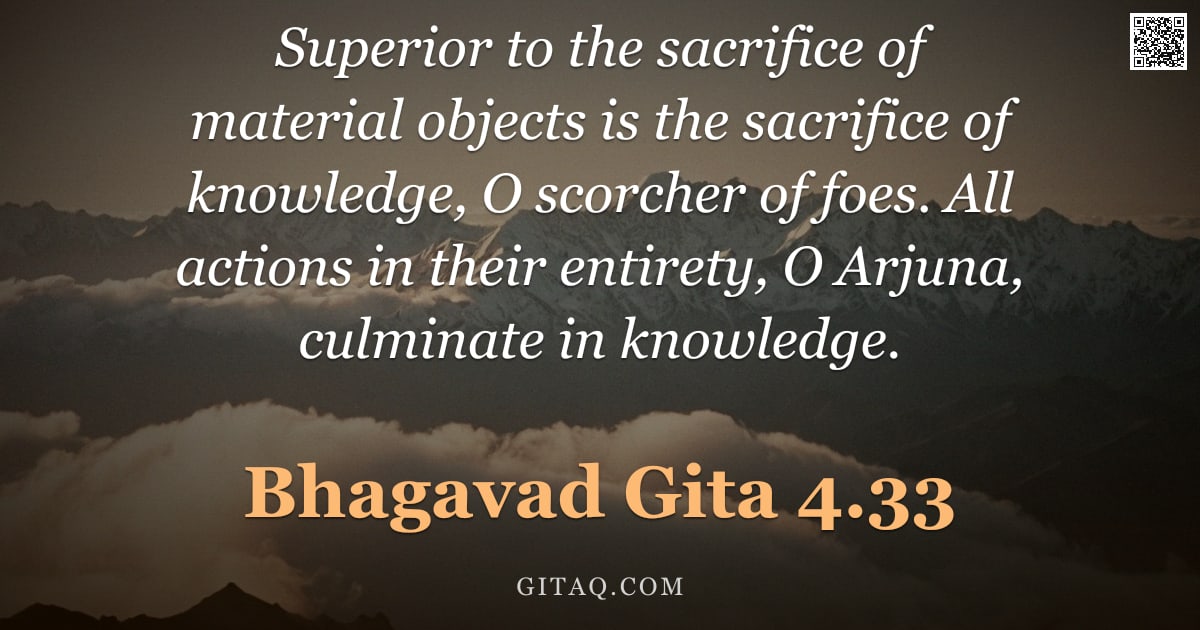
श्रेयान्द्रव्यमयाद्यज्ञाज्ज्ञानयज्ञः परन्तप | सर्वं कर्माखिलं पार्थ ज्ञाने परिसमाप्यते ||४-३३||
śreyāndravyamayādyajñājjñānayajñaḥ parantapa . sarvaṃ karmākhilaṃ pārtha jñāne parisamāpyate ||4-33||
What Does This Verse Mean?
In this verse, Lord Krishna tells Arjuna that the sacrifice of knowledge (Jnana Yajna) is far superior to any material ritual or offering made with physical objects. He explains that when one truly understands the nature of reality through wisdom, all actions and their accumulated effects are completely resolved in that state of knowing. The core teaching is that intellectual realization transcends external ceremonies as the ultimate means to spiritual freedom.
The Teaching Behind It
This verse belongs primarily to the Jnana Yoga (path of knowledge) strand of Vedanta, which asserts that wisdom is the highest form of purification. It develops the concept that while Karma Yajna (ritual action) purifies the mind, only Jnana (direct realization of the Self) can completely burn up all past karma and lead to liberation.
Word by Word
Classical Commentary
Where This Happens
This verse occurs on the battlefield of Kurukshetra during a critical moment where Lord Krishna has just finished explaining various forms of sacrifice and spiritual discipline to Arjuna. The warrior prince, overwhelmed by his duty to fight his own kin, was seeking clarity on which path would yield the greatest benefit for humanity. As the conversation deepens from external rituals to internal transformation, Krishna emphasizes that true knowledge is the final destination where all actions find their resolution.
Living It Out Today
Consider a professional who has spent years trying to 'fix' a workplace conflict through endless meetings and apologies (material sacrifice) without success; they are stuck in anxiety. By applying this verse's teaching, the individual shifts focus from external fixes to deep self-inquiry: understanding that their fear of judgment is an illusion rooted in false identification with the ego. This shift in perspective dissolves the tension naturally, allowing them to act with clarity and compassion rather than reactive defense.
Explained for Children
Imagine you have a pile of messy toys (all your worries and past mistakes), but instead of cleaning them up one by one, you find a magic switch that makes everything disappear instantly because it was all just an illusion. Lord Krishna is telling Arjuna that learning the truth about who we really are is like finding that magic switch; it clears away every single problem better than doing any number of physical chores or special ceremonies.
Daily Reflection
Today, try shifting your focus from the physical act of doing something to the spiritual clarity with which you do it. You might find that when you offer your work as an offering of knowledge rather than just a chore for results, the burden of 'karma' simply vanishes. This transformation happens not by stopping action, but by letting wisdom illuminate every step you take.
A Practice for Today
Close your eyes and visualize all your daily tasks, from the mundane to the profound, dissolving into a single stream of conscious awareness. Rest in the knowing that this inner fire of wisdom is what truly consumes every action you perform.
Key Teachings
- The Superiority of Knowledge
While material sacrifices have value, the sacrifice performed through spiritual knowledge is far superior and leads to ultimate liberation. This teaching establishes that intellectual realization is not just an alternative path but the highest form of worship. - Transformation Through Fire
Just as a blazing fire reduces wood to ash, the fire of wisdom reduces all accumulated karma to nothingness. It implies that action performed with full awareness leaves no binding residue for the future. - Completion in Consciousness
The verse teaches that every worldly activity finds its true conclusion and fulfillment only when immersed in divine knowledge. Without this consciousness, actions remain incomplete cycles of cause and effect; with it, they become a unified offering to the Divine.
Themes
Related Verses
Read This Next
- 4.19 — To understand who qualifies as a 'sage' when their actions are already burned up by knowledge.
- 5.23 — To learn how to maintain inner peace and equanimity while engaging in action, the state described here.
- 7.19 — To see the result of this knowledge: a devotee who has come to know the Supreme Person after many births.
Recommended Reading
GitaQ earns from qualifying purchases as an Amazon Associate.