Bhagavad Gita 4.32
Jnana Karma Sanyasa Yoga · English Translation
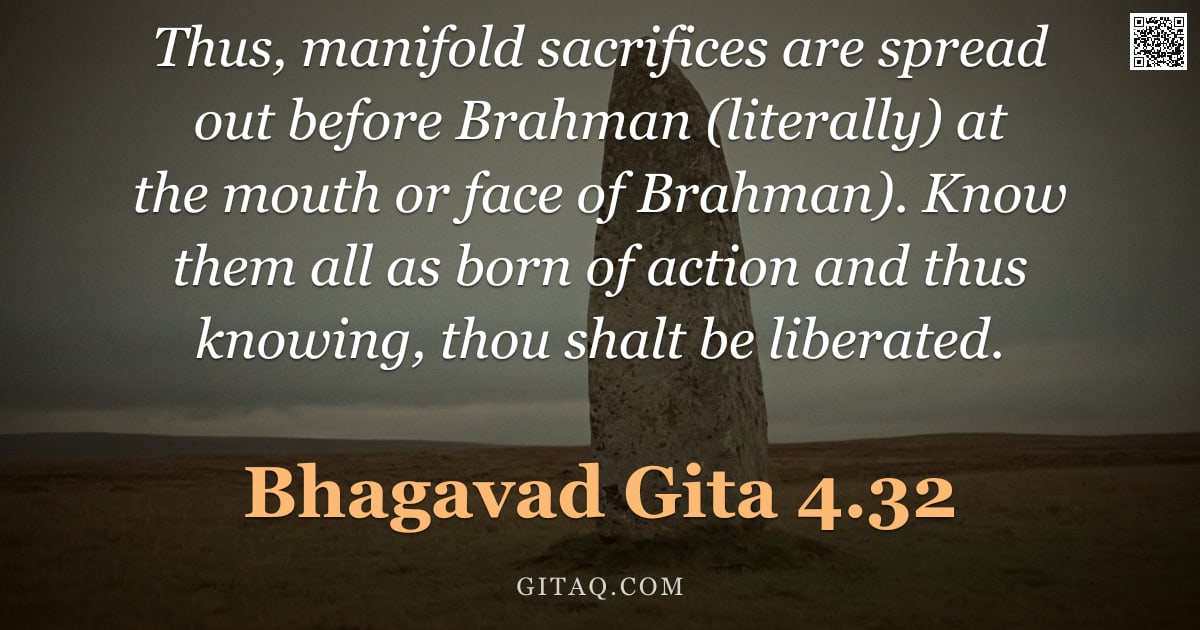
एवं बहुविधा यज्ञा वितता ब्रह्मणो मुखे | कर्मजान्विद्धि तान्सर्वानेवं ज्ञात्वा विमोक्ष्यसे ||४-३२||
evaṃ bahuvidhā yajñā vitatā brahmaṇo mukhe . karmajānviddhi tānsarvānevaṃ jñātvā vimokṣyase ||4-32||
What Does This Verse Mean?
Lord Krishna tells Arjuna that all forms of sacrifice and spiritual practice he has described are essentially rooted in action (karma). He explains that these diverse rituals, which originate from the divine wisdom within us, can be understood as different expressions of selfless service. By recognizing this unity behind every action and performing them with true knowledge, one achieves liberation from the cycle of karma.
The Teaching Behind It
This verse synthesizes Karma Yoga (the yoga of action) with Jnana Yoga (the yoga of knowledge), teaching that true liberation comes when one sees the divine essence in all actions. It develops the concept that ritualistic sacrifice is not separate from daily life but is fulfilled through selfless work performed with spiritual awareness.
Word by Word
Classical Commentary
Where This Happens
This verse occurs on the battlefield of Kurukshetra during the Mahabharata war, where Arjuna has become paralyzed by grief and confusion about fighting his relatives. Lord Krishna has just spent several verses explaining that various forms of sacrifice (yajna) are manifestations of divine knowledge found within all beings. As Arjuna listens to this synthesis of action and wisdom, he begins to transition from a state of despair to one of clarity, ready to understand how duty itself can be spiritual.
Living It Out Today
Consider a professional facing burnout while working on a critical project; instead of viewing the long hours as mere labor or punishment, they reframe every task as an offering (yajna) to their team and family. By understanding that this action is not just 'work' but a sacred expression of skill and service, the anxiety transforms into purposeful engagement. This shift in perspective allows them to complete difficult tasks without attachment to immediate results, leading to mental peace even amidst high pressure.
Explained for Children
Imagine you have a huge box of toys where some are cars, some are dolls, and some are blocks. Even though they look very different, they all come from the same special place in your room that makes playtime fun. Krishna is saying that every good thing we do—like helping at home or studying hard—is like one of those toys; it's a way to share love with the world. When you realize that doing these things out of kindness (not just because someone told you to) is special, your heart feels free and happy.
Daily Reflection
You often worry about whether your work is 'good enough' or if it leads to spiritual progress, yet this verse reminds you that action itself becomes the bridge to freedom when understood correctly. The manifold sacrifices of daily life are not separate from your devotion; they arise directly from what you do and how you perceive doing them. When you shift your vision to see these actions as born of Brahman's will rather than personal desire, the heavy chains of karmic binding begin to loosen.
A Practice for Today
Sit quietly and visualize your daily actions not as burdens, but as offerings placed gently upon the altar of Brahman within you. As you breathe, acknowledge that every effort made with consciousness is a sacred fire transforming ordinary life into liberation.
Key Teachings
- The Universality of Sacrifice
All forms of worship and sacrifice are not distant rituals but are inherent in the very fabric of existence at the mouth of Brahman. Recognizing this transforms mundane duties into sacred acts, dissolving the barrier between the profane and the holy. - Action as the Source
True knowledge reveals that all sacrificial forms are born from action (karmaja), meaning engagement is the root of spiritual practice. To ignore work in favor of theoretical understanding misses the point, for liberation arises through the conscious performance of duty. - Liberation Through Knowledge
The verse promises that knowing this truth—the non-dual nature of action and sacrifice—is the key to ultimate release. It is not enough to perform actions; one must possess the wisdom to see their divine origin, which alone grants vimoksha (liberation).
Themes
Related Verses
Read This Next
- 2.47 — To understand the foundational principle of acting without attachment to results, which sets the stage for viewing action as sacrifice.
- 3.9 — This verse defines work done in a spirit of yajna (sacrifice) as the only means to avoid bondage, directly expanding on 4.32's theme.
- 12.15 — To see how one who is not distressed by others and does not distress them embodies the spirit of selfless action described in this verse.
Recommended Reading
GitaQ earns from qualifying purchases as an Amazon Associate.