Bhagavad Gita 4.31
Jnana Karma Sanyasa Yoga · English Translation
यज्ञशिष्टामृतभुजो यान्ति ब्रह्म सनातनम् | नायं लोकोऽस्त्ययज्ञस्य कुतोऽन्यः कुरुसत्तम ||४-३१||
yajñaśiṣṭāmṛtabhujo yānti brahma sanātanam . nāyaṃ loko.astyayajñasya kuto.anyaḥ kurusattama ||4-31||
What Does This Verse Mean?
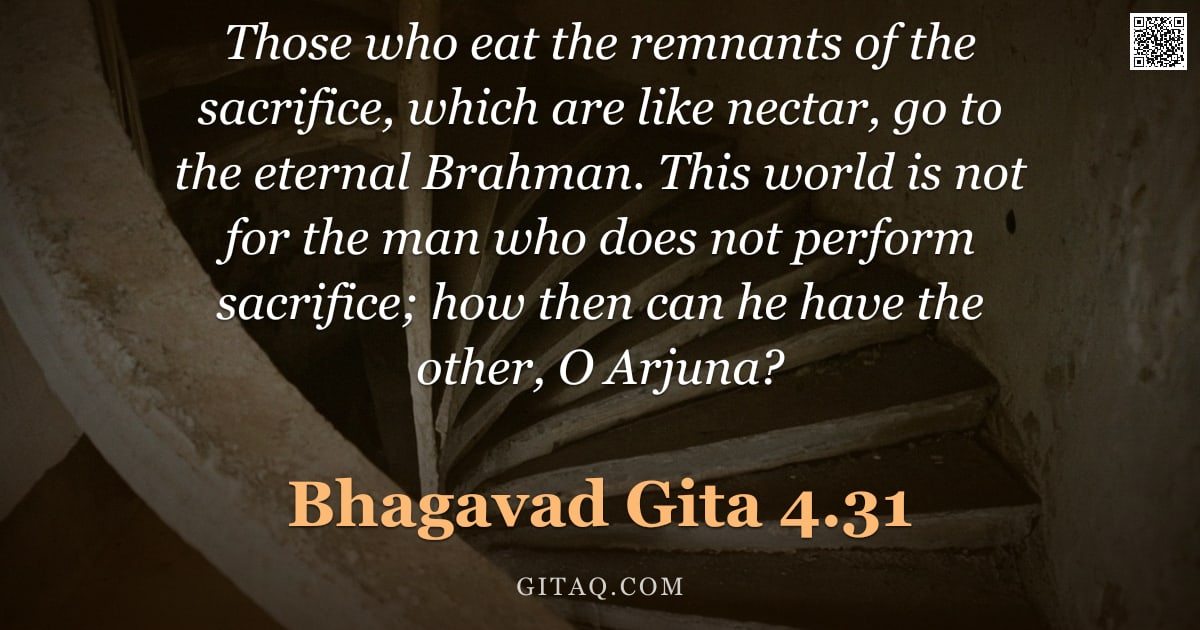
Lord Krishna tells Arjuna that those who consume the sacred remnants of a sacrifice, which are as pure and sweet as nectar, attain the eternal reality known as Brahman. He explains that this physical world offers no true happiness or future for anyone who neglects to perform their duties with a spirit of selfless offering. Conversely, refusing to engage in such righteous action isolates one from both worldly fulfillment and spiritual liberation. The core teaching is that acting without attachment transforms ordinary deeds into a bridge toward the divine.
The Teaching Behind It
This verse synthesizes Karma Yoga with Jnana Yoga, demonstrating how selfless action (Karma) purifies the mind to become capable of realizing ultimate knowledge. It develops the concept that Yajna is not merely a ritual but any action performed without attachment to results, serving as the essential bridge between material existence and spiritual realization.
Word by Word
Classical Commentary
Where This Happens
This verse occurs on the battlefield of Kurukshetra during a critical moment when Arjuna is paralyzed by confusion and reluctance to fight his kinsmen. Krishna has just finished explaining the nature of sacrifice (Yajna) as an act that purifies the mind, moving from theoretical knowledge to practical application for the warrior-king. Speaking to Arjuna, who is identified here as 'Kurusattama' (the best of the Kurus), Krishna addresses his specific hesitation by linking duty directly to spiritual destiny. The listener is currently grappling with a crisis of conscience, fearing that action leads to sin rather than liberation.
Living It Out Today
Consider a professional facing burnout while leading a critical project; instead of viewing it as an exhausting burden or a means for personal promotion, they can reframe the work as a 'sacrifice' performed for the team's success and customer trust. By focusing on the quality of their contribution rather than the outcome (the bonus or praise), they experience less anxiety and find deeper satisfaction in their daily tasks. This shift transforms a stressful obligation into a source of inner peace, allowing them to excel without being trapped by fear of failure.
Explained for Children
Imagine you bake cookies for your family or friends; after they enjoy them, some of the taste remains on their lips as 'remnants,' making everyone happy. Krishna says when we do good things like helping others just because it is right—and not to get a reward—it's like sharing that delicious nectar with God and ourselves. If you only think about yourself and never help anyone or share your work, this world feels lonely and empty for you too. So, doing our best at school or home without worrying about praise makes us feel connected to something bigger and special.
Daily Reflection
You often wonder if your busy life prevents you from finding spiritual depth, but this verse reveals that every action can become a bridge to the Divine when done as an offering. By viewing your work not as a burden but as 'remnants of sacrifice,' you transform mundane moments into nectar that nourishes your soul. The world becomes uninhabitable for those who act only for themselves, yet it opens up like a temple for one who acts in service.
A Practice for Today
Close your eyes and visualize offering your daily actions as food to the Divine, transforming ordinary tasks into a sacred sacrifice (yajna). Feel that by doing so with devotion, you consume the nectar of wisdom that purifies your heart and connects you directly to eternal peace.
Key Teachings
- The Alchemy of Action
Ordinary actions performed with the spirit of sacrifice are transmuted into 'nectar' that sustains spiritual life. This teaches that renunciation is not about abandoning duties, but changing one's relationship to them through selfless offering. - The Necessity of Yajna
One cannot attain the eternal Brahman or even find true fulfillment in this world without engaging in sacrifice. The verse asserts that a life devoid of giving and connecting to something greater than oneself leads to spiritual isolation. - The Path to Eternal Truth
Those who partake in the remnants of divine offering are granted access to the timeless reality, Brahman. This establishes that devotion expressed through action is the direct vehicle for realizing one's unity with the Absolute.
Themes
Related Verses
Read This Next
- 2.47 — This verse establishes your right to action while renouncing attachment to results, providing the foundational mindset for performing yajna without expectation.
- 3.30 — Krishna explicitly instructs Arjuna to offer all actions and their fruits to Him here, deepening the practical application of sacrifice mentioned in 4.31.
- 12.15 — To understand who truly goes to Brahman, read this verse where Krishna describes the qualities of a devotee whose actions are naturally sacrificial and compassionate.
Recommended Reading
GitaQ earns from qualifying purchases as an Amazon Associate.