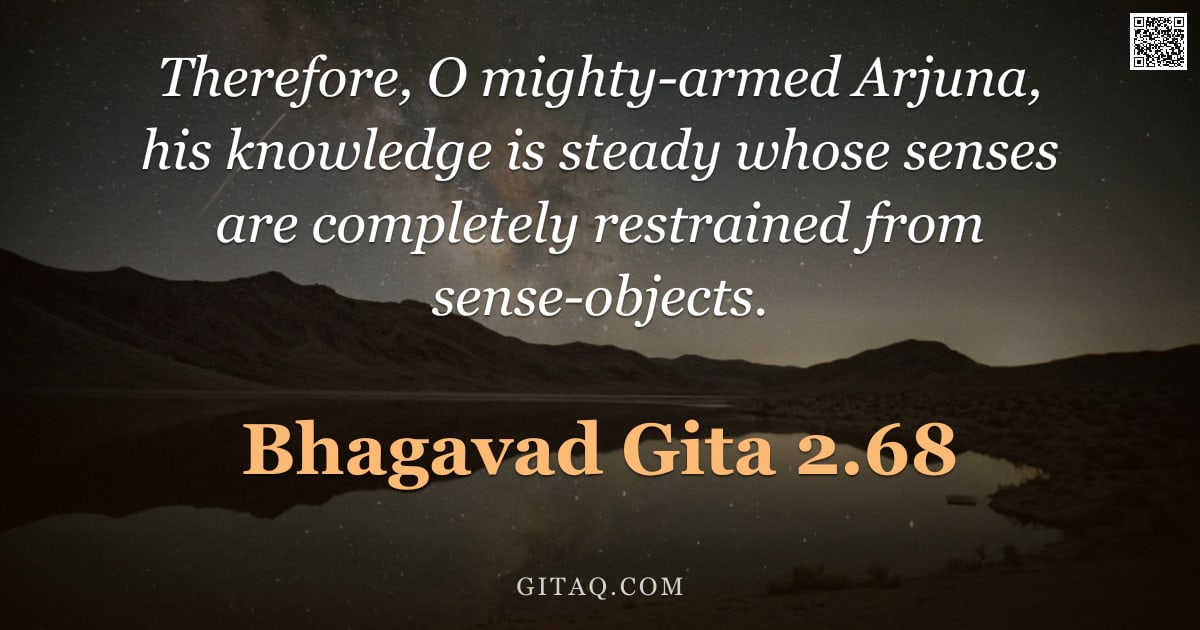
Bhagavad Gita 2.68
Sankhya Yoga · English Translation
तस्माद्यस्य महाबाहो निगृहीतानि सर्वशः | इन्द्रियाणीन्द्रियार्थेभ्यस्तस्य प्रज्ञा प्रतिष्ठिता ||२-६८||
tasmādyasya mahābāho nigṛhītāni sarvaśaḥ . indriyāṇīndriyārthebhyastasya prajñā pratiṣṭhitā ||2-68||
What Does This Verse Mean?
In this verse, Lord Krishna addresses Arjuna as the 'mighty-armed' warrior to explain that true wisdom and mental stability arise only when one gains complete control over their senses. He teaches that if a person allows their eyes, ears, or mind to chase after external pleasures without restraint, their understanding becomes unstable. Conversely, when an individual successfully withdraws their attention from sensory objects, their intellect (prajna) settles into a state of unshakeable steadiness.
The Teaching Behind It
This teaching is foundational to Sankhya Yoga (the path of knowledge) within the Gita's framework, specifically introducing the prerequisite for meditation: sense withdrawal. It develops the concept that steady intellect (prajna-pratishtha) is not an innate trait but a result of disciplined self-control, serving as the bedrock upon which higher spiritual realization and Karma Yoga are built.
Word by Word
Classical Commentary
Where This Happens
This verse occurs in Chapter 2 of the Bhagavad Gita on the battlefield of Kurukshetra, where Krishna has just finished explaining the eternal nature of the soul to Arjuna. Having listened to teachings about deathless consciousness and duty, a confused but slightly calmer Arjuna still struggles with his attachment to fighting his relatives. As the sun rises over the two armies, Krishna concludes this section by establishing that true wisdom is not abstract knowledge, but the practical mastery of one's own mind amidst chaos.
Living It Out Today
Consider a modern scenario where you are trying to focus on an important work project while your phone buzzes constantly with notifications and social media updates. Instead of reacting instantly to every alert (the sense-object), practicing this verse means consciously choosing not to pick up the device, thereby training your mind to stay steady in its task. By restraining these impulses, you prevent anxiety from fracturing your concentration, allowing for deep work and clear decision-making even during high-pressure deadlines.
Explained for Children
Imagine your senses are like five playful puppies that love chasing balls and running after squirrels outside the yard; if you let them run wild without holding onto their leashes, they will pull you in every direction. Lord Krishna tells Arjuna (and us) that when we learn to gently hold those leash controls so our eyes don't just stare at toys or ears only listen to loud noises, our brain finally gets quiet and calm. This inner peace is like a strong tree root that doesn't shake even when the wind blows hard.
Daily Reflection
Today, I invite you to notice how often your peace is held hostage by what passes through your five senses. When we allow our eyes, ears, or tongue to dictate our mood based on external stimuli, our inner stability crumbles like a house built on sand. True steadiness isn't about ignoring the world, but finding an anchor within yourself so that no fleeting object can shake your foundation.
A Practice for Today
Close your eyes and imagine your senses as horses, gently guided rather than whipped toward their objects of desire. Visualize the mind settling into a state of stillness not by force, but because it has found its true resting place in wisdom.
Key Teachings
- The Link Between Restraint and Wisdom
Lord Krishna establishes a direct causal relationship: true knowledge (prajñā) does not exist independently but flourishes only when the senses are fully restrained. Without this discipline, wisdom remains theoretical; with it, understanding becomes a living reality. - Restraint from Objects, Not Existence
The verse specifies that restraint is 'from sense-objects' (indriyārthebhyah), meaning one must withdraw attention from the allure of external pleasures rather than destroying the senses themselves. This teaches a balanced approach where the world remains available but does not dominate the practitioner's consciousness. - The State of Steadiness
When the mind is no longer pulled outward by cravings, it achieves 'pratiṣṭhitā,' a state of being firmly established and unwavering. This steadiness is the prerequisite for deep meditation and the ultimate realization of one's true nature.
Themes
Related Verses
Read This Next
- 2.54 — To explore the specific characteristics and symptoms of a person who has actually achieved this steady wisdom described in verse 68.
- 3.7 — To understand how to apply sensory restraint through action (Karma Yoga) for those engaged in worldly duties rather than renunciation.
- 12.15 — To see the result of this steadiness as described by Krishna, where a devotee who controls their senses becomes dear to all beings and to Him.
Recommended Reading
GitaQ earns from qualifying purchases as an Amazon Associate.