Bhagavad Gita 2.69
Sankhya Yoga · English Translation
या निशा सर्वभूतानां तस्यां जागर्ति संयमी | यस्यां जाग्रति भूतानि सा निशा पश्यतो मुनेः ||२-६९||
yā niśā sarvabhūtānāṃ tasyāṃ jāgarti saṃyamī . yasyāṃ jāgrati bhūtāni sā niśā paśyato muneḥ ||2-69||
What Does This Verse Mean?
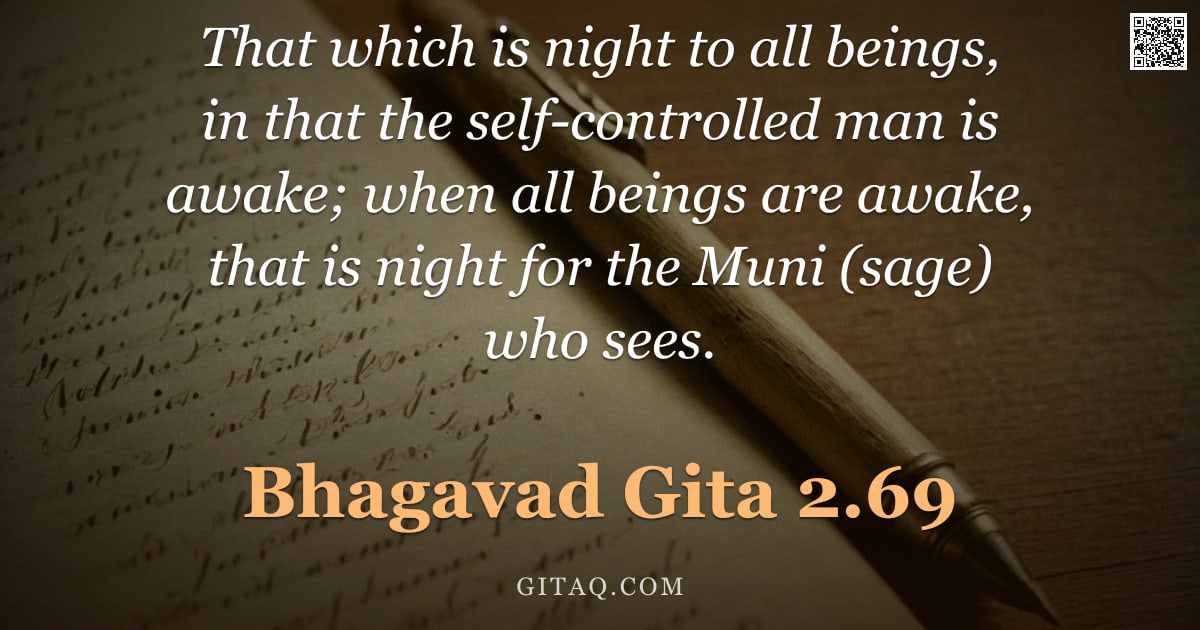
In this verse, Lord Krishna explains the unique state of consciousness for a spiritually awakened person to Arjuna. He uses a powerful metaphor: just as ordinary people are asleep in ignorance during their spiritual 'night,' a self-controlled sage is fully awake and aware even when others seem active. Conversely, what looks like an energetic day of activity for most beings appears like a deep sleep or illusion to the wise one who sees beyond it. The core teaching emphasizes that true awareness comes from turning inward rather than chasing external distractions.
The Teaching Behind It
This verse is a cornerstone of Jnana Yoga (the path of knowledge) and Sankhya philosophy within the Gita's framework. It develops the concept of 'Viveka' or discrimination between the real, eternal consciousness and the temporary world of sensory perception. The teaching asserts that ordinary human wakefulness is actually a state of spiritual ignorance, while true enlightenment requires an inward turning that feels like sleep to those lost in material distractions.
Word by Word
Classical Commentary
Where This Happens
This verse appears in Chapter 2 of the Bhagavad Gita, known as Sankhya Yoga, where Lord Krishna begins to explain the nature of the soul and consciousness to Arjuna. The conversation takes place on the battlefield of Kurukshetra moments after Arjuna has laid down his bow, overwhelmed by grief and attachment for his relatives and teachers. Having just described how a wise person (Sthitaprajna) remains steady amidst pleasure and pain in previous verses, Krishna now uses this vivid analogy to illustrate that true wakefulness is spiritual awareness, not physical activity.
Living It Out Today
Consider a high-pressure work environment where everyone else is rushing around reacting to emails, social media notifications, and office gossip with anxiety. While the rest of your team feels 'awake' because they are constantly busy responding to external triggers, you can choose to be like the Muni by staying internally focused on your core values and long-term goals despite the chaos. In this scenario, while others react impulsively to every sound or notification (the day), you maintain a calm, strategic perspective that allows you to make better decisions without being overwhelmed.
Explained for Children
Imagine everyone at school is playing loudly in the playground during recess; they are very busy and happy, but if you close your eyes, everything looks like a big blur of noise to someone who just wants peace. This verse says that when most people are running around thinking about toys and games (like being awake), a wise person feels calm inside because they know there is more than just the playground. But for that same wise person, when everyone else stops playing and tries to be quiet or serious, it might feel like 'night' or sleep time to them because their mind is still active with good thoughts while others are confused. It's about knowing how your own heart feels inside better than what you see outside.
Daily Reflection
Today, consider how often you chase fleeting pleasures that leave you feeling exhausted and unaware of your true nature by evening. When you withdraw from these external distractions with discipline, you discover a profound inner clarity that others miss during their 'waking' hours of distraction. Embrace this quiet vigilance as the path to genuine freedom rather than seeing it as isolation.
A Practice for Today
Sit quietly and observe your senses withdrawing from external distractions just as the world retreats into night at sunset. In this inner stillness, cultivate a state of alert awareness where you remain fully awake to the Self while the rest of the mind sleeps in illusion.
Key Teachings
- The Paradox of Spiritual Wakefulness
What appears as a time for rest and unconsciousness to ordinary beings is actually the moment when the disciplined sage truly awakens. This teaches that spiritual consciousness operates on an inverted timeline compared to material existence. - The Power of Sensory Withdrawal
True self-control involves turning inward, allowing external stimuli to fade like a nightfall for those who are not yet awake. This withdrawal is the prerequisite for accessing deeper layers of wisdom and inner peace. - The Perspective of the Seer
The Muni sees reality differently because they have transcended the illusion that binds ordinary beings to a cycle of desire and fatigue. By shifting one's focus from the transient world to the eternal Self, life transforms into a continuous state of divine awareness.
Themes
Related Verses
Read This Next
- 2.58 — This verse details the practical mechanism of withdrawing senses from sense objects, illustrating how to achieve the 'night' state described in 2.69.
- 3.30 — Following this with a call for surrender and dedicating actions helps maintain that wakeful awareness while living actively in the world of others.
- 12.15 — This verse describes the qualities of a devotee who is not disturbed by others, reflecting the stability of one who has mastered this inner vigilance.
Recommended Reading
GitaQ earns from qualifying purchases as an Amazon Associate.