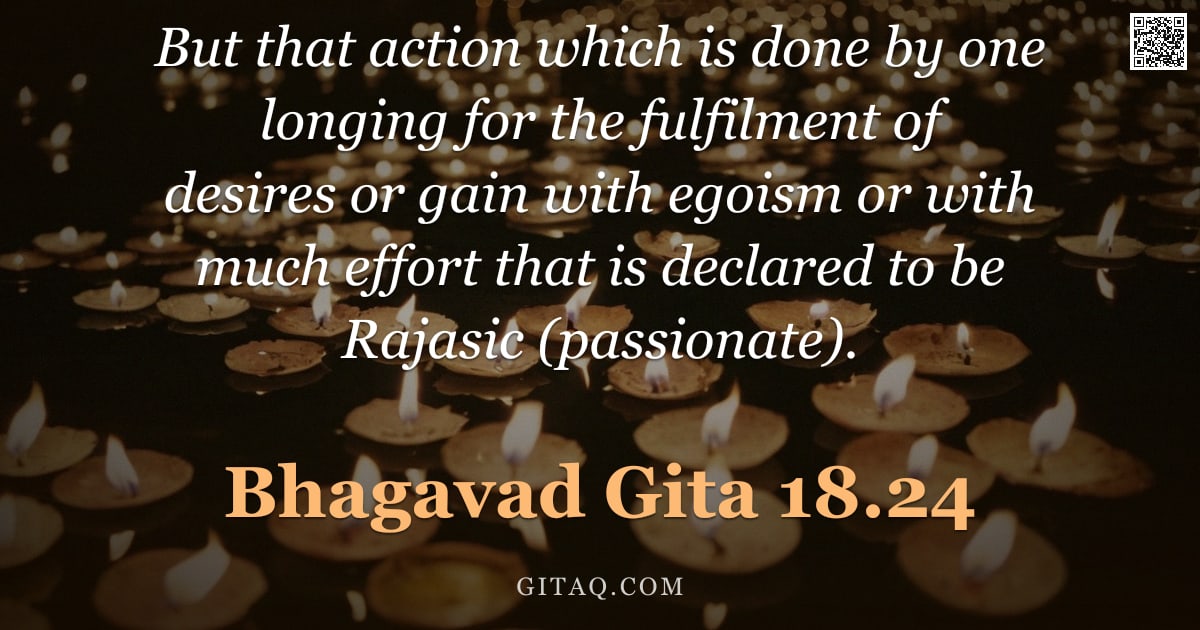
Bhagavad Gita 18.24
Moksha Sanyasa Yoga · English Translation
यत्तु कामेप्सुना कर्म साहंकारेण वा पुनः | क्रियते बहुलायासं तद्राजसमुदाहृतम् ||१८-२४||
yattu kāmepsunā karma sāhaṃkāreṇa vā punaḥ . kriyate bahulāyāsaṃ tadrājasamudāhṛtam ||18-24||
What Does This Verse Mean?
In this verse, Lord Krishna describes a type of action driven by selfish desires and egoism that requires excessive struggle to achieve personal gain. He explains that when someone works primarily for the reward or out of pride in their own ability, that effort is classified as 'Rajasic' (passionate) rather than pure. This teaching warns against performing duties just for personal profit because it binds the doer further to the cycle of stress and dissatisfaction.
The Teaching Behind It
This teaching belongs to the framework of Karma Yoga and Sankhya philosophy, specifically analyzing the Gunas (qualities of nature). It develops the concept that action is not judged by its external result but by the internal state of consciousness—specifically how egoism and intense desire for fruit corrupt the purity of work.
Word by Word
Classical Commentary
Where This Happens
This verse appears near the conclusion of the Bhagavad Gita's teachings on the battlefield of Kurukshetra, where Lord Krishna is instructing Prince Arjuna. Just before this, Krishna has been categorizing actions based on their nature (Sattvic, Rajasic, Tamasic) to help Arjuna understand his own motivations for fighting. As Arjuna listens with a confused heart torn between duty and attachment, he realizes that even the desire to win the war if driven by ego is an obstacle.
Living It Out Today
Consider a professional employee who works late nights not because the project needs it, but specifically to secure a promotion or outcompete their colleagues. This person feels constant anxiety, exhaustion, and resentment when they don't get immediate recognition, mirroring the 'Rajasic' struggle described in this verse. The solution is to shift focus: perform the work with excellence as a duty of skill (Karma Yoga) rather than a transaction for personal glory.
Explained for Children
Imagine you are studying hard only so your parents will buy you a new video game, or doing chores but thinking 'Look how great I am!' That kind of effort feels heavy and tiring. Krishna says that when we work just for our own wants or to show off, it is like running in place without really going anywhere happy. True happiness comes from working because it needs to be done, not because you want a prize at the end.
Daily Reflection
You might find that even small acts turn into burdens when we cling too tightly to how they will benefit us personally. This verse invites you to release the heavy grip of 'I must gain' so that your work becomes a natural flow rather than a struggle for validation. When you act without demanding a specific reward, the exhaustion fades and peace replaces the anxiety of expectation.
A Practice for Today
Observe your intentions as you begin any task today; notice if the drive to achieve a specific result is overshadowing the act itself. If ego or excessive strain arises, pause and gently shift your focus from the desired outcome back to the quality of the offering in this very moment.
Key Teachings
- The Trap of Instrumental Action
Action performed solely as a tool to secure personal gain or fulfill selfish desires is classified as Rajasic. This mindset traps the doer in a cycle where the value of work depends entirely on its external payoff. - The Burden of Ego
When 'I' and 'mine' dominate our actions, every effort becomes heavy because it is weighed down by self-importance. This ego-centric approach transforms natural duty into a source of mental agitation. - The Exhaustion of Striving
Rajasic action often requires excessive physical and mental strain, as the doer fights against circumstances to force an outcome. True liberation comes when we move from forced exertion toward effortless alignment with duty.
Themes
Related Verses
Read This Next
- 2.47 — This verse establishes the foundational principle of acting without attachment to results, offering the direct antidote to the Rajasic mindset described in 18.24.
- 3.9 — Here, Krishna explains how action performed as a sacrifice (Yajna) purifies one from the bonds of karma that result from selfish desires.
- 12.15 — This verse describes the qualities of a devotee who is not agitated by worldly fluctuations, providing the emotional stability needed to transcend ego-driven actions.
Recommended Reading
GitaQ earns from qualifying purchases as an Amazon Associate.