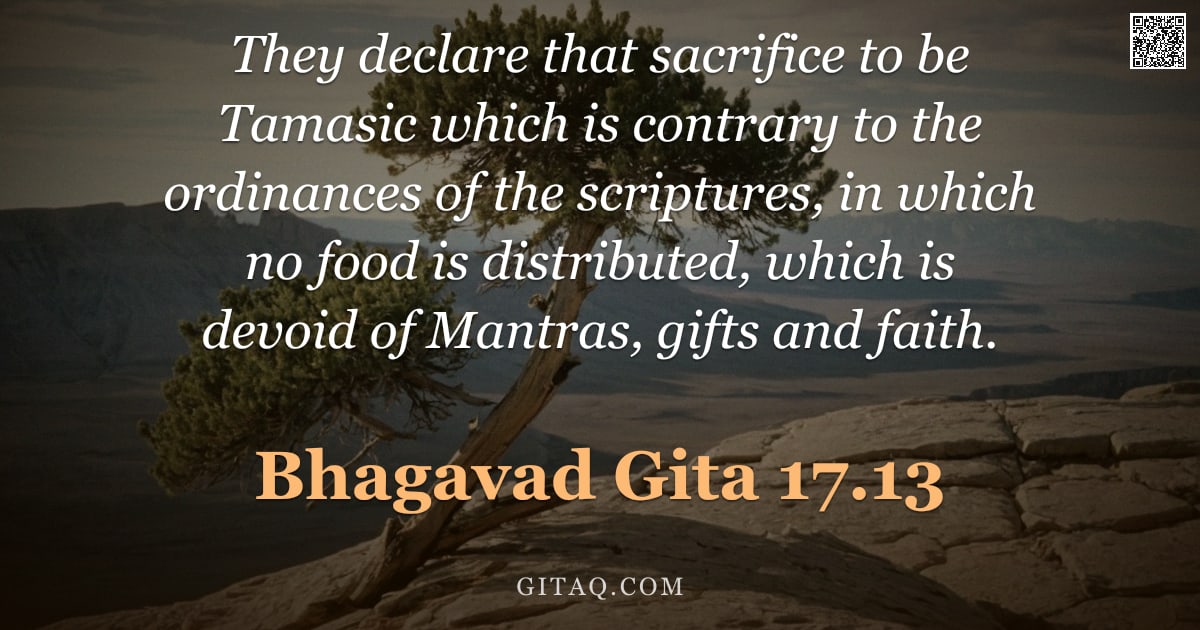
Bhagavad Gita 17.13
Shraddhatraya Vibhaga Yoga · English Translation
विधिहीनमसृष्टान्नं मन्त्रहीनमदक्षिणम् | श्रद्धाविरहितं यज्ञं तामसं परिचक्षते ||१७-१३||
vidhihīnamasṛṣṭānnaṃ mantrahīnamadakṣiṇam . śraddhāvirahitaṃ yajñaṃ tāmasaṃ paricakṣate ||17-13||
What Does This Verse Mean?
In this verse, Lord Krishna describes a specific type of ritual sacrifice that is considered 'Tamasic' or rooted in ignorance and darkness. He explains that if a religious act lacks scriptural guidance, excludes the chanting of sacred mantras, refuses to share food with others, offers no gifts to those who help, and is performed without genuine faith, it is worthless. Krishna emphasizes that true spiritual action requires adherence to divine laws, selfless sharing, devotion, and belief in the process.
The Teaching Behind It
This verse is a core teaching of Karma Yoga (the yoga of selfless action) as it defines how to purify one's actions by rejecting those driven by ignorance. It develops the concept that external rituals are meaningless without internal alignment to Dharma (cosmic order), faith, and generosity, effectively categorizing spiritual practices based on their underlying motivation.
Word by Word
Classical Commentary
Where This Happens
This verse occurs in Chapter 17 of the Bhagavad Gita during the conversation between Lord Krishna and Arjuna on the battlefield of Kurukshetra. Just prior to this discussion, both have been exploring how human nature is divided into three modes (goodness, passion, and ignorance), which influence everything from food choices to faith itself. The listener, Arjuna, has just received a detailed classification of different types of sacrifices based on these modes and is now learning exactly what constitutes an inferior or ignorant form of worship that should be avoided.
Living It Out Today
Consider a modern scenario where you volunteer for a community project but refuse to listen to the established guidelines, skip thanking your team members publicly, keep all resources for yourself rather than sharing them with those in need, and do it only because you feel pressured by peers. In this situation, despite your effort, the action becomes draining and ineffective, mirroring the 'Tamasic' sacrifice described here; true fulfillment comes from following a clear purpose, expressing gratitude through gifts or recognition, ensuring inclusivity for all participants, and acting with genuine belief in the cause.
Explained for Children
Imagine you are baking a cake for your family but you forgot to follow the recipe, didn't say any nice words while cooking, hid all the ingredients so no one could taste it, and did it only because someone forced you. That is like what this verse calls 'Tamasic'—an action that looks like good work on the outside but feels empty inside because there is no love or rules involved. Krishna teaches us that for any kind act to be truly special, we need a plan (like following a recipe), say something nice, share it with others, and do it with our whole heart.
Daily Reflection
You may find that you often perform good deeds without truly believing in their higher purpose, turning them into empty rituals devoid of spiritual life. True faith is not just about following rules; it is about infusing your actions with love and sincerity so they become a bridge to the divine rather than heavy burdens. When you offer food or service without the spirit of devotion, even well-intentioned acts can feel hollow.
A Practice for Today
Sit quietly and examine your own actions today, asking if they are rooted in genuine faith or merely performed out of habit and social pressure. Visualize a sacrifice made with pure intention, where the offering flows from a heart connected to the divine rather than one seeking recognition.
Key Teachings
- The Necessity of Scriptural Guidance
Actions performed contrary to divine ordinances lack spiritual value and are considered Tamasic. Adhering to the wisdom of scripture ensures that our efforts align with cosmic order rather than personal whim. - Faith as the Soul of Action
Without Shraddha (faith), any sacrifice or service becomes a mechanical exercise devoid of life. Faith transforms external rituals into internal spiritual experiences, connecting the doer to the divine source. - The Elements of True Worship
A complete act of worship requires mantras for consecration, food distribution for generosity, and gifts as an expression of surrender. The absence of these elements renders a ritual incomplete and spiritually inert.
Themes
Related Verses
Read This Next
Recommended Reading
GitaQ earns from qualifying purchases as an Amazon Associate.