Bhagavad Gita 18.10

Moksha Sanyasa Yoga · English Translation
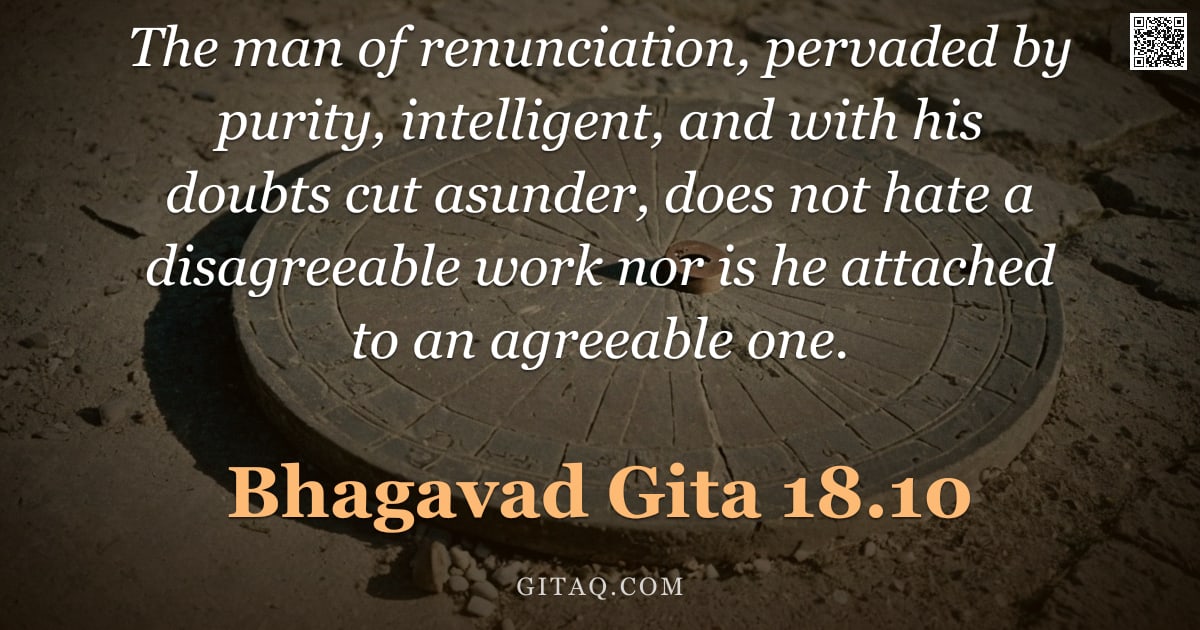
Bhagavad Gita 18.10 — "The man of renunciation, pervaded by purity, intelligent, and with his doubts cut asunder, does not "
Bhagavad Gita 18.10 — Moksha Sanyasa Yoga
Sanskrit

न द्वेष्ट्यकुशलं कर्म कुशले नानुषज्जते | त्यागी सत्त्वसमाविष्टो मेधावी छिन्नसंशयः ||१८-१०||

Transliteration

na dveṣṭyakuśalaṃ karma kuśale nānuṣajjate . tyāgī sattvasamāviṣṭo medhāvī chinnasaṃśayaḥ ||18-10||

What Does This Verse Mean?

In this verse, Lord Krishna describes the true nature of a wise person who has taken up renunciation (Tyagi). Such an individual is filled with inner purity and clarity of mind, allowing them to see beyond superficial likes and dislikes. The core teaching is that they do not hate difficult tasks when necessary, nor do they become obsessed or dependent on pleasant ones; instead, they perform all actions as a duty without emotional attachment.

The Teaching Behind It

This verse synthesizes Karma Yoga (the path of selfless action) with Jnana Yoga (the path of knowledge), illustrating that true renunciation is an internal state rather than merely external abandonment. It develops the concept of 'Sattva' or purity, showing how a mind established in goodness and free from doubt transcends the dualities of pleasure and pain.

Word by Word
न not, द्वेष्टि hates, अकुशलम् disagreeable, कर्म action, कुशले to an agreeable one, न not, अनुषज्जते is attached, त्यागी the abandoner, सत्त्वसमाविष्टः pervaded by purity, मेधावी intelligent, छिन्नसंशयः with his doubts cut asunder
Classical Commentary
All actions are eally welcome to the man of renunciation. He is not affected by either pleasure or pain. He is not elated at performing pleasant actions nor does he find unpleasantness when he does disagreeable actions. He does not hate the latter, nor is he attached to the former. Neither has he aversion to painful actions nor attraction to pleasant ones. As he has no attachment to any action or its rewards, he will do any action for the welfare of all beings. Akusalam Karma Disagreeable work or work done with expectation of reward, which becomes the cause of bondage to Samsara, by producing a body. He does not hate an unpleasnt action, thinking? Of what use is itKusale To good ones which include obligatory daily duties. He has no attachment to them even with the notion that they lead to salvation by purifying the heart and conseently giving rise to the dawn of knowledge and devotion to it. When one abandons attachment to action and desire for its reward and performs actions vigorously, his heart is filled with Sattva or purity which produces discrimination between the Real and the unreal, the Eternal and the transient. Then he attains knowledge of the Self which dispels all the doubts caused by ignorance. He now realises that the only means of attaining the spureme bliss or eternal peace or immortality is knowledge of the Self. This rends asunder all his doubts. What is the nature of doubt Does Brahman exist or not Do the Upanishads deal with Saguna Brahman or Nirguna Brahman Is the individual soul identical with the Supreme Being or not Will I be able to realise the Self or not Will any of the Karmas (Prarabdha? Sanchita and Agami) affect me Does this Samsara whose nature is the feelings I do this and I enjoy this belong to the Self or to the mind and intellect What are the means for liberation -- Yoga, devotion? Karma or knowledge of the Self What is Moksha Is it Selfrealisation or the attainment of the Salokya? Samipya? Sarupya and Sayujya states (dwelling in the kingdom of God, proximity to Him, assuming the same form as the Lord and merging in Him)When a man practises Karma Yoga he gets purity of heart and through purity of heart knows himself to be the immutable actionless Self Who is destitute of birth, or remains without acting or causing others to act (Cf. V.13). He attains devotion to the knowledge of the Self and freedom from all actions. The purpose of the Karma Yoga described above has been taught in this verse. Medhavi He who is endowed or united with wisdom. He is a Sthitaprajna. What is Medha, then It is the immediate knowledge of the identity of the individual soul and the Supreme Being by meditation on the right significance of the great sentence (I am Brahman or That thou art), which,is free from the three kinds of doubts, viz.? Samsaya Bhavana (doubt)? Asambhavana (improbability) and Viparitabhavana (perversion), and by the practice of the four means and service of the Guru (who is versed in the scriptures and established in Brahman) and hearing the truths from him. Such a Medhavi will not think that prohibited actions which bind an ignorant man will be unfavourable to him. He will never think that they will bind him if he has to perform them, because he is above good and evil, virtue and vice, right and wrong. He has no idea of agency (Kartritva Abhimana) he feels that he is a Kritakritya, one who has accomplished all actions. This does not mean that he will do wrong actions. As his will is one with the cosmic will, whatever action he performs will be in accordance with the scriptures. He will never deviate even a fraction of an inch from the rules of the scriptures. The Lord alone works through his mind and senses as he has no individual will. RagaDvesha (likes and dislikes) are the motives that induce a worldly man to actions. As they are absent in a sage or a Medhavi, he can renounce the fruits of all actions and actions as well. As the ocean remains calm amidst stormy waves, even so a Sattvic man remains calm amidst adverse or stormy conditions of life. He recognises that the happenings of life are inevitable. He acts in a variety of ways but is not disturbed as he has a balanced and disciplined mind. There must be no hatred for unpleasant or disagreeable action that brings physical suffering, danger or unlucky results or untoward conseences, when it is the work that should be done. You will have to accept such work also with a willing heart and work with hear and soul. You must have a profound and comprehensive understanding of its need and meaning also. Arjuna failed to understand in the beginning the deep significance and need of the work given by the Lord. He brought in his own foolish philosophy. He failed to do his bounden duty because, due to ignorance, he thought it was an unpleasant or disagreeable action to kill people but in the end when his eyes were opened by the valuable teachings of the Lord, he understood the need and the meaning of the work although it appeared to him as disagreeable and unpleasant in the beginning, and said My illusion is destroyed. I have gained knowledge through Thy grace? O Krishna. I am firm, my doubts are gone. I will act according to Thy instructions.

Where This Happens

This verse appears in Chapter 18 of the Bhagavad Gita, known as Moksha Sanyasa Yoga, where Lord Krishna is concluding his teachings on Arjuna. At this point in the Mahabharata narrative, the battlefield of Kurukshetra has been silent after a long discourse covering various paths to liberation. Arjuna has just asked for final clarification on which path leads to true freedom: renunciation (giving up action) or selfless performance of duty. Krishna is now describing the specific character traits and mental state required to truly embody this wisdom.

Living It Out Today

Consider a software engineer who must rewrite critical, outdated code that nobody likes because it causes frequent crashes; they do not hate this tedious work but complete it efficiently because it serves the greater good of stability. Simultaneously, when offered an easy task like attending a social mixer during a deadline crunch, they participate without becoming attached to the enjoyment or feeling guilty about delaying their main goal if necessary. This balanced approach prevents burnout from resentment and distraction from pleasure-seeking.

Explained for Children

Imagine you have two chores: cleaning your messy room (which feels hard) and playing with your favorite toy (which feels fun). A grown-up who really understands life knows that if it's time to clean the room first, they don't get angry or complain about it. Once the job is done, they can play happily without thinking too much about how 'easy' the cleaning was compared to the game. This verse teaches us that being smart means doing what needs to be done right now, whether it feels good or not.

Daily Reflection

Today, I invite you to examine how often your energy is wasted on resenting the necessary chores of life or becoming overly attached to moments of joy. True freedom isn't found in doing only what feels good and avoiding what doesn't, but in meeting every situation with a steady mind that sees the work itself as the offering. When you stop labeling tasks as disagreeable or agreeable based solely on your immediate feelings, you discover an inner strength that allows you to act justly regardless of external circumstances.

A Practice for Today

Close your eyes and gently recall an unpleasant task you avoided today; notice if a subtle tension arises, then consciously release the judgment of that work as 'bad.' Next, visualize an enjoyable activity you are currently engaged in without needing it to last forever or defining your happiness. Rest in this space where action happens freely, unburdened by hatred for difficulty or clinging to pleasure.

Key Teachings

  1. Transcending Dualistic Reaction
    The verse teaches us not to let the nature of a task dictate our emotional response; we must avoid both aversion toward difficult work and attachment toward pleasant work. This balanced approach prevents the mind from being tossed by the waves of likes and dislikes, allowing for pure action.
  2. The Nature of True Renunciation
    Renunciation is not merely abandoning actions but adopting a state of purity (sattva) where one performs duties without craving their fruits. A true renunciate engages with the world while remaining internally detached, acting from wisdom rather than impulse.
  3. The Clarity of Wisdom
    Wisdom here is described as 'cutting through doubt,' indicating that a clear mind sees beyond superficial pleasures and pains to understand the necessity of duty. When doubts are removed, one acts with certainty and integrity, regardless of whether the work seems agreeable or not.

Themes

Detachment from resultsEmotional balanceSelfless duty (Dharma)Purity of mind (Sattva)Wisdom and clarityRenunciation in action

Related Verses

2.473.304.186.518.66

Read This Next

  1. 2.47 — This foundational verse establishes the principle of performing duty without attachment to results, which is essential before one can truly practice non-aversion.
  2. 3.30 — It expands on offering all actions to the Divine as a practical method for purifying the mind and removing personal aversions or attachments during action.
  3. 12.15 — This verse describes the qualities of a devotee who is not agitated by others, aligning perfectly with the stable equanimity required to avoid hating disagreeable work.

Recommended Reading

GitaQ earns from qualifying purchases as an Amazon Associate.

Share This Verse

Frequently Asked Questions

Does 'renunciation' mean quitting your job or family to become a monk?
No, this verse clarifies that true renunciation is internal rather than external. A person of wisdom performs all duties—whether they are difficult household chores or professional responsibilities—but does so without hatred for the hard parts and without obsession with the easy ones.
Why is 'purity' (Sattva) mentioned as a key trait here?
Purity of nature (Sattva) allows the intellect to function clearly and impartially. When the mind is free from the disturbances of anger, greed, or excessive desire, it can naturally distinguish between what needs to be done now versus what is merely desired.
In Other Languages: Bhagavad Gita 18.10 →