Bhagavad Gita 18.11
Moksha Sanyasa Yoga · English Translation
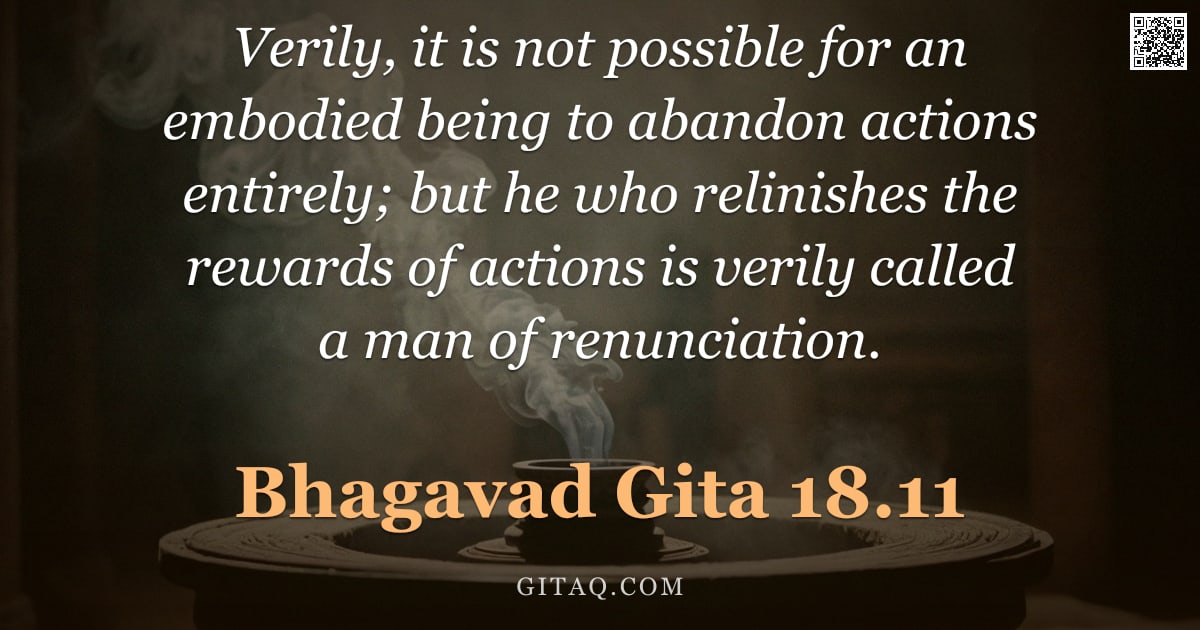
न हि देहभृता शक्यं त्यक्तुं कर्माण्यशेषतः | यस्तु कर्मफलत्यागी स त्यागीत्यभिधीयते ||१८-११||
na hi dehabhṛtā śakyaṃ tyaktuṃ karmāṇyaśeṣataḥ . yastu karmaphalatyāgī sa tyāgītyabhidhīyate ||18-11||
What Does This Verse Mean?
In this verse, Lord Krishna addresses Arjuna's confusion about whether total withdrawal from the world is necessary for spiritual progress. He clarifies that no human being can ever stop performing actions completely because our bodies and minds are constantly engaged in life processes. The true essence of renunciation (Tyaga) is not abandoning work itself, but rather letting go of attachment to the results or rewards of those actions.
The Teaching Behind It
This verse is foundational to Karma Yoga, which teaches that spiritual liberation comes through selfless action rather than physical inaction or escapism. It develops the concept of Nishkama Karma (desire-less action), establishing that one must fulfill their societal duties while maintaining an internal detachment from the fruits of those actions.
Word by Word
Classical Commentary
Where This Happens
This verse appears in Chapter 18 of the Bhagavad Gita, set on the battlefield of Kurukshetra where Prince Arjuna is paralyzed by grief and confusion before the great war begins. Krishna has just concluded his extensive teachings on the three types of renunciation (Sattvic, Rajasic, Tamasic) regarding action. As he transitions to summarizing how one achieves liberation while living in society, this specific verse corrects a potential misunderstanding that spiritual seekers must become hermits who do nothing at all.
Living It Out Today
Consider an employee working on a high-stakes project where their promotion depends entirely on the outcome; they feel paralyzed by anxiety about losing. Instead of quitting their job or refusing to participate in meetings, they apply this teaching by focusing intensely on delivering quality work every day without obsessing over whether they will get the raise. By shifting their identity from 'someone seeking a reward' to 'a professional executing duty,' they reduce stress and perform better.
Explained for Children
Imagine you have to do your homework every day; you can't just stop doing it because that would mean no one goes to school! The secret isn't to throw away your books and stop working. Instead, true bravery is like playing a game where you try your very best but don't get upset if you win or lose—you just enjoy the play itself. This means focusing on giving your effort without worrying about getting a trophy.
Daily Reflection
You often feel overwhelmed trying to detach completely from the results of your hard work, but Krishna reminds us that total inaction is impossible for anyone carrying a body. The true path isn't about stopping your hands from working, but freeing your heart from the anxiety of 'what comes next.' Today, try doing one task with full attention and then releasing the outcome to the Divine, finding peace not in escape, but in engaged surrender.
A Practice for Today
Sit quietly and acknowledge that your presence here, breathing and alive, means you are already engaged with the world; there is no need to force yourself into a void of non-action. Instead, gently shift your focus from what you will gain or lose by acting to simply performing the action itself as an offering.
Key Teachings
- The Impossibility of Total Inaction
An embodied being is bound by nature's three modes (gunas) and cannot cease all activity without ceasing to live. Even the decision to do nothing or remain silent requires a mental action, proving that absolute inactivity is not an option for the living. - Renunciation as Internal Detachment
True tyaga (renunciation) is defined by letting go of attachment to the fruits of labor rather than abandoning the duties themselves. This transforms action from a source of bondage into a path of liberation when performed without selfish desire for reward. - The Paradox of Active Sannyasa
One can achieve the state of a renunciate (sannyasi) while fully participating in worldly life by offering all results to the Supreme. This teaching bridges the gap between householder duties and spiritual freedom, making every action potential yoga.
Themes
Related Verses
Read This Next
- 2.47 — This foundational verse on performing duty without attachment establishes the core principle that Krishna expands upon in this chapter.
- 3.30 — It provides the practical method of dedicating all actions to the Divine, showing how to practically implement the renunciation described here.
- 12.15 — This verse describes the qualities of a devotee who has mastered this balance of action and non-attachment, offering an inspiring model to follow.
Recommended Reading
GitaQ earns from qualifying purchases as an Amazon Associate.