Bhagavad Gita 18.45
Moksha Sanyasa Yoga · English Translation
स्वे स्वे कर्मण्यभिरतः संसिद्धिं लभते नरः | स्वकर्मनिरतः सिद्धिं यथा विन्दति तच्छृणु ||१८-४५||
sve sve karmaṇyabhirataḥ saṃsiddhiṃ labhate naraḥ . svakarmanirataḥ siddhiṃ yathā vindati tacchṛṇu ||18-45||
What Does This Verse Mean?
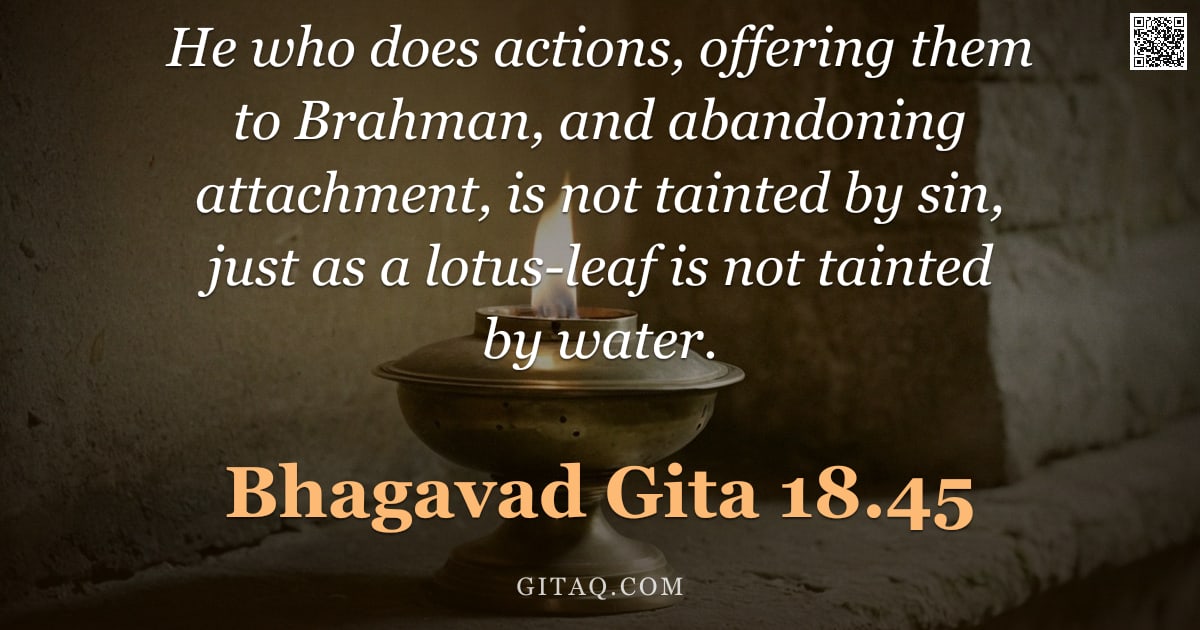
In this verse, Lord Krishna explains to Arjuna that true success comes from wholeheartedly performing one's own prescribed duties without attachment to the results or anxiety about outcomes. He teaches that when a person acts with dedication and offers their work as a form of worship, they remain untouched by negative karma or sin. This state of mind allows an individual to achieve spiritual perfection while living in the world.
The Teaching Behind It
This verse is a cornerstone of Karma Yoga, which integrates action with spiritual discipline by advocating for selfless work as a path to liberation. It develops the concept that performing one's own duty (svadharma) with full dedication and offering it to the Divine leads to perfection while maintaining inner purity.
Word by Word
Classical Commentary
Where This Happens
This verse appears near the conclusion of the Bhagavad Gita during Chapter 18, where Krishna is finalizing his teachings to Prince Arjuna on the battlefield of Kurukshetra. After resolving Arjuna's confusion and despair regarding his duty as a warrior, Krishna emphasizes that liberation comes from performing one's specific svadharma (inherent duty) without attachment. At this moment, Arjuna has just received the complete knowledge of renunciation in action, preparing him to fight with renewed clarity.
Living It Out Today
Consider an employee who is overwhelmed by a high-pressure project; instead of obsessing over the bonus or fearing failure, they focus entirely on doing each task with excellence and integrity. By detaching their self-worth from the final outcome and viewing the work as a contribution to the greater good, they perform better and experience less burnout. This approach transforms a stressful deadline into an opportunity for professional growth without the heavy burden of anxiety.
Explained for Children
Imagine you are playing your favorite game; if you play just for fun without worrying about winning or losing, you have more energy and enjoy it more! Lord Krishna says that when we do our homework, chores, or schoolwork because it is what needs to be done—and not just to get a trophy—we stay happy. Just like a lotus flower grows in muddy water but stays clean on top, doing your best with a pure heart keeps you safe from feeling bad about mistakes.
Daily Reflection
Today, I invite you to look at your tasks not just as chores but as sacred opportunities to align your actions with the divine will. When you perform your duties without clinging to success or fearing failure, you discover a profound inner peace that remains untouched by external circumstances. This shift from 'doing for myself' to 'doing through me' transforms ordinary moments into paths of liberation.
A Practice for Today
Close your eyes and visualize yourself fully immersed in your current duties, offering the results of your work to the divine consciousness rather than holding onto them for personal gain. Imagine this act of surrender as a lotus leaf resting on water; notice how you can engage deeply with life's challenges without becoming stained by anxiety or attachment to outcomes.
Key Teachings
- Natural Duty as the Path
True perfection is found not in abandoning one's specific role, but in wholeheartedly engaging with the duties inherent to one's nature. The verse teaches that 'sve sve' (one's own) karma is the designated vehicle for spiritual growth and self-realization. - Surrender Over Attachment
The essence of this practice lies in offering actions to Brahman while abandoning attachment to their fruits. This detachment acts as a filter, preventing the accumulation of karmic sin even amidst intense worldly activity. - The Lotus Metaphor
Just as water slides off a lotus leaf without wetting it, spiritual discipline ensures that material actions do not stain the soul. One can remain fully active in the world while maintaining an inner state of absolute purity and non-attachment.
Themes
Related Verses
Read This Next
- 2.47 — Foundational teaching on performing duty without concern for the fruits of action.
- 3.30 — Expands on the practice of surrendering all works to Krishna as a method of liberation.
- 12.15 — Describes the qualities of one who is not disturbed by others and does not disturb, reflecting the purity mentioned in 18.45.
Recommended Reading
GitaQ earns from qualifying purchases as an Amazon Associate.