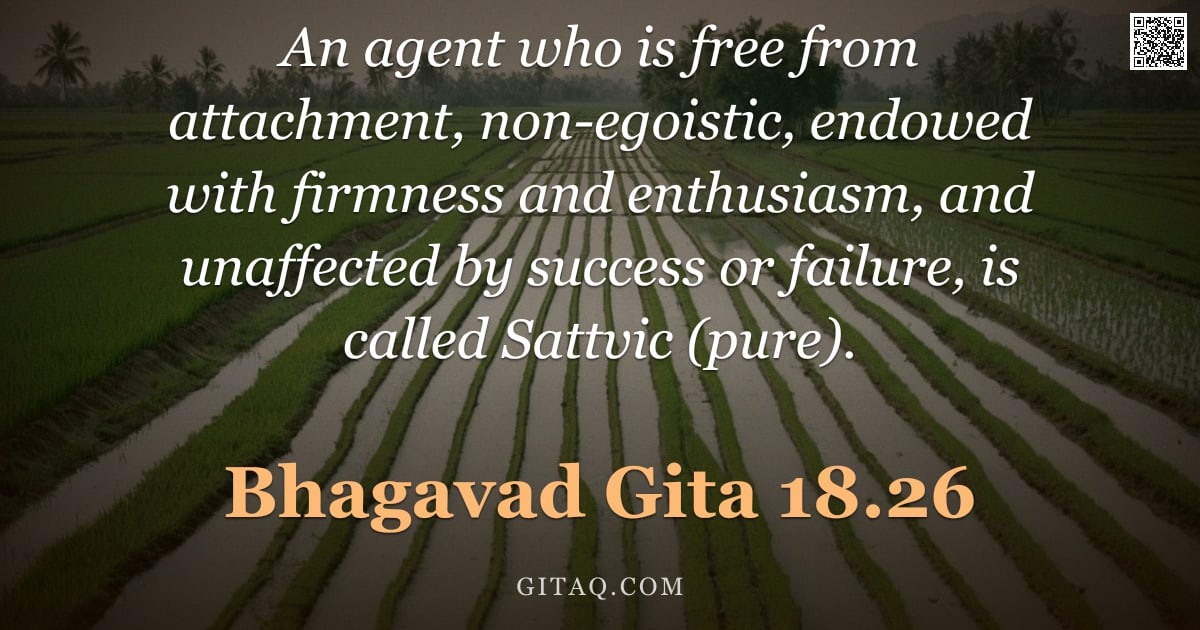
Bhagavad Gita 18.26
Moksha Sanyasa Yoga · English Translation
मुक्तसङ्गोऽनहंवादी धृत्युत्साहसमन्वितः | सिद्ध्यसिद्ध्योर्निर्विकारः कर्ता सात्त्विक उच्यते ||१८-२६||
muktasaṅgo.anahaṃvādī dhṛtyutsāhasamanvitaḥ . siddhyasiddhyornirvikāraḥ kartā sāttvika ucyate ||18-26||
What Does This Verse Mean?
In this verse, Lord Krishna describes the qualities of a 'Sattvic' doer to Arjuna during their conversation on the battlefield of Kurukshetra. Such a person acts without attachment to outcomes or ego, maintaining steady courage and enthusiasm regardless of success or failure. The key teaching is that true purity in action comes from performing one's duty with dedication while remaining mentally unaffected by the results.
The Teaching Behind It
This verse is a cornerstone of Karma Yoga (the yoga of action), emphasizing that spiritual purity arises when actions are performed without attachment to results or egoistic identification. It bridges Sankhya philosophy by distinguishing between the doer and the self, teaching that one can engage fully in worldly duties while remaining internally detached from the fruits of those deeds.
Word by Word
Classical Commentary
Where This Happens
This verse appears in Chapter 18, where Lord Krishna is concluding his teachings on renunciation and liberation (Moksha) to Prince Arjuna. At this moment, the great war of Kurukshetra has just begun or is imminent, and Arjuna is overwhelmed by confusion about fighting his own kin. Krishna uses this verse to categorize different types of performers as he guides Arjuna from a state of despair toward understanding his duty (Dharma) with a pure heart.
Living It Out Today
Consider a project manager leading their team through a high-stakes product launch where the outcome is uncertain. A Sattvic approach means preparing meticulously, motivating the team with energy and resolve, but not letting self-worth fluctuate based on whether the launch succeeds or fails financially. This mindset prevents burnout from failure anxiety or arrogance after success, allowing for clear decision-making focused solely on doing the work well.
Explained for Children
Imagine you are playing your favorite game and giving it everything you have, cheering yourself on even when things get tough. A Sattvic person is like a player who plays fair, doesn't brag about being better than others, and keeps trying their best no matter if they win or lose the match. They don't feel sad for long after losing or overly proud after winning; they just enjoy playing because it's what needs to be done.
Daily Reflection
You carry so much weight in your hands because you believe every small victory is yours alone and every setback defines your worth. Today, try to act from a place of pure capability rather than egoic need for approval or fear of loss. When you let go of the attachment to the fruit of your labor, you discover that true strength comes not from controlling results but from steady devotion in action.
A Practice for Today
Close your eyes and silently release any grip on the outcome of today's tasks, acknowledging that success or failure belongs to a larger design than you control. Visualize yourself performing each action with full enthusiasm but without identifying as the 'doer' who must own the result.
Key Teachings
- Freedom from Attachment
The verse begins by defining a Sattvic agent as one free from 'muktasango,' meaning they are unbound by selfish cravings for the fruits of their actions. This detachment does not imply inaction, but rather allows work to flow without the mental clutter of greed or possessiveness. - The End of Ego
By shedding 'ahamvadi,' or ego-centricity, one stops viewing themselves as the sole author and owner of their deeds. This shift transforms work from a personal performance into an offering, removing the heavy burden of pride and insecurity. - Equanimity in Action
True courage is found in remaining unchanged by success or failure ('siddhyasiddhyornirvikara'), maintaining inner stability regardless of external fluctuations. This steady mindset, fueled by firmness and enthusiasm, ensures that the quality of one's work remains pure even when outcomes vary.
Themes
Related Verses
Read This Next
- 2.47 — Read this next as it establishes the foundational principle of performing duty without attachment to results.
- 3.30 — This verse complements 18:26 by instructing you to dedicate all actions and their fruits to the Divine, further dissolving personal ego.
- 12.15 — Include this reading to see how a person free from envy and attachment is described as most dear to Krishna, connecting Sattvic action to devotion.
Recommended Reading
GitaQ earns from qualifying purchases as an Amazon Associate.