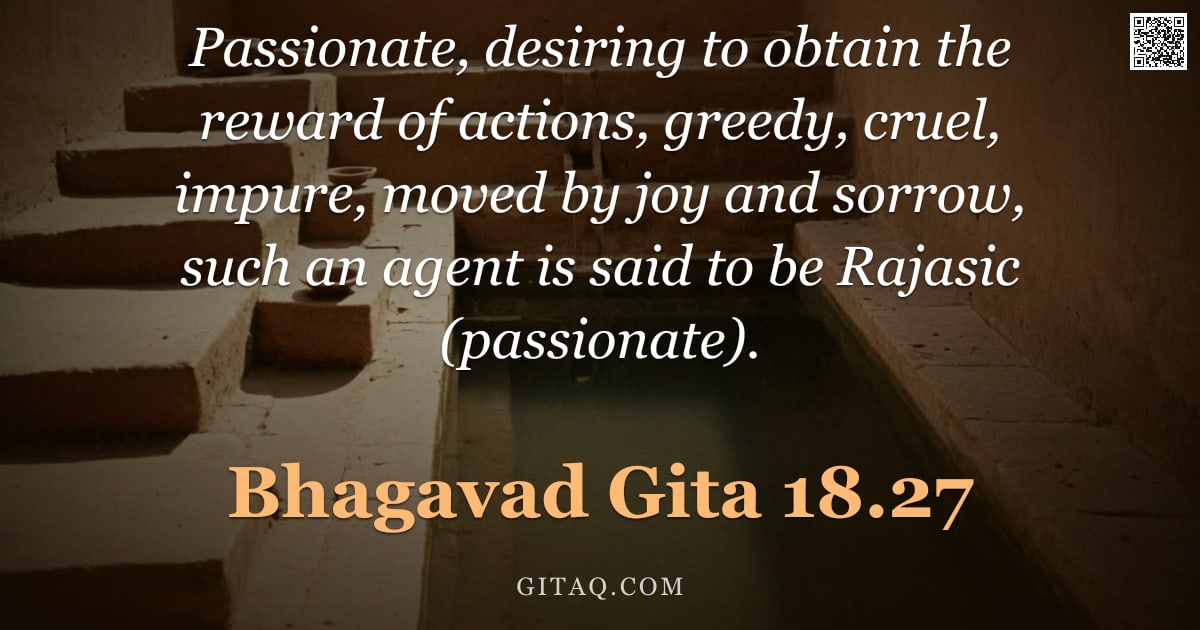
Bhagavad Gita 18.27
Moksha Sanyasa Yoga · English Translation
रागी कर्मफलप्रेप्सुर्लुब्धो हिंसात्मकोऽशुचिः | हर्षशोकान्वितः कर्ता राजसः परिकीर्तितः ||१८-२७||
rāgī karmaphalaprepsurlubdho hiṃsātmako.aśuciḥ . harṣaśokānvitaḥ kartā rājasaḥ parikīrtitaḥ ||18-27||
What Does This Verse Mean?
In this verse, Lord Krishna describes a person driven by passion and ego who acts only to get rewards or praise for their work. This individual is often greedy, harsh in speech and action, emotionally unstable when things go well or poorly, and lacks inner purity. Such a person is labeled 'Rajasic' because they are bound by the mode of passion, which creates constant restlessness and suffering rather than true peace.
The Teaching Behind It
This verse belongs to the teaching on 'Triguna' (the three modes of material nature), specifically detailing the characteristics of Rajas, which is characterized by intense activity driven by desire. It complements the broader framework of Karma Yoga by illustrating how attachment to results and emotional volatility bind the soul to the cycle of birth and death.
Word by Word
Classical Commentary
Where This Happens
This teaching occurs on the battlefield of Kurukshetra during the Mahabharata war as Lord Krishna concludes his discourse with Arjuna in Chapter 18, titled 'Moksha Sanyasa Yoga'. Having just described the three types of knowledge, action, and intellect based on the modes of nature (Sattva, Rajas, Tamas), Krishna now categorizes different kinds of actors to help Arjuna understand his own motivations. At this moment, Arjuna is listening with a focused mind after witnessing the terrifying visions of Krishna's universal form and resolving to fight; he seeks clarity on how to act without being trapped by these human weaknesses.
Living It Out Today
Consider an employee who stays late every night not because they care about the project, but solely to impress their boss for a promotion or bonus. When this person receives praise, they feel elated and arrogant, but if criticized or passed over for a raise, they become bitter, aggressive toward colleagues, and lose sleep with anxiety. This verse invites us to examine our own drive: are we working out of duty and service (Sattva) or just chasing the next reward while fearing failure?
Explained for Children
Imagine someone who only plays their favorite video game if there is a prize at the end; if they don't get it quickly, they throw a tantrum or yell at everyone. This verse describes that kind of person: someone who does things just to win awards, gets very mean when frustrated, and swings from being super happy to crying over small problems. Krishna teaches us that doing good for love's sake is better than doing good only to get a trophy.
Daily Reflection
Today, I invite you to gently examine the motivation behind your daily tasks: Are they fueled by greed and the fear of missing out on rewards? When we act from a place of passion alone, our minds become turbulent, swinging between elation and despair based on external outcomes. True freedom begins when we can perform necessary actions without letting these emotional extremes dictate our inner peace.
A Practice for Today
Sit quietly and observe where your actions are driven by the desire for a specific reward rather than duty itself. Notice how attachment to joy or sorrow colors every step you take, binding you to the cycle of reaction.
Key Teachings
- The Trap of Transactional Duty
This verse warns against performing actions solely as a transaction to secure a specific return, which binds the soul through greed. When work becomes a means to an end rather than a duty in itself, it fuels the restless nature of Rajas. - The Turbulence of Dualities
A passionate mind is constantly agitated by the swings of joy and sorrow, unable to find stability. This emotional volatility arises because our sense of self-worth becomes dependent on external successes or failures. - Purity as a Prerequisite for Peace
True action requires inner cleanliness, free from cruelty and selfish desire. Without cultivating purity of heart, even well-intentioned actions can become sources of suffering for oneself and others.
Themes
Related Verses
Read This Next
- 2.47 — Read this next for Krishna's foundational instruction on doing your duty without clinging to the fruits of action.
- 3.30 — This verse offers a practical method of surrendering all actions to the Divine, countering the self-centered drive described in 18.27.
- 12.15 — Explore how one who is free from joy and sorrow becomes dear to Krishna, providing a clear picture of the Sattvic state opposite to Rajas.
Recommended Reading
GitaQ earns from qualifying purchases as an Amazon Associate.