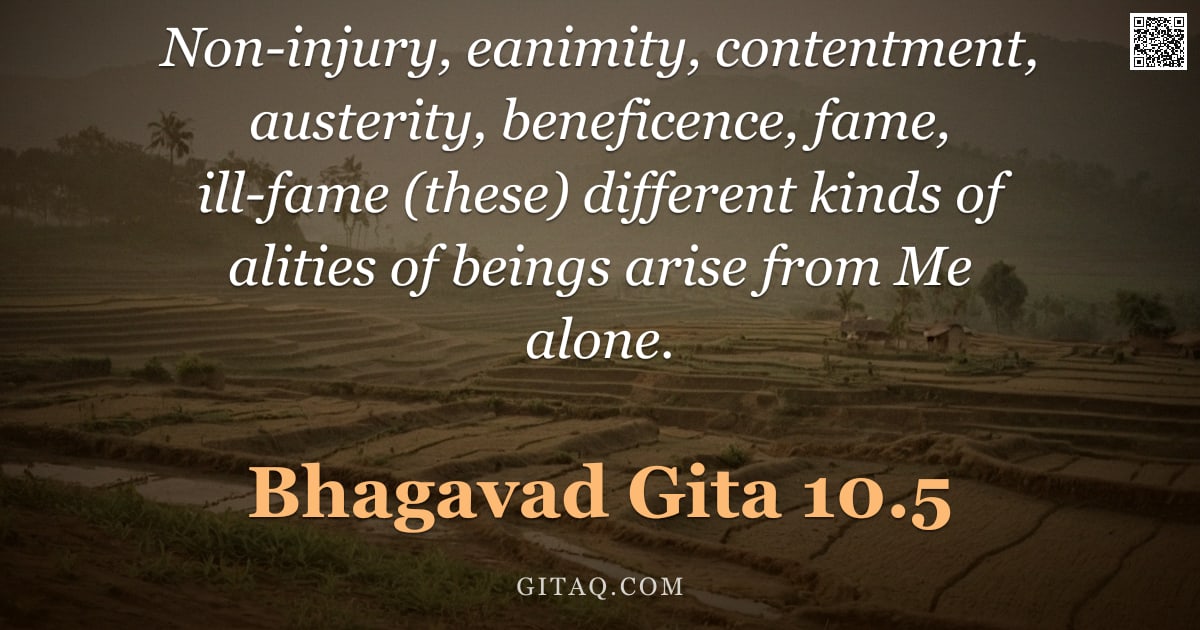
Bhagavad Gita 10.5
Vibhuti Yoga · English Translation
अहिंसा समता तुष्टिस्तपो दानं यशोऽयशः | भवन्ति भावा भूतानां मत्त एव पृथग्विधाः ||१०-५||
ahiṃsā samatā tuṣṭistapo dānaṃ yaśo.ayaśaḥ . bhavanti bhāvā bhūtānāṃ matta eva pṛthagvidhāḥ ||10-5||
What Does This Verse Mean?
In this verse, Lord Krishna tells Arjuna that every quality found in living beings—whether positive like non-violence and contentment or negative like ill-fame—is ultimately a manifestation of the Divine alone. He explains that even though these traits appear different on the surface, they all originate from his essential nature as the source of all existence. The key teaching is to recognize the divine presence within both virtuous actions and human flaws, understanding that nothing exists outside of God's energy.
The Teaching Behind It
This verse belongs primarily to the teaching of Sankhya philosophy regarding prakriti (material nature) and its relationship to Purusha, while also deeply supporting Bhakti Yoga by establishing God as the sole source. It develops the concept that all qualities (gunas) in beings are not independent realities but are borrowed energies derived from the Supreme Being.
Word by Word
Classical Commentary
Where This Happens
This verse appears in Chapter 10 of the Bhagavad Gita during the intense dialogue on the battlefield of Kurukshetra between Prince Arjuna and Lord Krishna. Just before this, Arjuna has asked Krishna to reveal his specific divine forms (Vibhutis) so he can understand the magnitude of what they are facing. The listener, Arjuna, is currently in a state of deep reverence and confusion as he tries to comprehend how one entity can be present everywhere simultaneously.
Living It Out Today
When you face a difficult decision at work where your reputation might take a hit, remember that both the potential for success (fame) and failure (ill-fame) arise from the same source of energy. Instead of becoming consumed by anxiety over outcomes or pride in achievements, view these results as temporary manifestations to be handled with equanimity. This perspective allows you to act with integrity and non-violence towards colleagues regardless of whether they respond positively or negatively.
Explained for Children
Imagine you have a huge bucket of colorful paint called 'God.' Everything in the world—like being kind (non-injury), feeling happy with what you have (contentment), or even making mistakes—is just different colors mixed from that same big bucket. Just like how all your toys are made by the toy factory, every good and bad thing people do comes from God's energy. When we remember this, it helps us see everyone as part of one big family connected to the source.
Daily Reflection
Today, notice how even your difficult moments are rooted in that same divine energy; there is no separation between your struggles and God's presence. When you feel restless or dissatisfied, remember that true contentment arises when you stop fighting these feelings as 'yours' and recognize them as transient waves of the One Self. This shift turns every emotion into a sacred opportunity to see the Divine in all its varied forms.
A Practice for Today
Begin by silently acknowledging that your current state of mind, whether it feels like peace or turmoil, is a reflection of the Divine within you. Visualize non-injury and contentment not as distant ideals to chase, but as natural qualities blooming from your connection to the Source.
Key Teachings
- The Source of All Qualities
Every virtue like ahimsa (non-injury) and tapas (austerity), as well as every challenge, originates from the Divine. Nothing exists independently; all human experiences are unique expressions of that single source. - The Duality of Existence
Fame and ill-fame, prosperity and austerity exist side-by-side as distinct modes (pṛthagvidhāḥ) created by the Lord. Recognizing this helps us accept life's fluctuations without losing our spiritual center. - Divine Immanence in Character
Your character traits are not accidental but divine manifestations intended for your growth and service to the world. By cultivating these qualities, you align yourself with the very nature of God.
Themes
Related Verses
Read This Next
- 7.21 — This verse expands on how devotees worship specific forms of the Lord that they desire to embody.
- 9.4 — It reinforces the concept that all beings exist within the Divine, yet remain distinct in their individuality.
- 18.73 — This closing verse confirms Arjuna's realization of Krishna as the source and end of all creation discussed earlier.
Recommended Reading
GitaQ earns from qualifying purchases as an Amazon Associate.