Bhagavad Gita 10.6
Vibhuti Yoga · English Translation
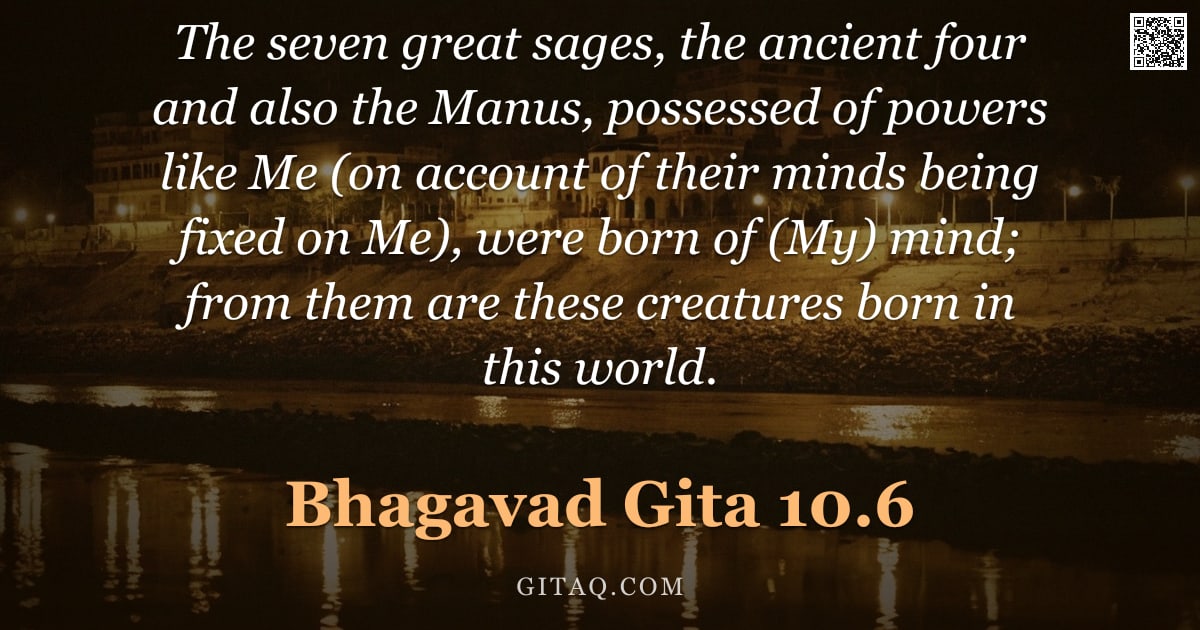
महर्षयः सप्त पूर्वे चत्वारो मनवस्तथा | मद्भावा मानसा जाता येषां लोक इमाः प्रजाः ||१०-६||
maharṣayaḥ sapta pūrve catvāro manavastathā . madbhāvā mānasā jātā yeṣāṃ loka imāḥ prajāḥ ||10-6||
What Does This Verse Mean?
In this verse, Lord Krishna explains the origin of humanity to Arjuna by revealing that he is the source of all great spiritual teachers and ancestors. He states that seven ancient sages (the Saptarishis), four mind-born progenitors (Marichi, etc.), and twelve Manus were born directly from his divine will through meditation. The key teaching is that because these beings kept their minds fixed on Krishna, they inherited a fraction of his power to create life and guide the world.
The Teaching Behind It
This verse is central to Bhakti Yoga (the path of devotion) within the broader framework of Vedanta, illustrating that love for the Divine transforms the mind into a creative force. It develops the concept that all creation originates from the Supreme Consciousness and returns to it when one's focus remains fixed on the source.
Word by Word
Classical Commentary
Where This Happens
This verse occurs in Chapter 10 during the Kurukshetra battlefield while Lord Krishna is serving as Arjuna's charioteer. Having just begun to reveal his divine form (Vibhuti) by listing various manifestations of himself, Krishna aims to remove Arjuna's confusion and doubt about facing a battle against relatives. The listener, Arjuna, has been overwhelmed by the scale of war and is seeking reassurance that he is not fighting alone against destiny.
Living It Out Today
When you are leading a major project or making a difficult decision at work, remember that your success often stems from focusing on a higher purpose rather than just personal gain. If you approach your leadership with an attitude of service—like the ancient sages who focused their minds inwardly—you naturally attract talent and resources to help bring those ideas to life.
Explained for Children
Imagine you are drawing a picture with your favorite crayons, but then those drawings come alive and start making new pictures all by themselves. In this verse, Lord Krishna tells Arjuna that he is like that special artist who created the very first great teachers of wisdom. Just as a parent passes their love to a child through birth, these ancient sages were born from Krishna's mind because they loved him so much and thought about him constantly.
Daily Reflection
Today, I invite you to see your own creative spark not as something separate or accidental, but as a direct emanation from the Divine mind. When you feel overwhelmed by the chaos of life, remember that just like the ancient sages and Manus were born through devotion, your deepest potential is unlocked when you fix your awareness on the source of all being. You are never truly alone because every thought and action flows from that same divine intelligence.
A Practice for Today
Begin by closing your eyes and gently bringing awareness to the space between your thoughts, recognizing that this very mind is a reflection of the Divine Source. Visualize yourself as an expression born from that infinite consciousness, allowing the sense of separation to dissolve into a feeling of being held in the heart of all existence.
Key Teachings
- The Mind as a Creative Vessel
This verse establishes that consciousness is not merely reactive but generative, capable of manifesting entire lineages through the power of focused thought. It teaches us that our mental state determines our reality and lineage, just as the divine mind gave birth to the primordial saviors. - Devotion as a Transformative Force
The sages possessed powers equal to the Divine specifically because their minds were fixed upon Him in devotion. This highlights that spiritual power is not inherent through physical effort alone, but arises from aligning one's intellect and will with the Source. - Divine Origin of All Beings
All living creatures trace their lineage back to these divine beings who were born directly from God, emphasizing a non-dual connection between creator and creation. It reminds us that every soul is part of this same sacred family tree rooted in the Divine.
Themes
Related Verses
Read This Next
- 2.47 — To understand how fixing one's mind on duty and action (Karma Yoga) parallels the mental fixation described in this verse.
- 3.30 — For a practical instruction on surrendering all actions to God, which is the method by which we align our minds like the sages did.
- 12.15 — To see how those who are dear to Krishna possess the same qualities of a mind fixed on Him that allowed the ancient sages to manifest their glory.
Recommended Reading
GitaQ earns from qualifying purchases as an Amazon Associate.