Bhagavad Gita 8.1
Akshara Brahma Yoga · English Translation
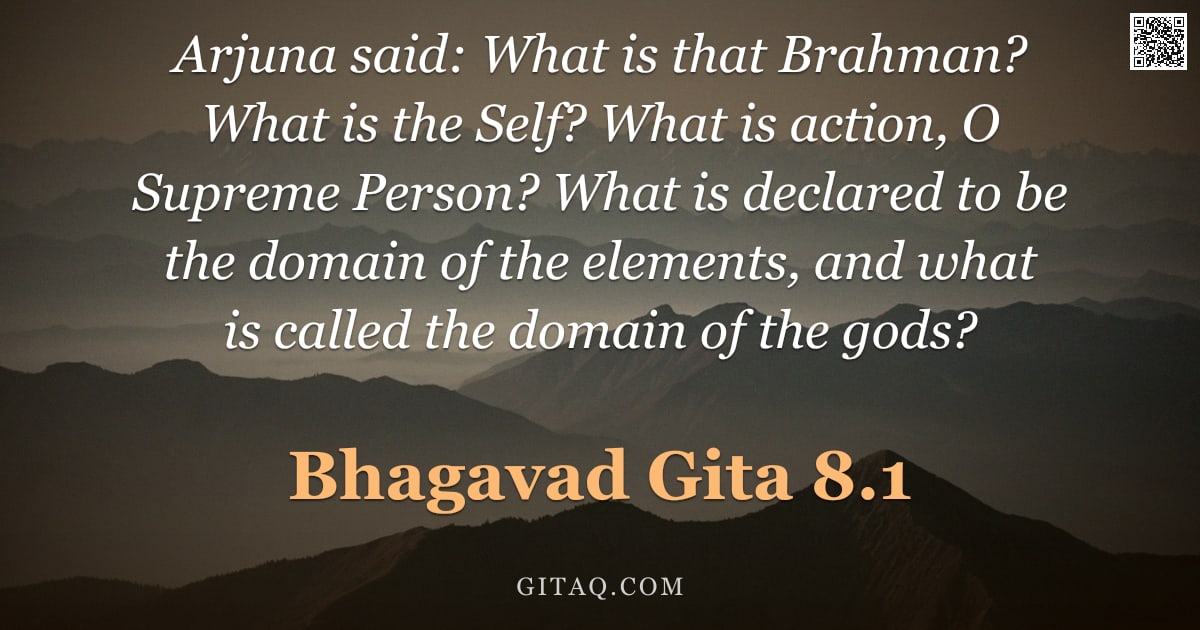
अर्जुन उवाच | किं तद् ब्रह्म किमध्यात्मं किं कर्म पुरुषोत्तम | अधिभूतं च किं प्रोक्तमधिदैवं किमुच्यते ||८-१||
arjuna uvāca . kiṃ tad brahma kimadhyātmaṃ kiṃ karma puruṣottama . adhibhūtaṃ ca kiṃ proktamadhidaivaṃ kimucyate ||8-1||
What Does This Verse Mean?
Arjuna asks Lord Krishna, who is the Supreme Person (Puruṣottama), to clarify several fundamental concepts he still finds confusing after hearing about duty and action. He specifically inquires about the true nature of Brahman (the Ultimate Reality), Adhyātma (the individual self or soul), Karma (action), and how these relate to the physical world, the divine forces within it, and what happens at death. This verse sets the stage for Krishna's detailed explanation of the imperishable Absolute in Chapter 8. The key teaching here is that true spiritual progress requires a clear intellectual understanding of who we are and where our consciousness should be focused.
The Teaching Behind It
This verse belongs primarily to Jnana Yoga (the path of knowledge) and introduces the metaphysical framework necessary for Dhyana Yoga (meditation). It develops the concept that one's final state at death is determined by the consciousness held during life, which requires understanding the distinction between the eternal Self (Adhyātma), the transient physical world (Adhibhūta), and the divine forces governing nature. Without this intellectual clarity, spiritual practice lacks direction.
Word by Word
Where This Happens
This verse occurs at the very beginning of Chapter 8 on the battlefield of Kurukshetra, moments after Arjuna has received his initial instructions from Krishna regarding duty (Karma Yoga) in Chapters 1 through 7. Despite understanding that he must fight to restore dharma, Arjuna remains intellectually and spiritually confused about the deeper metaphysical nature of reality, specifically what happens at the moment of death. He speaks with humility as a disciple addressing his charioteer and guide, Krishna (Puruṣottama), seeking clarity on concepts that determine one's future after life.
Living It Out Today
When facing a major career pivot or a difficult family decision where the outcome is uncertain, you often feel overwhelmed by competing priorities like immediate financial security versus long-term values. This verse invites you to pause and ask yourself: 'What are my true guiding principles (Adhyātma) compared to just reacting to external pressures?' By clarifying what truly matters to your core identity rather than getting lost in the noise of daily tasks, you can make decisions from a place of stability. It shifts your focus from anxiety about results to aligning your actions with an enduring truth.
Explained for Children
Imagine you have a big puzzle about life, but some pieces don't fit together yet. That's what Arjuna felt on the battlefield; he was asking his friend Krishna to help him solve these confusing pieces like 'Who am I?' or 'What is God really?'. Just like when you ask your teacher why we do things in school so you understand the rules better, Arjuna wants a clear picture of how everything connects. He's not just guessing; he wants to know the secret code that explains the whole universe and our place inside it.
Daily Reflection
Today, you are invited to look beyond the surface of your life's changing circumstances and ask who is truly observing them. You might wonder about the nature of your own self versus the roles you play in society or family; remember that these outer forms arise and pass away like waves on an ocean. The true answer lies not in what changes, but in the unchanging awareness within you that witnesses every shift without being altered by it.
A Practice for Today
Sit quietly and ask yourself, 'What is the imperishable reality within me that remains unchanged by the shifting forms of this world?' Let your mind rest on the silence behind every thought, recognizing it as the very essence of Brahman. In this stillness, feel a deep connection to the divine presence that sustains all creation.
Key Teachings
- The Definition of Brahman
Arjuna begins by seeking to understand the fundamental nature of the Absolute Reality, asking what constitutes the imperishable essence. This establishes that true knowledge starts with inquiring into the ultimate source rather than getting lost in superficial appearances. - The Inner Self (Adhyatma)
The verse distinguishes between external reality and the inner spiritual law, asking what constitutes our individual soul's nature. This teaches that the divine is not just a distant force but intimately present as the core of your own existence. - Action for the Whole
By inquiring about 'karma,' Arjuna links spiritual understanding to righteous action and duty. This highlights that true devotion requires aligning one's actions with the cosmic order, acting as a instrument of the divine will.
Themes
Related Verses
Read This Next
- 2.13 — To understand how the soul changes bodies but never dies, expanding on Arjuna's inquiry about Adhyatma.
- 5.9 — To see how a realized being perceives all beings as one in Brahman while performing actions without attachment.
- 14.3 — To learn the nature of material energy and how it gives birth to living entities, clarifying Adhibhuta.
Recommended Reading
GitaQ earns from qualifying purchases as an Amazon Associate.