Bhagavad Gita 9.5
Raja Vidya Raja Guhya Yoga · English Translation
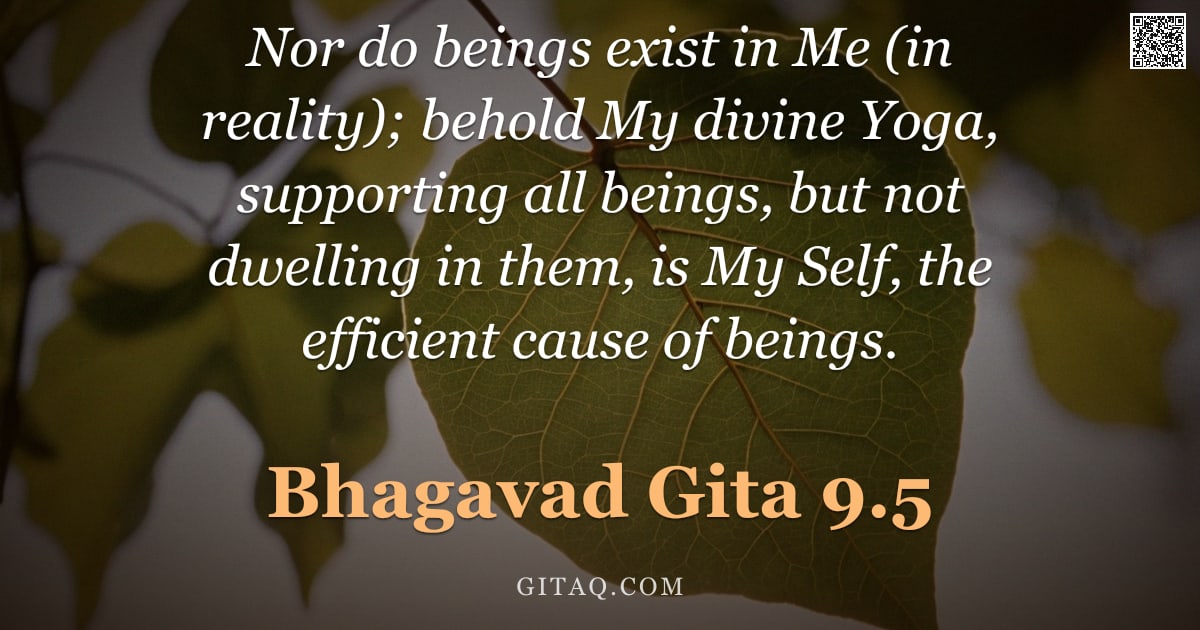
न च मत्स्थानि भूतानि पश्य मे योगमैश्वरम् | भूतभृन्न च भूतस्थो ममात्मा भूतभावनः ||९-५||
na ca matsthāni bhūtāni paśya me yogamaiśvaram . bhūtabhṛnna ca bhūtastho mamātmā bhūtabhāvanaḥ ||9-5||
What Does This Verse Mean?
In this verse, Lord Krishna explains to Arjuna the paradox of His relationship with creation: He is the source and sustainer of all beings, yet remains untouched by them. Just as a magician creates an illusion without being trapped inside it, or space fills everywhere while remaining distinct from objects within it, God supports existence but does not get bound by it. The key teaching is that the Divine Self (Atman) acts upon creation to bring forth and sustain life, even though He stands apart from all material changes.
The Teaching Behind It
This verse is a cornerstone of Jnana Yoga (the path of knowledge) and Advaita Vedanta's concept of the relationship between Brahman and Maya. It develops the doctrine that while God is the material cause (bhuta-bhrut, sustaining all beings), He remains distinct from creation because His essential nature is beyond modification.
Word by Word
Classical Commentary
Where This Happens
This verse occurs during the seventh chapter of instruction within Chapter 9, where Krishna is revealing 'Raja Vidya' (the King of Knowledge) to Arjuna after a series of teachings on devotion. On the battlefield of Kurukshetra, Arjuna has just witnessed Krishna's Universal Form and is still processing how the Supreme Lord can be both immanent in everything yet transcendent beyond it. As Arjuna struggles with his duty as a warrior against his own kin, this teaching aims to dissolve his attachment by clarifying that while he must act, the true Self behind all action remains unchanged.
Living It Out Today
When you are leading a high-stakes project at work and face potential failure or intense pressure, remember your role is to execute the task with full dedication (acting as 'bhutabhrit') without letting the outcome define your self-worth. You can support your team and drive results while mentally maintaining an inner stability that remains unshaken by success or criticism, much like the screen holding a movie but not being burned by it. This mindset allows you to make clear-headed decisions under stress, knowing you are observing from a place of calm rather than reacting emotionally.
Explained for Children
Imagine a giant projector in a dark room showing movies of forests, oceans, and people on a screen. The light from the projector makes the images appear real and alive, but if you touch the movie characters or get scared by them, it doesn't affect the actual projector bulb inside. Krishna says He is like that special light—He creates all the worlds we see and keeps everything running, just as the film runs on screen, but He stays safe in His own place without ever getting hurt or changed by what happens in the movie.
Daily Reflection
You often feel like you are carrying the weight of everyone and everything around you, believing that if things go wrong for others, it must mean something has shifted inside you. Today, remember that while you support and sustain those you love through your presence and actions, your inner core remains untouched by their storms or joys. This divine Yoga is not a distant concept but the very reality of who you are: fully present in every interaction yet completely free from being defined by it.
A Practice for Today
Close your eyes and visualize yourself as an ocean of space, vast enough to hold every wave without being wet by the water itself. Hold this image while breathing deeply: just as the sky holds clouds but is never stained by them, let all life exist within you without binding your true Self.
Key Teachings
- The Paradox of Presence
The Lord supports all beings through His energy, making Him the efficient cause of existence, yet He remains distinct and separate from them. This teaches that total involvement in the world does not require losing one's own transcendental nature. - Divine Yoga as Sustenance
The term 'Yogamaiśvaram' reveals God's supreme power to hold the universe together like a thread holding pearls, without being entangled in them. This divine force is what allows life to function and evolve while maintaining its independence from material chaos. - Transcendence of Immanence
Although all beings dwell within the Divine like waves on an ocean, they do not truly exist *in* Him in a way that implies containment or loss. The Self is the source from which creation flows and into which it dissolves, remaining pure and unchanging throughout.
Themes
Related Verses
Read This Next
- 2.47 — To understand the foundation of performing action (karma) without attachment, which mirrors the concept of supporting beings without dwelling in them.
- 3.30 — This verse expands on surrendering all actions to the Divine while maintaining detachment, deepening the study of divine yoga.
- 12.15 — To explore the qualities of a devotee who is not disturbed by others and does not cause disturbance, reflecting the state of being untouched yet supportive.
Recommended Reading
GitaQ earns from qualifying purchases as an Amazon Associate.