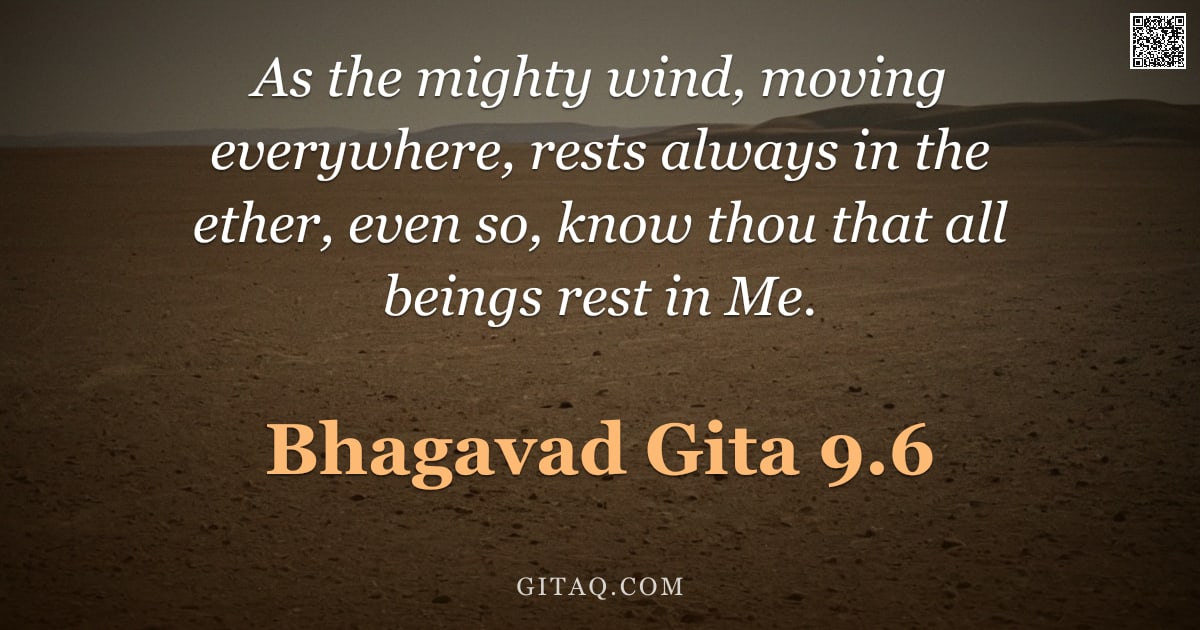
Bhagavad Gita 9.6
Raja Vidya Raja Guhya Yoga · English Translation
यथाकाशस्थितो नित्यं वायुः सर्वत्रगो महान् | तथा सर्वाणि भूतानि मत्स्थानीत्युपधारय ||९-६||
yathākāśasthito nityaṃ vāyuḥ sarvatrago mahān . tathā sarvāṇi bhūtāni matsthānītyupadhāraya ||9-6||
What Does This Verse Mean?
In this verse, Lord Krishna is speaking to Arjuna on the battlefield of Kurukshetra. He uses a powerful analogy: just as the mighty wind moves everywhere yet always rests within the vast sky without affecting it or being affected by it, all living beings exist and move while resting in Him. The key teaching is that God's presence permeates every creature simultaneously; we are never separate from the Divine, even when we feel isolated.
The Teaching Behind It
This verse is a cornerstone of the Gita's Advaita Vedanta (non-dualistic) teaching within the Bhakti Yoga framework, illustrating the concept of Ishvara as both transcendent (beyond creation like the sky) and immanent (present in every atom). It develops the understanding that while individual souls appear distinct due to their movements and actions, they are never ontologically separate from the Source.
Word by Word
Classical Commentary
Where This Happens
This verse appears in Chapter 9 of the Bhagavad Gita, where Krishna has just begun revealing his 'Raja Vidya' (Royal Knowledge) and spiritual secrets to Arjuna. The conversation takes place on the battlefield of Kurukshetra, moments after Krishna has convinced a reluctant Arjuna that it is his duty as a warrior to fight against adharma (unrighteousness). Arjuna is still struggling with emotional attachment to fighting his own relatives, and he needs reassurance about the nature of reality before proceeding into battle.
Living It Out Today
When you feel overwhelmed by a high-stakes work project or family crisis, remember that your anxiety does not change the underlying fabric of reality; just as wind cannot escape the sky, no problem can separate you from the inner peace and support available in every moment. Instead of trying to 'fix' everything alone, pause to recognize that all beings involved are connected through a larger consciousness, which reduces feelings of isolation and helplessness. This perspective allows you to act with clarity and compassion rather than fear or desperation.
Explained for Children
Imagine you have a huge balloon filled with air, but inside that balloon, there is also space for wind to blow freely everywhere. Even though the wind moves through balloons and rooms all day long, it always stays within the sky or open spaces around us. Krishna says something similar about God: just like the invisible wind lives in the big blue sky while moving everywhere, every single person you meet—your friends, your teachers, even strangers—is living inside God's love at that very moment.
Daily Reflection
Today, try to remember that no matter how busy or chaotic your external world becomes, there is a quiet foundation within you that never moves or changes. Just as the mighty wind travels everywhere but rests safely in the infinite sky without being stained by dust, your spirit can engage fully with life while remaining untouched by its turmoil. You are not limited to just one room or moment; you contain all beings and experiences yet remain free from their limitations.
A Practice for Today
Close your eyes and visualize yourself as an ocean while thoughts arise like the wind moving through the sky; notice that just as the vast ether remains untouched by the movement of air, your true Self remains undisturbed amidst all life's activities. Rest in this silent awareness where you are both the space holding everything and the witness who knows it.
Key Teachings
- The Paradox of Omnipresence
God is simultaneously the active force moving through every atom like wind, and the passive background containing that movement. This teaches us not to see the Divine as separate from creation but as the very medium in which existence unfolds. - Non-Attachment of the Absolute
The ether (space) supports all weather phenomena yet remains untouched by them, illustrating that the Creator is never tainted or affected by the actions of creatures. This provides a model for living in the world without being defined or burdened by worldly events. - Universal Containment
Just as wind rests within space, all individual souls and material forms rest within the one Divine consciousness. Recognizing this helps dissolve the illusion of separation between the seeker and the sought.
Themes
Related Verses
Read This Next
- 2.47 — To understand how to act in this world (like the moving wind) without attachment to results.
- 3.30 — To learn the specific practice of offering all actions and their fruits back to the Divine, reinforcing the concept of resting everything within God.
- 12.15 — To see how a devotee who realizes this truth becomes like space itself—free from distress for others or by others.
Recommended Reading
GitaQ earns from qualifying purchases as an Amazon Associate.