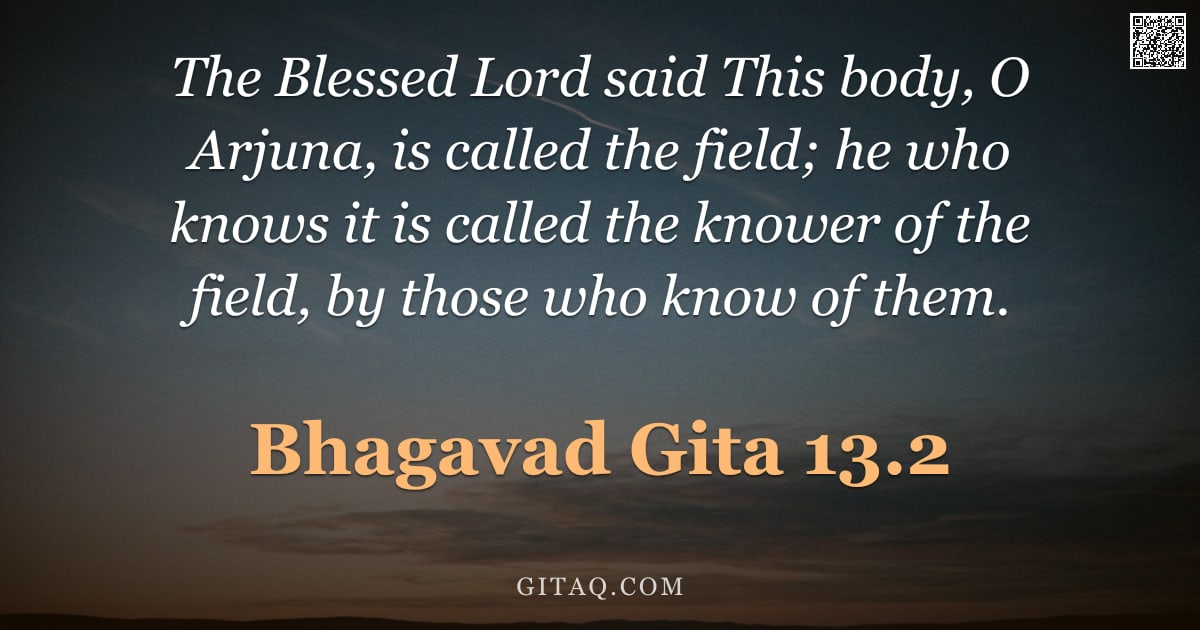
Bhagavad Gita 13.2
Kshetra Kshetrajna Vibhaga Yoga · English Translation
श्रीभगवानुवाच | इदं शरीरं कौन्तेय क्षेत्रमित्यभिधीयते | एतद्यो वेत्ति तं प्राहुः क्षेत्रज्ञ इति तद्विदः ||१३-२||
śrībhagavānuvāca . idaṃ śarīraṃ kaunteya kṣetramityabhidhīyate . etadyo vetti taṃ prāhuḥ kṣetrajña iti tadvidaḥ ||13-2||
What Does This Verse Mean?
In this verse, Lord Krishna addresses Arjuna to introduce a fundamental distinction between the physical body and the conscious self that inhabits it. He defines the body as 'the field' because it is where all experiences like pleasure, pain, birth, and death take place. The one who truly understands or perceives these changes within the body is known as 'the knower of the field.' This teaching sets the stage for understanding that while we identify with our bodies, our true nature is the awareness behind them.
The Teaching Behind It
This verse is a cornerstone of Sankhya philosophy, which distinguishes between matter (Prakriti) represented by the field and consciousness (Purusha) represented by the knower. It serves as the foundational definition for Jnana Yoga, or the path of knowledge, emphasizing that self-realization comes from discerning what is temporary (the body) versus eternal (the observer). This distinction prepares the seeker to detach from physical identification and realize their true spiritual identity.
Word by Word
Classical Commentary
Where This Happens
This conversation occurs on the battlefield of Kurukshetra during the Mahabharata war, just after Arjuna has laid down his weapons in despair and refused to fight. Krishna begins this discourse by shifting from comforting Arjuna's emotions to imparting deep metaphysical wisdom about reality itself. As the charioteer and spiritual guide, Krishna addresses Arjuna as 'Kaunteya' (son of Kunti) to establish a personal connection before introducing complex philosophical concepts.
Living It Out Today
When you feel overwhelmed by anxiety at work or family stress, stop identifying solely with your tired body or emotional state. Instead, imagine yourself stepping back mentally to observe the situation like an observer in a field; notice that while your heart races (the changing weather of the body), your awareness remains steady and distinct from the chaos. This shift from being 'in' the emotion to observing it creates immediate mental space for making clear-headed decisions rather than reacting impulsively.
Explained for Children
Imagine your body is like a garden where all sorts of things happen: flowers grow, weeds appear, it rains in some seasons and gets sunny in others. The 'garden' itself changes constantly as plants bloom or die. However, you are not just the garden; you are the gardener who watches over it, knows when to water it, and understands what is happening inside. In this verse, Lord Krishna tells us that our body is like a changing garden (the field), but your true self is the wise observer watching over it.
Daily Reflection
Today, I invite you to pause and realize that while your body may feel tired or anxious, it is merely a temporary field of activity. You are not the fluctuating sensations or the aging form; you are the steady awareness behind them all, simply observing the play of nature. By shifting your identity from the changing vessel to the unchanging witness, you find a deep sense of peace amidst life's constant movements.
A Practice for Today
Sit quietly and bring your awareness to the physical sensations of your body, recognizing it as the 'field' where life's experiences unfold without you being defined by them. Shift your attention inward to the silent observer within who witnesses these bodily changes, thoughts, and emotions; rest in that pure consciousness which is the true Knower.
Key Teachings
- The Body as the Field
The physical body is described metaphorically as 'kshetra' or field because it is the locus where all actions are performed and their results ripen. Just as a farmer tends to crops, we navigate our lives through this vehicle of experience. - Distinction Between Knower and Known
True wisdom lies in distinguishing between the changing object (the body) and the unchanging subject (the consciousness that knows it). This discernment prevents us from mistaking our temporary physical form for our eternal spiritual identity. - The Role of Self-Knowledge
Knowing the field is easy, but knowing the Knower of the field leads to liberation. The verse emphasizes that this dual knowledge—of both matter and spirit—is the gateway to understanding one's true nature.
Themes
Related Verses
Read This Next
- 2.47 — This foundational teaching on detachment in action complements the Gita's definition of the body as a field where karma is sown.
- 3.30 — Read this next to see how surrendering the fruits of one's actions within the 'field' leads to freedom from bondage.
- 12.15 — This verse describes the qualities of a devotee who has realized the Knower and thus transcends the distresses of the material field.
Recommended Reading
GitaQ earns from qualifying purchases as an Amazon Associate.