Bhagavad Gita 13.1
Kshetra Kshetrajna Vibhaga Yoga · English Translation
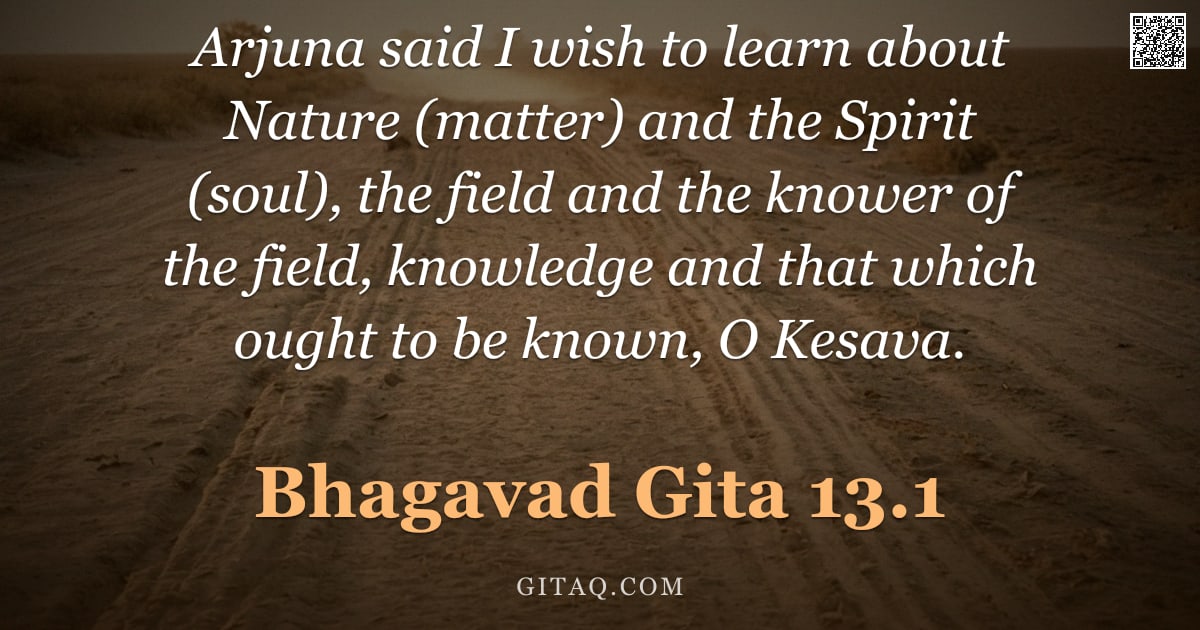
अर्जुन उवाच | प्रकृतिं पुरुषं चैव क्षेत्रं क्षेत्रज्ञमेव च | एतद्वेदितुमिच्छामि ज्ञानं ज्ञेयं च केशव ||१३-१||
arjuna uvāca . prakṛtiṃ puruṣaṃ caiva kṣetraṃ kṣetrajñameva ca . etadveditumicchāmi jñānaṃ jñeyaṃ ca keśava ||13-1||
What Does This Verse Mean?
In this opening verse of Chapter 13, Arjuna asks Lord Krishna to explain the fundamental difference between matter and spirit. He specifically requests a clear understanding of 'Prakriti' (the field or material nature) versus 'Purusha' (the knower of the field or consciousness). By asking for this knowledge, Arjuna seeks to understand what is worth knowing in order to find true peace amidst his confusion about duty and life.
The Teaching Behind It
This verse establishes the foundational framework for Sankhya philosophy, which is later synthesized into Vedanta through Krishna's teachings in this chapter. It introduces the critical distinction between 'Kshetra' (the field of matter and mind) and 'Kshetrajna' (the conscious self), a dualism that serves as the basis for understanding liberation from suffering.
Word by Word
Classical Commentary
Where This Happens
This verse occurs on the battlefield of Kurukshetra during the Mahabharata war, where Arjuna has just laid down his bow in despair after seeing his relatives and teachers ready to fight. Krishna has concluded His initial exhortations about duty (Svadharma) but pauses as a student-teacher relationship deepens when Arjuna realizes he needs more than just motivation; he needs the ultimate truth of existence. Spoken with humility, this marks the transition from practical advice on action to profound philosophical inquiry into the nature of reality.
Living It Out Today
When facing an overwhelming decision at work or a family crisis that feels like your whole world is collapsing, apply this verse by mentally separating yourself from the immediate chaos (the 'field') and recognizing your inner stability as the observer. Instead of getting lost in the stress signals flooding your mind, step back to identify which parts are external circumstances you can influence versus your core values and consciousness that remain unchanged. This shift allows you to make clear-headed choices based on what truly matters rather than reacting out of fear or temporary emotion.
Explained for Children
Imagine your body is like a bicycle that you ride every day. The bike itself—the wheels, pedals, and frame—is the 'field' of nature, while the rider inside who knows how to steer it and feels happy or tired is the 'knower.' Arjuna wants Krishna to explain exactly what makes up the bike versus what makes up the rider, so he can understand that even when the bike gets scratched or broken, the rider remains safe. This helps us realize we are not just our bodies, but something much deeper and special.
Daily Reflection
Today, you are invited to pause before the noise of daily tasks and ask yourself: who is truly listening? You often identify so deeply with your thoughts or emotions that you forget there is a deeper 'knower' behind every experience. Remember that while the field of life shifts from joy to sorrow, the one witnessing it remains steady and whole.
A Practice for Today
Begin by placing your attention on your body, recognizing it as the 'field' where life's experiences unfold and change. Then gently shift your awareness to that silent presence within which observes these changes without being touched by them; rest here for a few breaths.
Key Teachings
- Distinguishing Matter from Spirit
The verse initiates a vital discrimination between 'Prakriti' (matter/nature) which evolves, and 'Purusha' (spirit/soul) which is the silent witness. This separation allows us to stop identifying our true self with temporary physical or mental states. - The Field and Its Knower
Just as a farmer tends to his field, the body is described as the 'field' of action where karma grows. The 'Knower of the field' (Kshetrajna) is the conscious observer who must learn to distinguish itself from the activities happening within that field. - The Unity of Knowledge and Object
True wisdom requires knowing not just facts, but understanding 'that which ought to be known'—the ultimate reality behind all phenomena. This holistic knowledge transforms mere information into a spiritual realization that liberates the seeker. - The Unity of Knowledge and Object
True wisdom requires knowing not just facts, but understanding 'that which ought to be known'—the ultimate reality behind all phenomena. This holistic knowledge transforms mere information into a spiritual realization that liberates the seeker.
Themes
Related Verses
Read This Next
- 2.13 — Read this next for Krishna's explicit description of how the soul remains unchanged while inhabiting different bodies.
Recommended Reading
GitaQ earns from qualifying purchases as an Amazon Associate.