Bhagavad Gita 5.29
Karma Sanyasa Yoga · English Translation
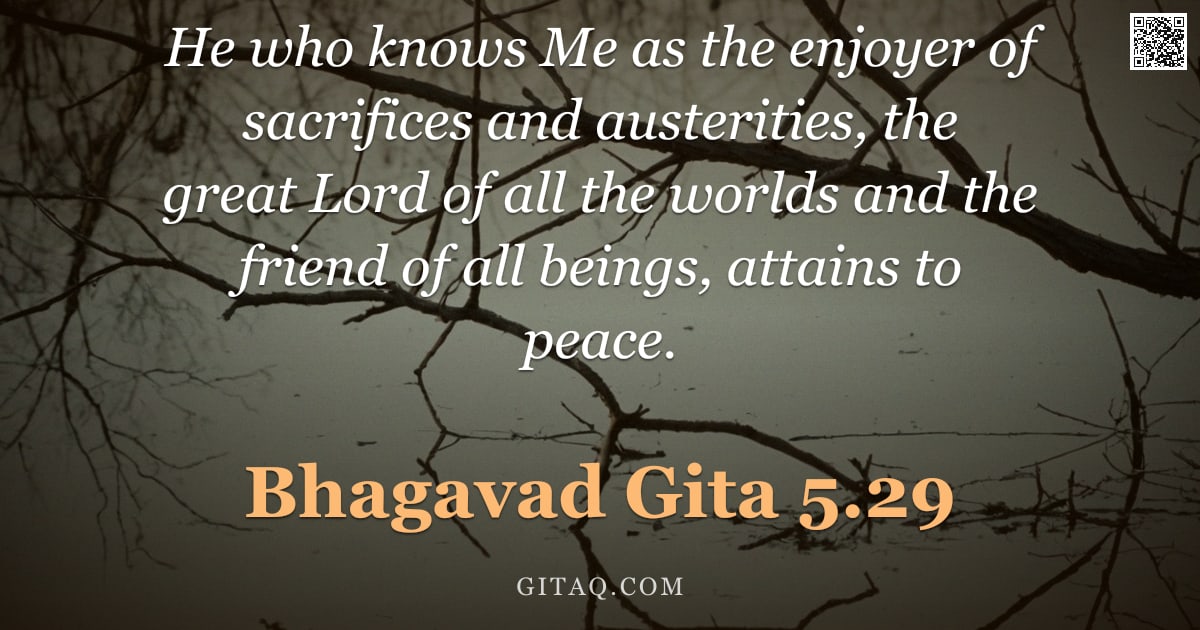
भोक्तारं यज्ञतपसां सर्वलोकमहेश्वरम् | सुहृदं सर्वभूतानां ज्ञात्वा मां शान्तिमृच्छति ||५-२९||
bhoktāraṃ yajñatapasāṃ sarvalokamaheśvaram . suhṛdaṃ sarvabhūtānāṃ jñātvā māṃ śāntimṛcchati ||5-29||
What Does This Verse Mean?
In this verse, Lord Krishna concludes the previous teachings by describing His true nature to Arjuna. He explains that He is the ultimate recipient of all religious rituals and austerities, the supreme ruler over every world, and the selfless friend who cares for all living beings. The core teaching is that truly understanding these four aspects of God leads directly to inner peace. This realization dissolves anxiety because one no longer feels alone or burdened by the need to control outcomes.
The Teaching Behind It
This verse serves as a synthesis of Bhakti Yoga (devotion) and Jnana Yoga (knowledge), bridging them through Vedanta philosophy. It develops the concept that realizing God's immanence as both the ultimate recipient of all actions and the intimate friend of every soul transforms one's relationship with the universe from transactional to relational, resulting in liberation.
Word by Word
Classical Commentary
Where This Happens
This verse appears in the fifth chapter of the Bhagavad Gita during a critical pause on the battlefield of Kurukshetra between Prince Arjuna and Lord Krishna. After explaining the path of renunciation (Sanyasa), Krishna is now synthesizing his previous lessons to show how knowledge leads to action without attachment. Arjuna, who was previously overwhelmed by confusion about duty versus personal desire, listens intently as Krishna defines His own role in the cosmos to alleviate Arjuna's spiritual distress.
Living It Out Today
Consider a professional facing a high-stakes project where they are anxious about whether their hard work will be recognized or if they have done enough. Instead of obsessing over personal credit (the 'enjoyer' aspect) or feeling isolated in the struggle, this verse suggests viewing one's effort as part of a larger purpose and trusting that there is a supportive order behind it (the 'friend'). By shifting focus from demanding specific results to seeing oneself as serving a greater good under divine guidance, the individual can perform their duties with clarity and reduced stress.
Explained for Children
Imagine you are part of a big, happy family where your dad takes care of everyone's needs and loves all his friends equally. Krishna is telling us that God is like that perfect Dad for the whole universe: He enjoys our good deeds (like sharing or helping), He runs everything with love, and He wants to be every creature's best friend. When you really understand that you have this amazing, loving support system behind you, your worries disappear and you feel calm and safe.
Daily Reflection
In your busy day today, try seeing yourself not as a solitary worker struggling against circumstances, but as one cherished friend among many in a vast community held together by divine care. When you face someone difficult or feel overwhelmed by the world's chaos, remember that Krishna is their true friend and protector just as much as yours. This shift from isolation to belonging brings an instant quietness to your heart.
A Practice for Today
Sit quietly and visualize yourself as a guest at a grand feast where the Lord alone is the host, the food, and the enjoyer of every offering you make through your daily actions. Let go of the need to claim credit for any work done; simply offer everything back to Him with gratitude.
Key Teachings
- The Lord as Enjoyer
Krishna reveals Himself as the ultimate recipient of all sacrifices and austerities, meaning every act done in devotion is directly received by Him. This truth liberates us from performing rituals for personal gain or recognition. - The Supreme Controller
He is described as the great Lord (Maheshvara) of all worlds, indicating His sovereignty over every sphere of existence and destiny. Recognizing this supreme authority allows us to surrender our anxiety about controlling outcomes that are beyond our grasp. - The Friend of All
He is the impartial friend (Suhrida) to all living beings, offering grace without discrimination based on merit or status. Knowing this universal friendship dissolves fear and isolation, leading naturally to true inner peace.
Themes
Related Verses
Read This Next
- 2.47 — This verse establishes the foundational principle of acting without attachment to results, which aligns with Krishna being the sole enjoyer.
- 3.30 — It expands on offering all actions to God through dedication, reinforcing the concept of Him as the ultimate recipient of sacrifice.
- 12.15 — This verse describes the qualities of a devotee who is dear to Krishna and reflects His nature as the friend of all beings.
Recommended Reading
GitaQ earns from qualifying purchases as an Amazon Associate.