Bhagavad Gita 5.28
Karma Sanyasa Yoga · English Translation
यतेन्द्रियमनोबुद्धिर्मुनिर्मोक्षपरायणः | विगतेच्छाभयक्रोधो यः सदा मुक्त एव सः ||५-२८||
yatendriyamanobuddhirmunirmokṣaparāyaṇaḥ . vigatecchābhayakrodho yaḥ sadā mukta eva saḥ ||5-28||
What Does This Verse Mean?
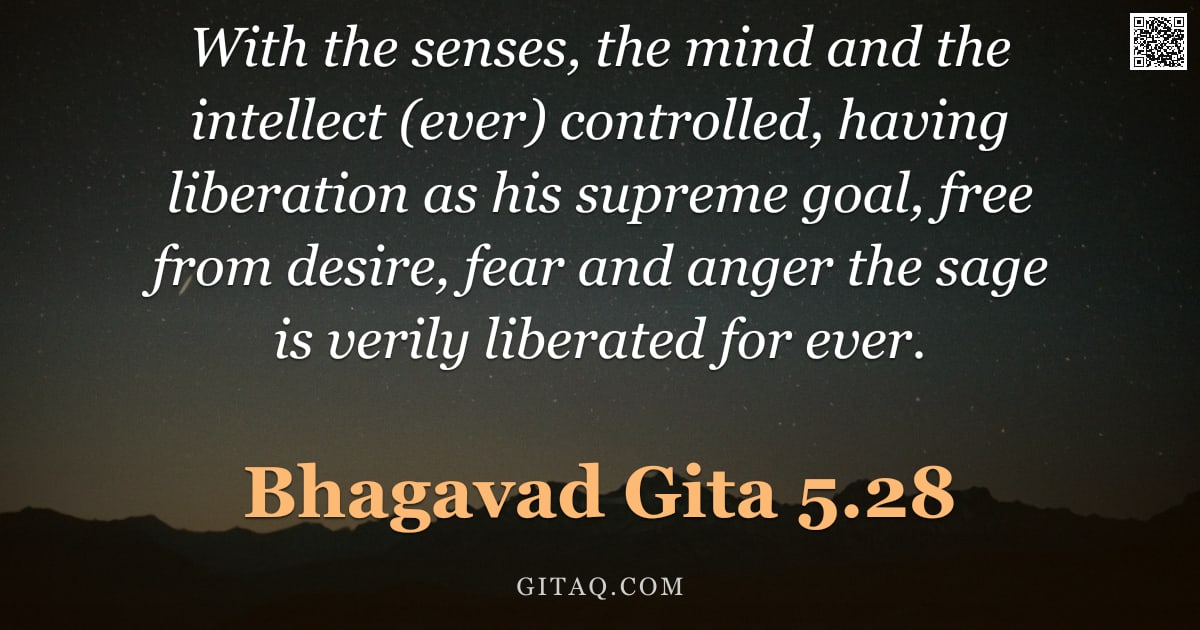
In this verse, Lord Krishna describes the ultimate state of a wise person who has mastered their senses, mind, and intellect to focus entirely on liberation (Moksha). He explains that true freedom is achieved when one remains untouched by desire, fear, or anger. This teaching is directed at Arjuna, offering him a clear picture of what a spiritually liberated sage looks like after mastering self-control.
The Teaching Behind It
This verse synthesizes the teachings of Karma Yoga (action without attachment) and Jnana Yoga (knowledge of the Self), emphasizing that external renunciation must be supported by internal mastery over the mind. It develops the concept of 'Sthita-prajna'—a person of steady wisdom who remains established in their true nature regardless of emotional fluctuations.
Word by Word
Classical Commentary
Where This Happens
This verse appears in Chapter 5 of the Bhagavad Gita during the intense dialogue on the battlefield of Kurukshetra between Lord Krishna and Prince Arjuna. Just prior to this, Krishna has been explaining that renunciation (giving up actions) is not enough without inner mastery; he must clarify what a truly 'renounced' person actually looks like in daily life. Arjuna is listening with deep confusion about how one can act while remaining detached from the world's chaos.
Living It Out Today
Consider a high-pressure work situation where you receive unfair criticism that triggers an immediate urge to argue or retreat in fear; this verse guides you to pause and observe your anger rising without letting it drive your response. By consciously controlling your senses and intellect, you can view the situation objectively as someone who has already decided their ultimate goal is inner peace rather than winning a temporary argument. This allows you to respond with clarity instead of reacting out of fear or ego.
Explained for Children
Imagine your mind and senses are like a wild horse; this verse teaches us how to be the skilled rider who calmly holds the reins so we don't get carried away. When you feel happy, angry, or scared, a wise person stays calm inside because they know these feelings come and go. Just like a tree that doesn't shake when the wind blows, someone with control over their mind remains peaceful no matter what happens around them.
Daily Reflection
In this busy world where anxiety often feels like a constant companion, you are invited to discover that true freedom lies not in changing your circumstances but in mastering your internal responses. When you consciously choose to let go of the grip of fear and the sting of anger, you reveal an inner stability that no external event can shake. This verse reminds you that liberation is not a distant future goal reserved for saints; it is a living reality available to you right now whenever you align your intellect with this higher peace.
A Practice for Today
Begin by gently withdrawing your attention from external stimuli, bringing the senses and mind into a quiet state of inner stillness. Rest for a moment as one who has surrendered all fear, desire, and anger to the divine presence within.
Key Teachings
- The Triad of Inner Control
True renunciation begins when the senses, mind, and intellect are harmonized under a single will. This internal discipline creates the necessary foundation for spiritual progress before one can even attempt external detachment. - Liberation as the Sole Aim
The sage fixes their consciousness entirely on Moksha (liberation) rather than temporary worldly gains or losses. This singular focus naturally dissolves distractions, allowing the practitioner to navigate life with unwavering clarity. - Freedom from the Trifecta of Suffering
Desire creates endless craving while fear and anger act as chains that bind the soul to suffering. The verse declares that when these three are absent, the sage is already liberated in this very life.
Themes
Related Verses
Read This Next
- 2.47 — Read this next to understand the foundational principle of performing duty without attachment to results.
- 3.30 — This verse complements Chapter 5 by offering a practical method: surrendering all actions to Krishna as an alternative form of renunciation.
- 12.15 — Read this final selection to see the qualities of one who is dear to Krishna, specifically regarding being free from anger and fear.
Recommended Reading
GitaQ earns from qualifying purchases as an Amazon Associate.