Bhagavad Gita 6.1
Dhyana Yoga · English Translation
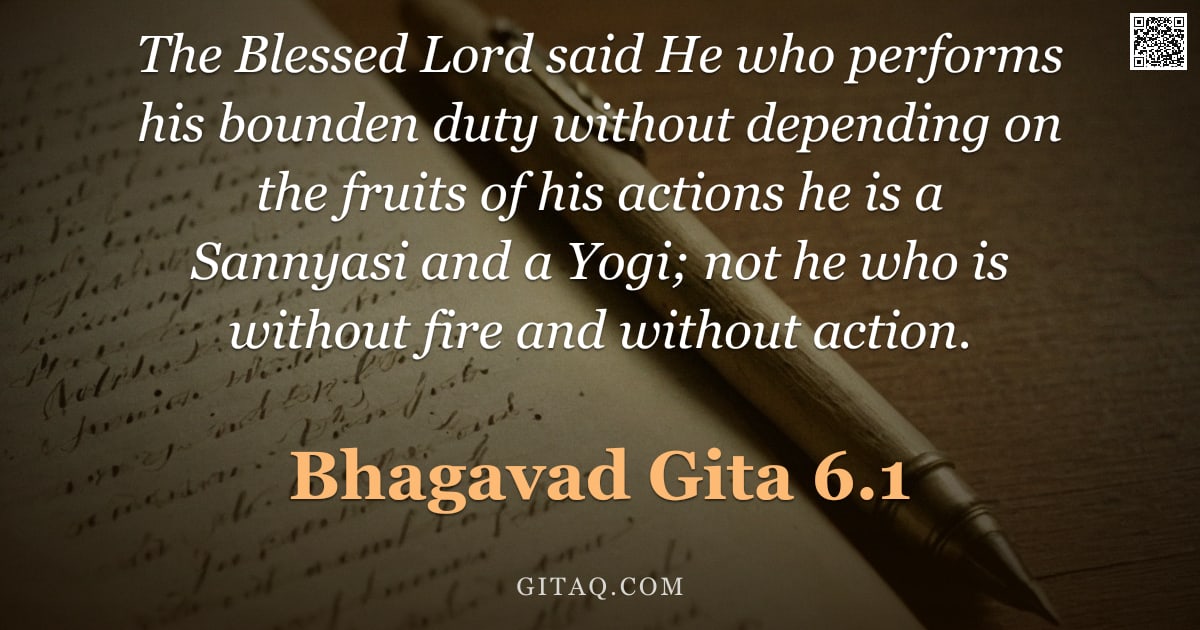
श्रीभगवानुवाच | अनाश्रितः कर्मफलं कार्यं कर्म करोति यः | स संन्यासी च योगी च न निरग्निर्न चाक्रियः ||६-१||
śrībhagavānuvāca . anāśritaḥ karmaphalaṃ kāryaṃ karma karoti yaḥ . sa saṃnyāsī ca yogī ca na niragnirna cākriyaḥ ||6-1||
What Does This Verse Mean?
In this verse, Lord Krishna is speaking to Arjuna to redefine what it truly means to be a spiritual renunciate or yogi. He teaches that the true essence of spirituality lies in performing one's necessary duties without attachment to the results, rather than simply giving up all actions or retreating into isolation. Krishna clarifies that merely abandoning fire rituals and daily work does not make someone a saint; instead, it is the attitude of detachment while acting that constitutes genuine yoga.
The Teaching Behind It
This verse establishes the core principle of Karma Yoga (the path of selfless action) within the broader context of Dhyana Yoga (meditation). It asserts that true renunciation (Sannyasa) is an internal state of detachment from results, not merely an external abandonment of duties or fire rituals. This teaching bridges Sankhya philosophy's distinction between the doer and the deed with practical spiritual practice.
Word by Word
Classical Commentary
Where This Happens
This verse appears at the very beginning of Chapter 6 in the Bhagavad Gita, set on the battlefield of Kurukshetra amidst the Mahabharata war. Just prior to this, Arjuna had expressed confusion and despair, asking Krishna if he should renounce his warrior duties entirely due to emotional turmoil about fighting relatives. Lord Krishna begins this chapter by correcting a common misconception that spiritual life requires abandoning one's social responsibilities or external rituals.
Living It Out Today
Consider a software engineer working on a critical project deadline; instead of being paralyzed by anxiety over whether the promotion they hope for will come, they focus entirely on writing clean code and solving problems in front of them. They perform their bounden duty with excellence but do not let the potential reward or failure dictate their peace of mind during the process. This approach allows them to handle high-pressure situations without burnout, embodying the teaching that action done without attachment is true yoga.
Explained for Children
Imagine you are playing your favorite game with friends. A true 'hero' plays their best because they love the game itself, not just to win a trophy or get praise from others. If someone stopped playing games entirely and hid in a room thinking that was being special, they would actually miss out on the fun of learning how to play well together. Lord Krishna is saying you become a true champion by doing your best at your daily tasks without worrying too much about getting an award first.
Daily Reflection
You often feel compelled to wait until you are 'done' with your worries before you can truly be at peace, yet this verse invites you to find freedom right now in the midst of action. It asks you to consider if you have been carrying the heavy burden of needing specific outcomes as a condition for your own happiness. The path to liberation is not found by abandoning your duties or your life's responsibilities, but by transforming how you engage with them.
A Practice for Today
Close your eyes and visualize yourself performing one task today with complete focus, mentally offering the result to the Divine immediately upon completion. Remind yourself that true renunciation is not leaving a job or home, but letting go of the mental grip on how things turn out.
Key Teachings
- Renunciation Through Action
True Sannyasa (renunciation) is defined not by external symbols like a fireless altar or bare skin, but by an internal state of non-attachment. One can remain fully engaged in the world while being spiritually detached from its results. - The Definition of Yoga
Yoga is equated here with karma-yoga, where one performs their prescribed duty as an offering rather than a transaction for reward. This perspective transforms daily work into a sacred spiritual practice that purifies the heart. - Action vs. Inaction
Merely stopping physical activity or avoiding social responsibilities does not constitute true renunciation if one's mind remains attached to desires. The Lord clarifies that abstaining from action while still craving results is a form of delusion, not liberation.
Themes
Related Verses
Read This Next
- 2.47 — This foundational verse explicitly instructs on having no claim over the fruits of action while remaining devoted to duty.
- 3.30 — Here Krishna elaborates on dedicating all actions and their results entirely to Him, deepening the practice described in this verse.
- 12.15 — This verse describes the qualities of a devotee who is content with everything that comes from Krishna's will, embodying the spirit of non-attachment.
Recommended Reading
GitaQ earns from qualifying purchases as an Amazon Associate.