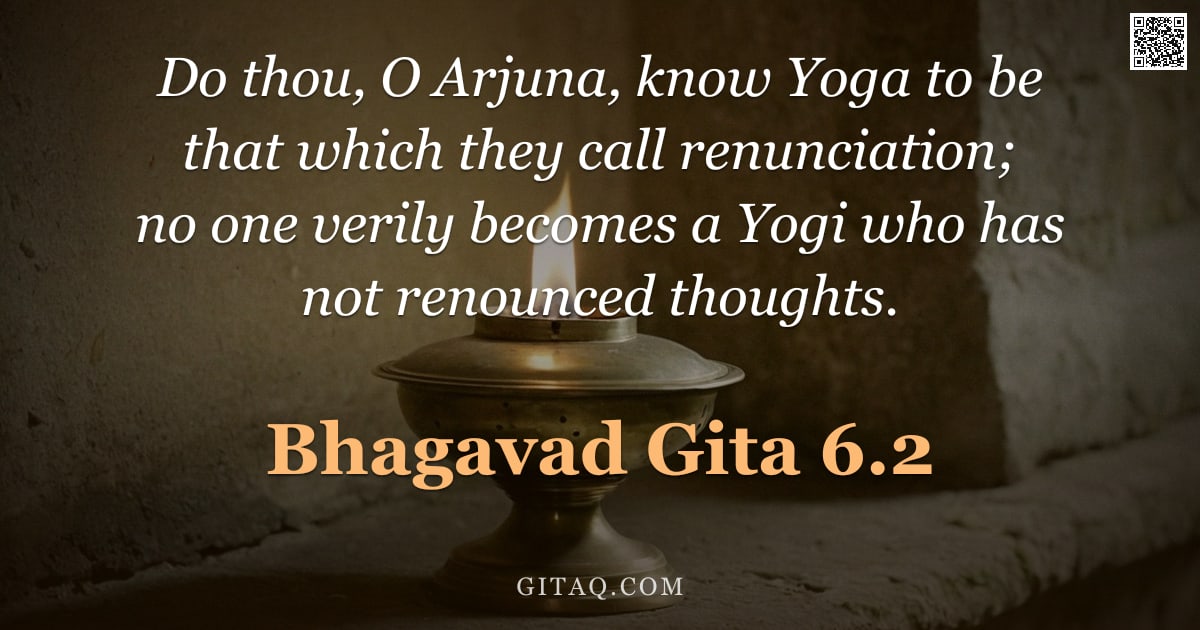
Bhagavad Gita 6.2
Dhyana Yoga · English Translation
यं संन्यासमिति प्राहुर्योगं तं विद्धि पाण्डव | न ह्यसंन्यस्तसङ्कल्पो योगी भवति कश्चन ||६-२||
yaṃ saṃnyāsamiti prāhuryogaṃ taṃ viddhi pāṇḍava . na hyasaṃnyastasaṅkalpo yogī bhavati kaścana ||6-2||
What Does This Verse Mean?
In this verse, Lord Krishna clarifies a common misunderstanding to Arjuna by defining the true nature of Yoga as renunciation. He explains that one cannot become a genuine Yogi without first giving up selfish desires and mental attachments (sankalpas). The core teaching is that external actions are not enough; internal detachment from outcomes and thoughts is essential for spiritual progress.
The Teaching Behind It
This verse is central to Dhyana Yoga (the Path of Meditation) while integrating concepts from Karma Yoga by emphasizing action performed without desire for fruits. It bridges Sankhya philosophy's distinction between the doer and the self by asserting that true renunciation occurs in the mind, not merely through physical withdrawal.
Word by Word
Classical Commentary
Where This Happens
This verse occurs in Chapter 6 of the Bhagavad Gita during the battlefield of Kurukshetra, where Lord Krishna is instructing Arjuna on the path of meditation. It follows a discussion where Arjuna expressed confusion about how to practice renunciation while still fulfilling his duty as a warrior. At this moment, Arjuna feels overwhelmed by grief and conflict, seeking clarity on whether he must abandon all action or just change his mindset.
Living It Out Today
Consider a professional facing a high-stakes presentation where they are paralyzed by the fear of failure or the desire for excessive praise. Krishna's teaching suggests that success comes not from trying harder to control the outcome, but from mentally letting go of the specific result beforehand. By focusing entirely on delivering value and doing their best in the moment without attachment to the applause, one can perform with clarity and reduce anxiety.
Explained for Children
Imagine you want to play a video game, but your hands keep shaking because you are too worried about losing. Krishna tells Arjuna that being a 'Yogi' (a wise person) means first calming those shaky worries so they can focus on the game itself. Just like cleaning up messy toys before building a castle helps build something strong, clearing away selfish thoughts helps us find peace and do our best work.
Daily Reflection
Today, notice how often you are waiting for a specific outcome before you can feel at peace or start your work. You might be holding onto 'sankalpa,' the mental grip of desire, thinking that once this thing happens, you will finally be free. But Krishna reminds us that true yoga is found in letting go of those future-anchored thoughts right now, regardless of external circumstances. When you release the need for a specific result, your mind becomes steady and ready to meet life with clarity rather than anxiety.
A Practice for Today
Sit quietly and observe your mind as it generates plans, worries, or desires about the future. Instead of acting on these impulses, simply label them 'thoughts' and gently return your attention to your breath. Recognize that true freedom begins not by stopping thoughts entirely, but by ceasing to identify with their demands.
Key Teachings
- Renunciation is Internal
The verse clarifies that true renunciation (sannyasa) is not merely about abandoning physical objects or worldly duties. It fundamentally requires the abandonment of attachment to specific outcomes and desires. - No Thoughtless Yogi Exists
Krishna states that no one becomes a yogi without renouncing 'sankalpa,' meaning thoughts driven by personal desire. One cannot achieve the state of yoga simply through external inaction if internal longing remains active. - Yoga and Sannyasa are Identical
The verse equates Yoga with renunciation, suggesting they are two names for the same spiritual discipline. To practice one is to practice the other; you cannot have true yoga without a mind free from craving.
Themes
Related Verses
Read This Next
- 2.47 — This verse elaborates on performing duty without attachment to results, which is the practical application of renouncing sankalpa.
- 3.30 — It describes surrendering all actions and their fruits to the Divine, offering a method for transforming internal desire into devotion.
- 12.15 — This verse defines the qualities of an ideal devotee who is free from personal desires and thus naturally renounced in spirit.
Recommended Reading
GitaQ earns from qualifying purchases as an Amazon Associate.